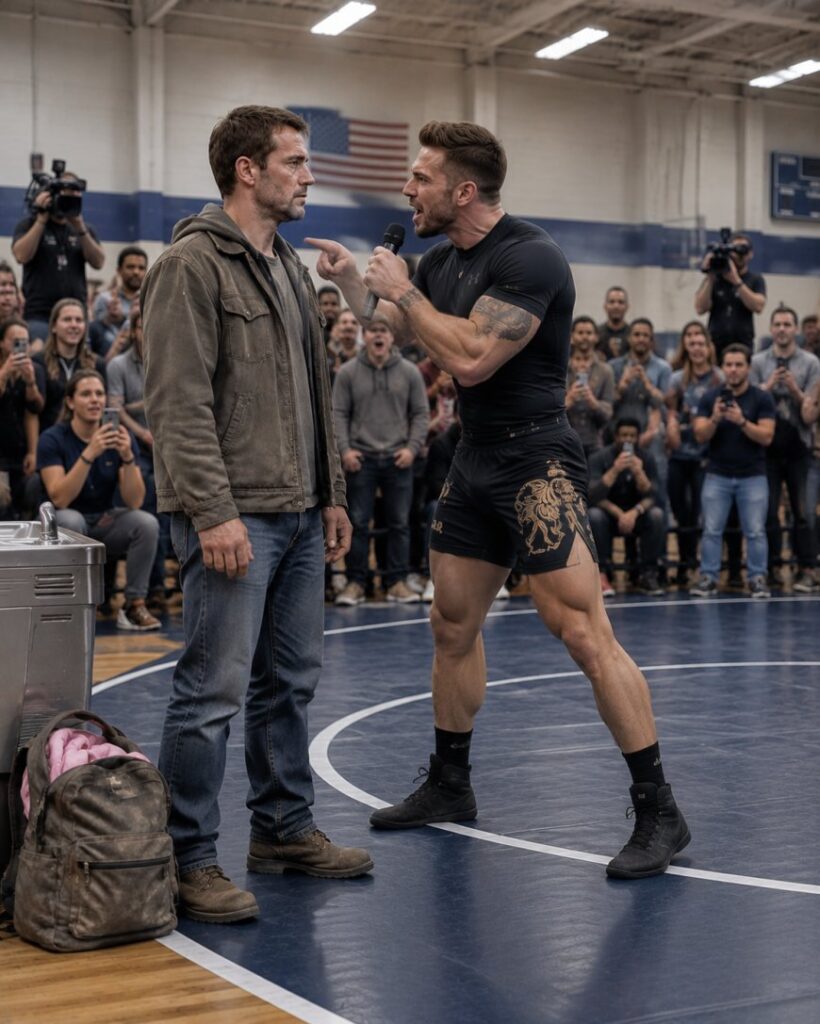
“I’m not going to waste your time with a sales pitch,” Carl said. “You watched me watch you on Thursday. You know I’m interested. I want to explain why, specifically, because I think the reason matters.”
“Go ahead,” I said.
“I’ve had trainers before. Good ones. Technically, people who could teach form and conditioning and put a kid through a legitimate program.” Carl leaned forward slightly. “What I’ve never been able to find is someone who has the specific combination of things I saw in you on Thursday.”
“You saw 47 seconds of a fight,” I said.
“I saw 47 seconds of a fight, and then I saw the 20 seconds after it.” Carl held my gaze. “You know what told me more about you than anything you did on that mat?”
I waited.
“The way you picked up that backpack,” Carl said. “You came off the mat after doing something extraordinary, and your first instinct—your automatic, unrehearsed first instinct—was to go back to that bag. Not to the crowd, not to the cameras, not to Logan Pierce. To a worn-out backpack with your kid’s stuff in it.”
Carl sat back. “I’ve been trying to find that in a person for 11 months. The kind of person who has genuine capability and isn’t looking to make it about themselves.”
I drank my coffee. “Tell me about the kids,” I said.
Carl talked for 40 minutes. I listened the way I’d been trained to listen—completely, without interrupting, without performing engagement, just actually receiving information and sorting it in real time.
The program currently ran three days a week with two groups—12 to 15 and 15 to 18—totaling about 34 kids across both groups. The physical training component was structured, but the retention problem was real. Kids would commit for a few weeks and then drift when life pulled them in other directions, which in this neighborhood meant any number of directions that Carl didn’t need to describe in detail.
“The technical side of what I need you to do, I can explain in an afternoon,” Carl said. “The other side—the part where a kid who doesn’t trust anybody decides whether you’re worth trusting—that I can’t train. Either you have it or you don’t.”
“How do you know I have it?” I asked.
Carl looked at me steadily. “Because a seven-year-old is riding a school bus right now who believes completely that her father is worth trusting. Kids don’t give that away. They watch first. They test. They pull back and wait and see what happens when things get hard.” He paused. “Somebody did the work with your daughter to earn that. I’m betting it was you.”
I set my mug down.
“The hours you described on the phone,” I said. “8 to 5, Monday through Friday, with Saturdays as needed for competition events.”
“Correct.”
“I have a service business. I’d need to wind down responsibly. Three regular clients. I’d want two weeks to handle that without leaving anyone in a bad spot.”
Carl nodded. “Two weeks is fine.”
“And I’ll need to understand the program structure completely before I lead a session. I won’t walk in front of kids without knowing exactly what I’m delivering.”
“That’s exactly what I want to hear,” Carl said.
I looked at the photographs on the office wall—a smaller version of the timeline from the hallway, distilled to the most significant moments. My eyes moved across them without haste.
“The kid you lost,” I said. “What happened?”
Carl was quiet for a moment. “He was 17. He was in the program for four months, and it was working. Genuinely working. You could see it in him. And then he had a situation at home that pulled him out. And by the time I tracked him back down six months later, he’d made a different set of choices.” Another pause. “He’s doing eight years. He’ll be 26 when he comes out.”
I nodded slowly.
“I think about him,” Carl said. “I don’t think there was a different version of the story where I did everything right and he was fine. But I think about what those four months did for him and what it cost to interrupt them.”
The room was quiet.
I looked at Carl. “I’ll take the position,” I said.
Carl let out a breath that was not quite a sigh but carried the weight of one. “Good,” he said. “Good. I’ll have the paperwork ready this week.”
He extended his hand across the desk. I shook it.
We were standing up, the meeting wrapping, when Carl’s phone buzzed on the desk. He glanced at it and something in his expression shifted—not alarm, but a sharpened attention.
“Interesting,” he said.
“What?” I asked.
Carl turned the phone around. It was a news alert. Local sports. The headline read: “Logan Pierce issues public statement following surprise defeat at Ironside Invitational.”
I looked at it.
Carl set the phone down. “I saw his team filming everything Thursday. Didn’t expect him to address it publicly this fast.”
I picked up my jacket from the back of the chair. “I’m not interested in his statement.”
“You might want to be,” Carl said carefully. “Because he named you.”
I stopped. Looked at Carl.
Carl picked the phone back up and read aloud, his voice neutral and measured: “Thursday’s event introduced me to someone I wasn’t expecting. Ryan Mitchell is a former Marine and a single father. What he demonstrated wasn’t just physical skill. It was a kind of discipline I haven’t seen outside professional training at the highest level. I offered the challenge as a marketing event. He answered it for a reason that had nothing to do with marketing. I think people should know his name.”
The room held the silence for a moment.
My jaw was doing the controlled stillness thing. “I didn’t ask for that,” I said.
“I know,” Carl said.
“I don’t want it.”





