They were sitting on the bench in their regular clothes, not training gear, with the specific posture of people who have done something they were not entirely sure they were allowed to do but have committed to the decision and are prepared to defend it.
Carl was standing just inside the door with an expression that communicated clearly that he had known about this and had made a considered judgment call.
I looked at the three kids. I looked at Carl.
Carl shrugged marginally. “They asked,” he said. “I thought you should know who was in your corner.”
I looked at Marcus. Marcus looked back at me without flinching.
“You’re not supposed to be here,” I said.
“I know,” Marcus said.
“How did you get in?”
“Mr. Hendrix,” Marcus said. Neutral. Unapologetic.
I looked at Carl again. Carl looked at the ceiling.
I put my bag down on the bench. I sat down across from the three of them. I looked at them the way I’d looked at things all my life—directly, completely, without performance.
“You came here to watch,” I said.
“We came here to be here,” Marcus said.
There’s a difference. I thought about that.
“There is a difference,” I said.
I looked at Danny, who had almost quit twice and hadn’t. I looked at Terrell, who was the youngest and worked hardest to make sure nobody remembered it. I looked at Marcus, who picked up his little brother three days a week and watched me train on a bench by the far wall because he needed to see what a person does when it gets hard.
I understood exactly why they were there. Not for the fight. For the same reason Lily’s field trip fees mattered. For the same reason picking up a child from the bus at 3:40 mattered. For the same reason a lighthouse keeper’s daughter went up the lighthouse stairs even when she was scared.
Because somebody needed to see the light stay on.
“You’ll watch from the tunnel entrance,” I said. “You stay with Carl. You don’t go anywhere he doesn’t take you. Understood.”
Three nods.
“Marcus,” I said.
Marcus looked at me.
“After Saturday, you and I are going to have a conversation about your future in this program,” I said. “A real one. About what you want and what it takes to get there.”
I held the younger man’s gaze.
“You’ve been watching me prepare for eight weeks. I’ve been watching you for the same amount of time. We should talk about what I’ve seen.”
Marcus was very still.
“Okay,” he said.
One word, but his voice was different on it than it had been on anything before.
Carl moved them to the tunnel area at 6:30. I finished my warm-up at 7:15. I sat in the locker room alone at 7:30 in the specific quiet before—and thought about nothing in particular and everything at once, the way I always did before something that required my full presence.
My phone was on the bench beside me. I picked it up. One text from Lily. Sent at 7:07.
“I’m watching with Mrs. Chen. Gerald is also watching. We already told him you’re going to win, so he’s prepared. Come home after. I’ll be up.”
I read it twice. I set the phone down. I breathed out slowly.
I was ready.
The walk out was something I had not prepared for specifically, and it caught me off balance in a way almost nothing else had—not because of the crowd, which was loud and real, but because of what I heard in it. Eight thousand people. And the sound they made when I came through the tunnel was not the generic roar of an audience warming up. It was something more specific, more human. The sound of people who had watched a video six million times and had made, individually and privately, a decision about what it meant and who it was for.
I didn’t acknowledge it. I walked the same way I walked everything—forward, with attention, without performance.
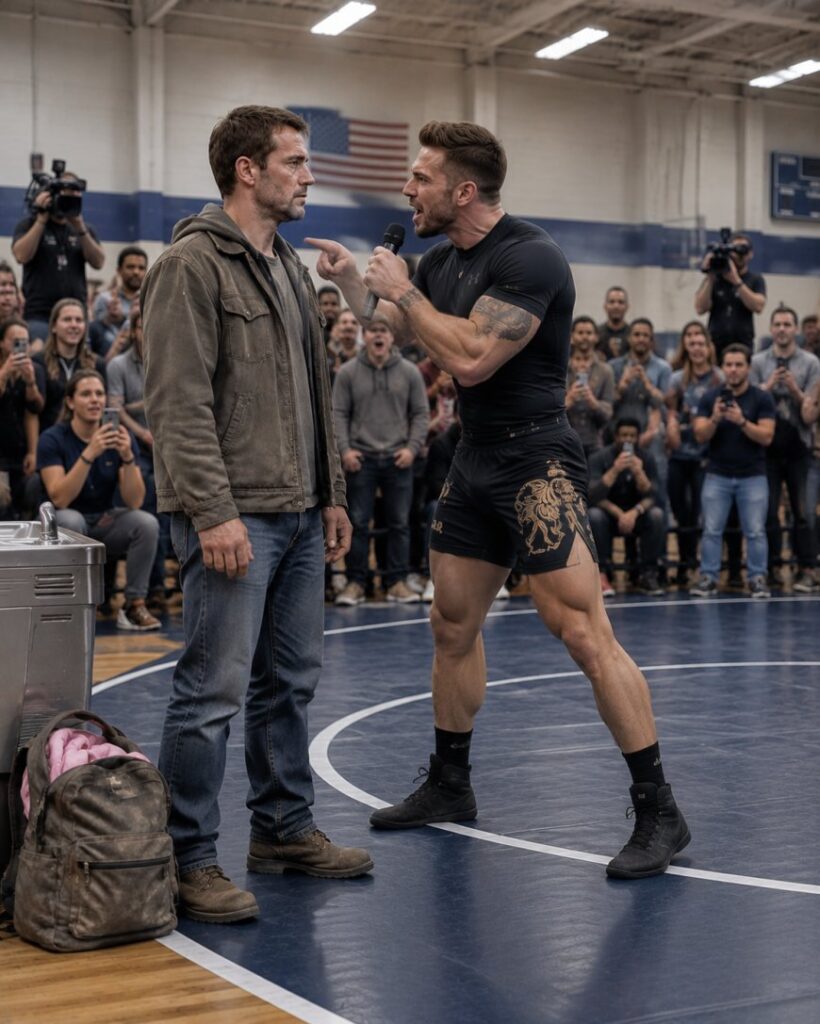
I got to the mat. Logan was already there on the opposite side. And when our eyes met across the distance, there was a moment of mutual recognition that had nothing theatrical in it. Two people who understood what they were about to do and why. And who had, in the weeks since an ordinary Thursday afternoon in a community sports center, arrived at a genuine version of respect that neither of them had been looking for.
The referee was Marcus—not Marcus from Hendrix, a different Marcus, the same official from Ironside who had looked at me twice on that Thursday and filed away the information that something was different about this one. When I saw him, the man gave a brief, real nod. I returned it.
The instructions were short. Both men listened. The bell rang.
What followed was not a repeat of 47 seconds.
Logan Pierce had done his preparation differently—the way he’d said. He came forward with intention rather than performance, reading instead of leading, which made him immediately more difficult than the version I had beaten at Ironside.
The first two minutes were careful, geometrical—two people moving around the same space with complete attention, neither one committing to anything the other could exploit.
I felt him. Not physically—my preparation had accounted for Logan’s physical capabilities thoroughly. I felt the difference in Logan’s competition quality. The ego had been subtracted. What remained was a fighter who was genuinely trying to find the gap in my system rather than proving to the crowd that he could.
That was harder. Not insurmountably harder, but honestly harder.
They clinched at 2:14. Logan was strong—genuinely strong—and his ground defense had been specifically addressed in his preparation, because he understood that the ground was where I had the decisive advantage. He broke the clinch before I could establish position and reset to the outside.
The crowd was loud. I didn’t hear it.





