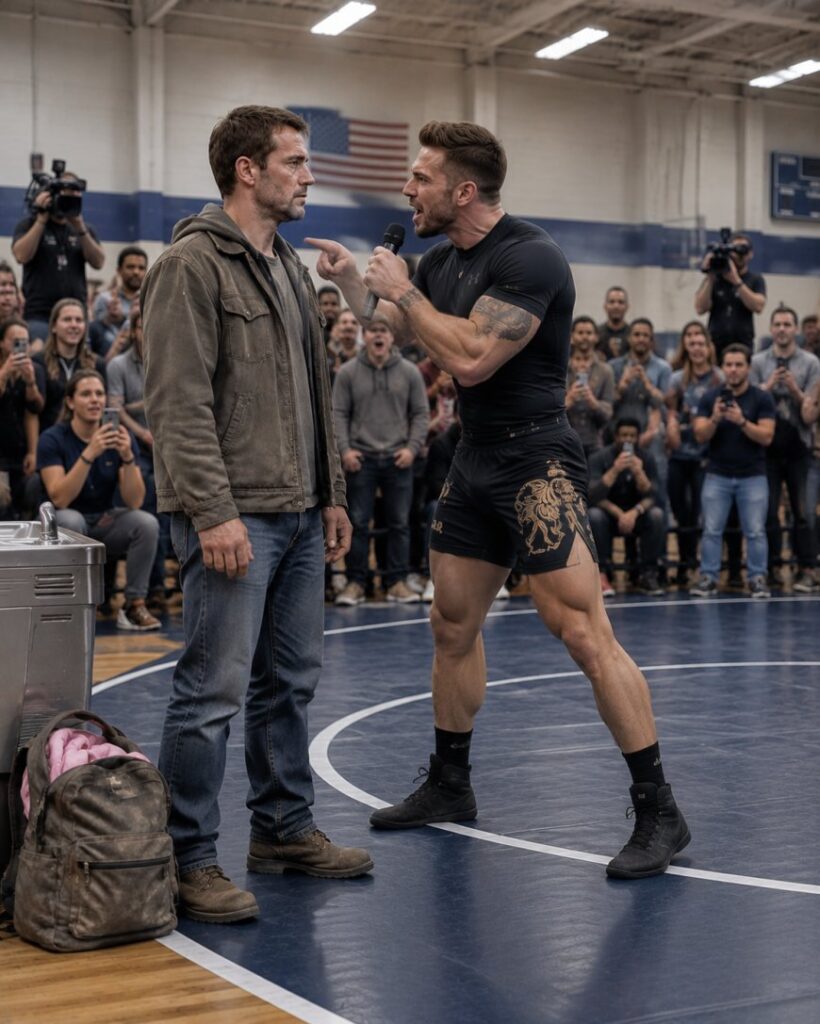
At 3:40, Logan caught me. Not cleanly—a partial connection, redirected, but enough. I felt it in my jaw and let the momentum carry me sideways rather than absorbing it straight, which limited the damage but put me momentarily out of my preferred position.
I reset in two steps. Logan pressed.
I let him come. And in that moment—Logan committing to a follow-through, confident in the partial success of the previous connection—I found the same geometry I’d found at Ironside. Not identical. Adjusted. Evolved to account for a better version of the same opponent.
I moved three inches. One beat. Logan’s weight committed past the point of correction.
I didn’t take him down immediately. I let the geometry develop for one more count—a calculation made in real time with the specific accuracy of someone who had spent eight weeks preparing exactly for this moment.
And then I finished it.
Logan went down. The crowd made a sound I had no language for—not a cheer, not a roar, something that had a different quality. The sound of 8,000 people witnessing something they had not fully believed they would see until it was happening in front of them and feeling, in the specific shared experience of a crowd that becomes temporarily one thing, the weight of what it meant.
I was on top of him. Logan tested once, twice. I was already in the adjusted position.
Logan tapped at 31 seconds of the second round.
The referee’s hand went up.
I stood. I stood in the center of the mat with 8,000 people and 2.6 million people watching through screens in living rooms and bars and bedrooms across the country. And I felt—not triumph exactly, because triumph was a performance, and this wasn’t. I felt something simpler and more complete than triumph.
I felt the specific satisfaction of a thing done right. Prepared for correctly. Executed honestly. For the right reason.
I looked toward the tunnel entrance. Carl was there. And beside Carl, three kids in regular clothes—Danny and Terrell and Marcus. And Marcus was not cheering the way the crowd was cheering. He was standing with his arms at his sides and his face completely open in a way I had never seen it before, like something that had been braced against the world had briefly come down.
I held his gaze across the distance. Marcus nodded once.
I nodded back.
Logan Pierce was on his feet. His team was around him—the standard post-fight operation—but Logan moved through them toward the center and extended his hand. And I shook it. And Logan looked at me with an expression that had genuine respect in it, unmanaged and real.
“You’re better than me,” Logan said. Not for the cameras. Just said it.
“On this day,” I said.
Logan shook his head. “Not just today.” He paused. “Don’t waste it.”
“I won’t,” I said.
I meant it differently than Logan meant it. Logan meant: Compete again. Build something public from this. Let the world see what you are.
I meant: Wake up tomorrow and go to Hendrix and stand in front of Marcus and Danny and Terrell and the 30 other kids who need to see what it looks like when a person operates from a clear sense of what matters.
Both meanings were true. They just had different timelines.
I went back through the tunnel. Carl was waiting, and the three kids, and Bryce, and the specific loud quiet of a night that had gone exactly as prepared for. People reached for me—reporters, officials, Logan’s management team with logistics to discuss. I moved through it all with the same quality I brought to everything: present, directed, unhurried, entirely clear on where I was going.
The post-fight obligations ran until 11:15. I was in the truck by 11:28.
I drove home. The city was running its late-night version around me—different traffic, different quality of light, the particular character of Columbus at close to midnight on a Saturday in November. I drove through it the way I’d driven every other route home from every other job for three years: with attention, without rushing, letting the familiar motion of it settle me.
I parked in front of my building at 11:41. I sat in the truck for a moment. My phone had 83 notifications. I turned the screen face down on the passenger seat.
I went inside. Up the stairs. Down the hall. I unlocked my door and pushed it open.
The lamp with the yellow shade was on in the living room, because Lily had said she’d be up, and Lily had meant it. She was on the couch in her pajamas with Gerald Bear and the library book she’d started this week, and she was not asleep—though she had clearly been close to it in the last 20 minutes, because her eyes, when she looked up at me, carried the particular weight of a child who fights sleep on principle.
“You’re home,” she said.
“I’m home,” I said.
I sat down on the couch beside her. She put the book on the cushion and leaned against my arm the way she always did—without announcement, just locating herself against me the way she’d been doing since she was old enough to move toward what felt like safety.
“Did you win?”
“Yes.”
“Was it hard?”
“Harder than last time.”
She nodded slowly. “Good,” she said. “Easy things don’t count.”
I looked at her. “Who told you that?”
“You did,” she said. “Last winter. When I almost didn’t want to do the science fair project because it was complicated.” She yawned, covering her mouth with Gerald’s ear. “You said easy things don’t prove anything. You have to do the hard thing to find out what you actually have.”
I sat with that.
“Dad,” she said.
“Yeah.”
“When I’m old enough—can I train at Mr. Hendrix’s gym?”
I looked down at her. Her eyes were mostly closed now. She was working on the last reserves of the intention to stay awake that had kept her on the couch for three hours past her bedtime.





