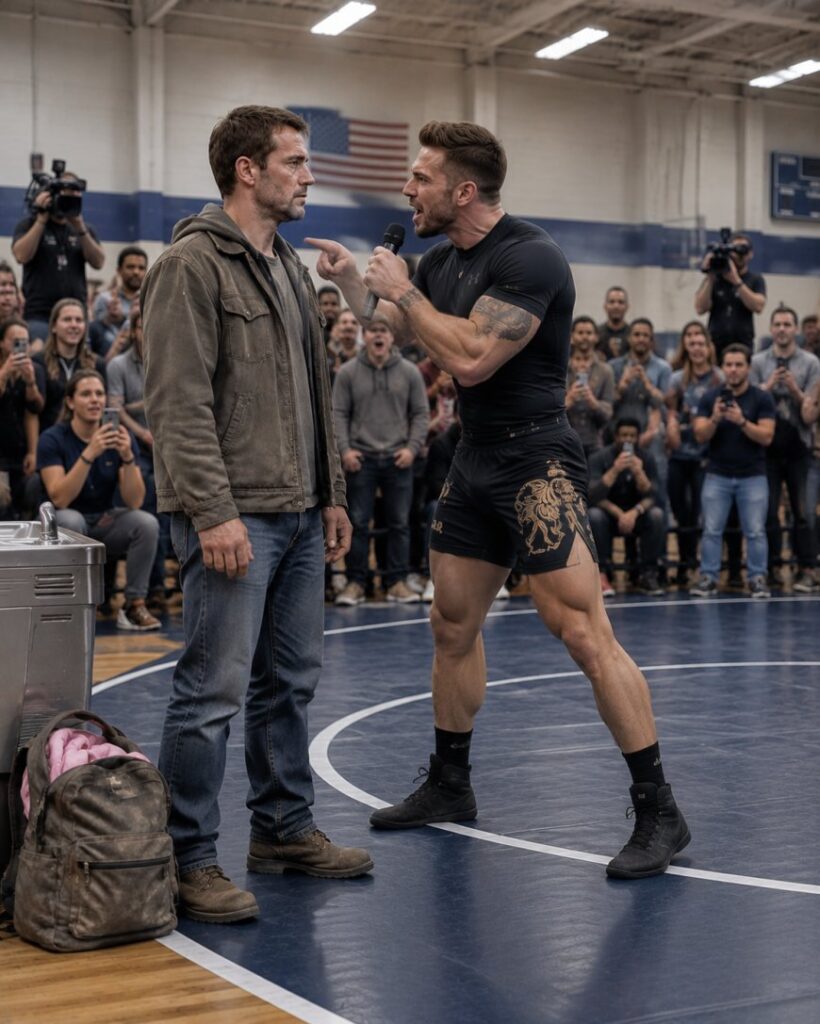
I went back to the mat.
The week before the fight, Logan Pierce showed up at Hendrix. Not to train. Not with a crew. He drove himself, parked, came through the front door at 9:15 on a Thursday morning while I was running the 12-to-15 group through a conditioning circuit.
Carl was the one who saw him first. He came to my elbow and said quietly, “Pierce is here.”
I kept my eyes on the group. “He come with anyone?”
“Just himself.”
“Tell him to wait.”
Carl went back. I ran the group through the remaining 20 minutes of the circuit without deviation—same pace, same attention, same corrections delivered to the same kids who needed them. I did not look toward the door. I did not give the group any indication that something was about this morning.
When the circuit was done and the group was cooling down, I told them to take 10 minutes and walked toward the door.
Logan was standing just inside the entrance in jeans and a plain jacket, looking exactly like what he was: a man who had come somewhere with a specific purpose and was waiting for the person he needed to speak to. He looked around the facility with genuine attention.
When I reached him, he extended his hand. I shook it.
“This is a good operation,” Logan said, looking at the space.
“It is,” I said.
“I came to talk to you about Saturday,” Logan said. “Not strategy. Not the fight itself. There’s something I should have said in person instead of over the phone, and I kept putting it off until now, which is later than I meant.”
He looked at me directly.
“I owe you an apology.”
I said nothing.
“What I did at Ironside,” Logan said. “Pointing you out. Calling you ‘ backpack guy.’ Making you the butt of whatever performance I was running for the cameras. That was wrong. I knew it was wrong while I was doing it. Not enough to stop—because stopping would have cost me in front of the audience, and I made the calculation that the audience mattered more than you did.”
He held my gaze.
“That was a bad calculation. And it took 47 seconds of you doing what you did for me to understand how bad.”
The gym ran its regular noise around them. Kids cooling down. Bryce adjusting equipment. Carl in his office with the door open, not listening with visible effort.
“You were performing,” I said. “I know the difference.”
“Performing or not, you were a real person,” Logan said. “With a real reason for being there. And I used you for content without your consent and without any regard for what it might cost you.”
He paused.
“I’m sorry.”
I looked at him for a moment.
“I accepted your apology four weeks ago when I agreed to the fight,” I said. “You don’t need to deliver it again.”
Logan almost smiled. “Fair,” he said. Then his expression settled into something more serious. “How are you feeling about Saturday? Ready?”
“Ready,” I said.
“No doubt?”
I considered the question honestly. “Doubt is not the same thing as unready,” I said. “A person without doubt isn’t paying attention. I have doubt. I also have eight weeks of preparation and a clear reason to be there.” I paused. “I’ll be fine.”
Logan nodded slowly.
“I’ve been preparing differently for this fight than any fight I’ve had in four years,” he said. “Not physically—physically, I’ve done what I always do. Differently here.” He touched his chest briefly. “I’m trying to compete the way you compete. Like it’s real. Not like it’s a production.”
He paused.
“I might actually push you Saturday.”
“I hope you do,” I said. “A fight that requires nothing from me doesn’t prove anything to the kids watching it.”
Logan looked toward the group of 12-to-15-year-olds cooling down across the floor. Marcus was among them, and Marcus was looking back at Logan Pierce with the flat, evaluating attention of someone who has decided he will form his own opinion of a person regardless of what anyone else thinks.
Logan met his gaze. Marcus didn’t look away.
Logan turned back to me. “That kid,” he said quietly.
“Marcus,” I said.
“He was watching you train when I came in.”
“Why?”
I looked across the floor at Marcus, who had returned to talking to another kid in the group with his usual economy of expression. “Because he’s trying to figure out how a person handles the part where it gets hard,” I said. “And he can’t learn that from a video.”
Logan was quiet for a moment.
“You’re going to be good at this,” he said. “Not about Saturday. About all of it.”
I shook his hand again. Logan left. I went back to my group.
Saturday arrived.
The event was held at a midsized arena in Columbus. Eight thousand seats, sold out weeks ago. Broadcast equipment rigged throughout for the national network feed.
I had been to the venue once before, a week earlier, to walk the space alone and understand its geometry before it filled. I had done this the same way I’d done it with the Hendrix floors on my first morning—not for superstition, not for ritual, but because knowing a space was simply sound preparation.
I arrived at the arena at 4:00 for an 8:00 main event. Standard timing. I had a locker room, a warm-up space, Bryce with me for the physical prep, and Carl—who had come because he said someone needed to make sure I ate something reasonable beforehand, and that someone was going to be him.
What I hadn’t expected was what was waiting in the locker room.
I opened the door and found three people inside who had not been in my plan. Marcus. And beside Marcus, two other kids from the younger group—a 14-year-old named Danny, who had been in the program for three months and almost quit twice, and a 12-year-old named Terrell, who was the youngest in the program and compensated for it by being the most relentlessly focused.





