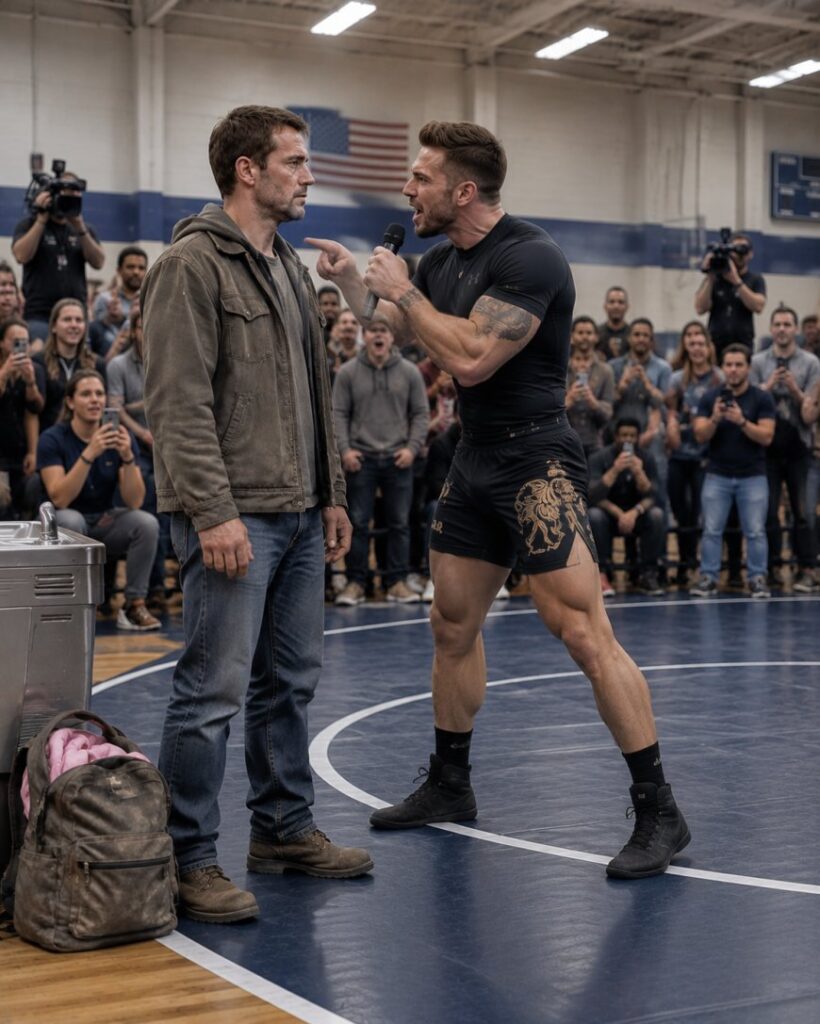
I waited.
“Why are you working a job?” Logan asked. “Whatever job you’re working—why, with what you just showed me? You could be—”
“Mr. Pierce,” I said.
Logan stopped.
My voice wasn’t hard. It wasn’t cold. It was the voice of a man who had made a decision a long time ago and was completely at peace with it.
“My daughter’s program ends in 30 seconds. I’ve never been late picking her up. I’m not going to be late today.”
I held Logan’s gaze for one more moment. Then I turned, pushed through the hallway door, and was gone.
The hallway was quieter. The noise from the main floor muffled behind the heavy door, and I moved through the familiar corridor—past the bulletin board covered in flyers for local programs, past the water fountain that worked, past the mural some community kids had painted three summers ago of the Columbus skyline in bright reds and blues—toward the reading room at the end of the hall.
The door was already opening. Lily came out first—the way she always did, because she had inherited something from her father, a preference for being in motion rather than waiting. She was carrying a library book under one arm and had her jacket half on, one sleeve dragging, and she was already looking for me before she was fully through the door.
She found me.
“Dad,” she said—the way she always said it, not like a greeting exactly, more like a confirmation, like her day wasn’t fully real until I was standing there making it real.
I crouched down to her level. She walked into my arms, and I held her, and over her shoulder I looked at nothing in particular and breathed.
“You’re on time,” she said into my shoulder, slightly accusatory, which meant she’d been worried.
“I’m always on time,” I said.
“You almost weren’t.”
I pulled back to look at her face. She had a smear of something purple on her left cheek—marker, probably, from some art project—and her hair was escaping from both sides of the braid I’d done that morning.
“Almost doesn’t count,” I said.
She considered this. “Mrs. Patterson says almost is the most important word in the English language.”
“Mrs. Patterson is a very smart teacher.”
“She says that if you’re almost on time for something important, you’re actually late.”
I stood up, took the library book from under her arm so she could finish getting her jacket on, and held it while she wrestled with the sleeve. “Then I’ll make sure almost never applies to picking you up,” I said.
“Good.” She got the sleeve on, looked up at me. “What happened to your hands?”
I glanced down. The knuckles of my right hand had a faint redness to them. Nothing broken, nothing serious. The kind of contact that leaves a mark you notice later rather than in the moment.
“Nothing,” I said. “Bumped them on something.”
Lily studied my hands with the particular attention of a seven-year-old who has decided she is not being given the full story. “They look like you hit something.”
“I told you—”
“Did you fight someone?”
“Lily—”
“Dad. Did you fight someone?”
I looked at her. She looked at me. Somewhere in the exchange, the same face looked back at itself from two different heights.
“We’ll talk about it in the truck,” I said.
Her eyes went wide. “We’ll talk about it in the truck? Was it bad? Truck—Lily, are you in trouble?”
“I’m not in trouble. Everything’s fine. Truck now.”
She uncrossed her arms—clearly filing this conversation away for continued excavation later—and fell into step beside me. Her hand found mine automatically, the way it always did in hallways and parking lots and anywhere with people moving around us. And I held it the way I always held it—firmly, without making a production of it.
We walked back down the corridor, past the mural, past the bulletin board, toward the side exit.
“I finished the book,” she said, shifting topics with a rapid lateral movement that characterized every conversation I’d had with her since she was five. “The one about the lighthouse keeper.”
“Yes?”
“It was sad but also happy at the end.”
“That’s the best kind.”
“The lighthouse keeper had a daughter,” she said. “And she had to learn to keep the light going when he was too sick to do it. And she was scared, but she did it anyway.”
I pushed the side door open. The late afternoon air was cool.
“Why was she scared?” I asked.
Lily thought about it as we walked toward the street. “Because,” she said finally, “the light was important. And if she messed it up, ships could crash. So being scared was the right thing to feel. But you do it anyway because the ships need the light.”
I walked.
“Dad?”
“Yeah.”
“Is that what you do when you’re scared about stuff? You do it anyway because we need the light?”
I looked down at her. She was looking straight ahead, working on something in her mind, the way she did when she’d arrived at a thought that was bigger than she was entirely sure how to carry.
“Where did that come from?” I asked.
She shrugged—a seven-year-old’s shrug, economical and deeply serious. “I was just thinking.”
I put my arm around her shoulders as we walked. “Yeah, Lily Bug,” I said quietly. “That’s pretty much exactly what it is.”
She nodded, satisfied, like a question that had been sitting with her for a while had finally been given a proper answer.
We walked the three blocks to the truck in the cooling Thursday afternoon—her hand in mine, the library book under my arm, the $20,000 check not yet written but already real somewhere in the world, the back rent and the tires and the field trip fees and the broken zipper all still exactly where they’d been three hours ago.





