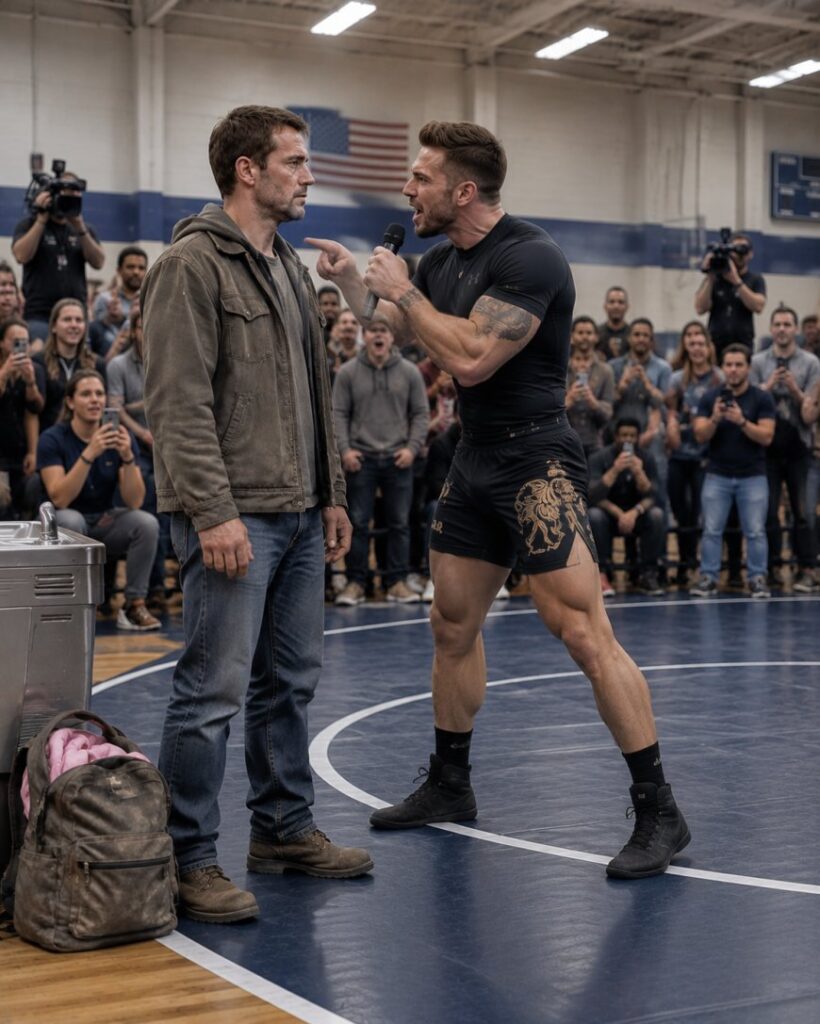
But something was different. Not fixed, not resolved—not anything so clean and immediate as that. Different in the way the air feels different before a change in weather, when you can’t see it yet but your body knows it’s coming because the pressure has shifted in some way that can’t be unfelt.
The evening moved forward the way evenings did. Dinner—scrambled eggs and toast, because it was Thursday and Thursday was the day before my delivery route ran and the refrigerator reflected that accurately. Homework at the kitchen table. Lily’s bath. Thirty minutes of reading before bed. Lights out at 8:30.
I sat on the edge of her bed while she settled.
“Dad,” she said.
“Yeah.”
“That man who offered the money. Was he mean?”
I considered the question with the seriousness it deserved, coming from her. “He was performing,” I said finally. “He was in front of cameras and an audience, and he was doing what he does in front of cameras and audiences. Whether that’s the same as mean, I don’t know.”
“He pointed at you,” she said. “I bet that felt mean.”
I looked at her. “How do you know he pointed at me?”
She met my eyes steadily. “Because you walked away from a mean thing and then you went back. You only go back to something if someone pushes it.”
I sat with that for a moment. “Go to sleep, Lily.”
“Okay.” She pulled her blanket up. “Dad?”
“Yeah.”
“I’m glad you went back.”
I turned off the lamp. “Go to sleep,” I said again.
She did.
I sat in the kitchen alone for a long time after that. At the table, with a glass of water I wasn’t drinking, looking at nothing in particular and thinking about everything.
The delivery job started at 9:00. I had an hour and forty minutes.
I thought about the $20,000 with the same careful, controlled attention I gave to every resource that had the potential to change something real. Not excitement—excitement was for people who hadn’t learned yet how quickly a large number could become a smaller number when reality started subtracting from it. I thought about it practically. The back rent first. The tires. The field trip fees. Lily’s winter coat. A buffer—whatever remained, put somewhere I wouldn’t touch unless it was necessary, because a buffer against the next emergency was worth more than any single comfort.
I did the math. The large number became a smaller number fairly quickly. But what remained after the subtracting was something I hadn’t had in a very long time.
Room. Not wealth, not security in any permanent sense—just a small, real measure of breathing space between where we were and the next crisis.
I sat with that and let myself feel it quietly, the way I let myself feel most things—without drama, without performance, with the simple acknowledgement that it was real.
Then I changed my shirt, filled a thermos with coffee, and went to work.
The delivery route ran from 9:00 in the evening until somewhere between 3:00 and 4:00 in the morning, depending on volume. I drove a panel van for a regional distribution company—package sorting first, then route delivery to commercial addresses that received overnight freight. The work was physical and solitary and required concentration without being complex, which suited me. I could think while I worked. I usually did.
That night, somewhere around the second hour of the route, my phone buzzed. I pulled over in a loading zone, engine running, and looked at the screen.
Unknown number. Columbus area code.
I answered.
“Mr. Mitchell?” A woman’s voice. Professional, slightly brittle—the voice of someone managing more than they had anticipated managing that evening. “This is Sandra Reyes. I work with Logan Pierce’s management.”
“I know who you are,” I said.
“Right. Of course.” A pause, brief, controlled. “I’m calling to confirm your banking information for the wire transfer. Mr. Pierce has authorized the full 20,000. As stated, we’d like to process it by end of business tomorrow.”
I gave her the information.
“Thank you,” she said. Another pause, slightly longer than the first. Then: “Mr. Mitchell, I have to ask. And this is completely off the record—not anything official from the organization. I just have to ask.”
“Ask.”
“How long ago did you leave the military?”
“Three years.”
“And you haven’t trained since?”
“Not formally.”
She was quiet for a moment. “I’ve been with Logan’s team for four years,” she said. “I’ve watched a lot of fights. I’ve seen a lot of people step onto that mat thinking they could do what you did today. None of them could.” Another pause. “You should know that.”
I didn’t respond.
“I’m not saying that for any particular reason,” Sandra said. “I just—I think sometimes people don’t know what they have. And it seems like a waste, is all.”
“Thank you for calling about the transfer,” I said.
She let the deflection stand. “You’ll see it in your account by 5 tomorrow afternoon.”
I thanked her and ended the call.
I sat in the loading zone for a moment—longer than necessary—engine running, the city quiet around the van. Then I pulled back out into the street and finished the route.
I got home at 3:47, checked on Lily. She was sleeping on her side with her arm around the stuffed bear she’d had since she was three—a bear named Gerald, for reasons she had never fully explained. I stood in the doorway of her room for approximately twenty seconds, which was my version of allowing myself something that felt close to gratitude, before closing the door carefully and going to bed.
My alarm was set for 6:15. I was asleep before my head finished settling.
I dreamed about sand—which happened sometimes, not with drama, not as a nightmare in the cinematic sense, but with the particular texture of the subconscious working through things it hadn’t finished processing. The heat. The weight of gear. The particular quality of attention required when every decision existed inside a margin that permitted no revision.





