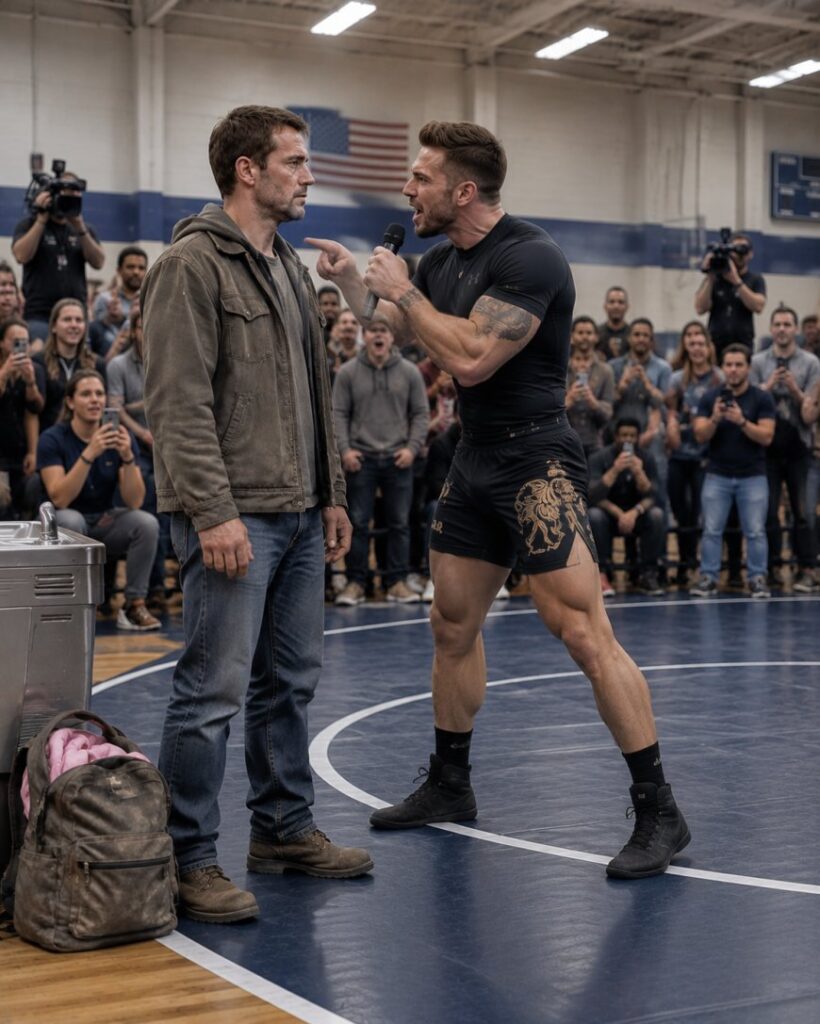
Carl nodded and went back to his desk. I rolled up my sleeves and started moving equipment for the next session.
The seven weeks didn’t shrink time. They filled it differently.
Training in the mornings at Hendrix—before the programs ran, the floor belonged to me from 6:00 to 8:00, and I used every minute of it. Work sessions with Carl’s assistant trainer, a former collegiate wrestler named Bryce, who was technically sound and had enough ego dissolved by experience to be genuinely useful. Evenings with Lily. Homework. Dinner. The taco truck on two more Thursdays, because it was now a thing—officially a ritual—and rituals mattered.
Logan Pierce sent over fight footage three weeks in. I watched it once, extracted what I needed, and didn’t watch it again. I wasn’t preparing to fight Logan Pierce’s history. I was preparing to fight whoever Logan Pierce had become in the weeks since Thursday—which was a different problem.
The video hit 6 million somewhere in week four. I knew because Lily told me at breakfast.
“Six million people watched you pick up your backpack,” she said, with the matter-of-fact delivery she used for information she had already processed.
“They watched more than that,” I said.
“I know,” she said. “But that’s the part that matters.”
She ate her pancake.
“Marcus from your gym said you’re the fastest person he’s ever seen move.”
I looked at her. “You talked to Marcus?”
“He has a younger brother at my school,” she said. “We ride the same bus sometimes.”
I absorbed this small world.
“Columbus is not that big,” she said, with the authority of someone who had given this matter consideration.
I almost smiled.
Week six. A Wednesday. I was finishing a morning training session when my phone buzzed with a number I recognized—Sandra Reyes from Logan’s management. I answered.
“Mr. Mitchell,” she said. “I need to tell you something before you hear it elsewhere. There’s been a development with the event.”
I stopped moving. “What development?”
“The venue’s capacity sold out in four hours when tickets went live last Tuesday. That part you may have known. What you don’t know is that a national sports network reached out to Logan’s promoter yesterday. They want to broadcast the event live. Estimated viewership in the range of 2 to 3 million.”
I stood very still.
“I’m not calling to pressure you,” Sandra said quickly. “The contract you signed is the contract. Nothing changes in your terms. I’m calling because Logan insisted you be told directly by us before you saw it in the news, which you will probably today.”
I looked at the mat. Two to three million people. Live.
“Mitchell?” Sandra said.
“I heard you,” I said.
“Are you—”
“I’m fine,” I said.
I ended the call.
I stood on the floor of Hendrix Performance and Athletic Training in Columbus, Ohio, in the early morning quiet before the program started, and thought about a man who had walked into a gym six weeks ago to pick up his daughter and had, in 47 seconds, made himself visible to a world he had spent three years learning to disappear inside.
I thought about Marcus saying it wasn’t the training—it’s because he had somewhere to be after. I thought about Lily saying, “Train right, win, and then come home.” I thought about a lighthouse keeper’s daughter standing at the top of a lighthouse in a book, scared out of her mind, keeping the light burning because the ships needed it.
I picked up my towel. I rolled my neck once. I got back to work.
Because there were still two weeks of preparation left, and I had never in my life walked into anything without being ready.
I wasn’t going to start now.
The last two weeks moved the way the final stretch of anything important moves—faster than you expect and slower than you can afford. I was at Hendrix every morning by 6. I trained alone for the first hour before anyone else arrived, working through sequences that lived in my muscle memory the way language lives in a person who grew up speaking it—not retrieved, just present. Bryce joined me at 7:00 for the technical work. The specific preparation for Logan’s patterns and tendencies.
Carl arrived at 8 and watched without commenting, which was its own form of communication. I had come to understand: when Carl watched without saying anything, it meant what he was seeing was correct.
The kids noticed the shift in my training intensity. The morning sessions ran earlier. The prep was more focused. The physical output was visibly different from the conditioning work I ran with the youth groups.
Marcus started arriving at Hendrix 20 minutes before his session started—not to train himself, but to watch. He never asked permission. He never explained it. He simply appeared, sat on a bench near the far wall, and watched with the concentrated attention of someone who was learning something he didn’t have a name for yet.
I noticed. I didn’t say anything about it for three days. On the fourth day, Marcus was on his bench at 7:40 when I finished a sequence and walked over to the water station. I looked at Marcus.
“What are you watching for?” I said.
Marcus didn’t look away. “The part where you get tired,” he said.
I drank.
“Why?”
“Because everyone gets tired,” Marcus said. “I want to see what you do when it happens.”
I sat down the water bottle.
“And?”
Marcus looked at me steadily. “You slow down a little. But you don’t change what you’re doing. You just do the same thing slower until you’re not slow anymore.” He paused. “Most people switch to easier stuff when they get tired. You don’t.”
I looked at him. “You’re going to be a good trainer someday,” I said.
Marcus said nothing, but something in his posture shifted—almost invisible. The kind of change that happens when a person receives something real and doesn’t know yet how to carry it.





