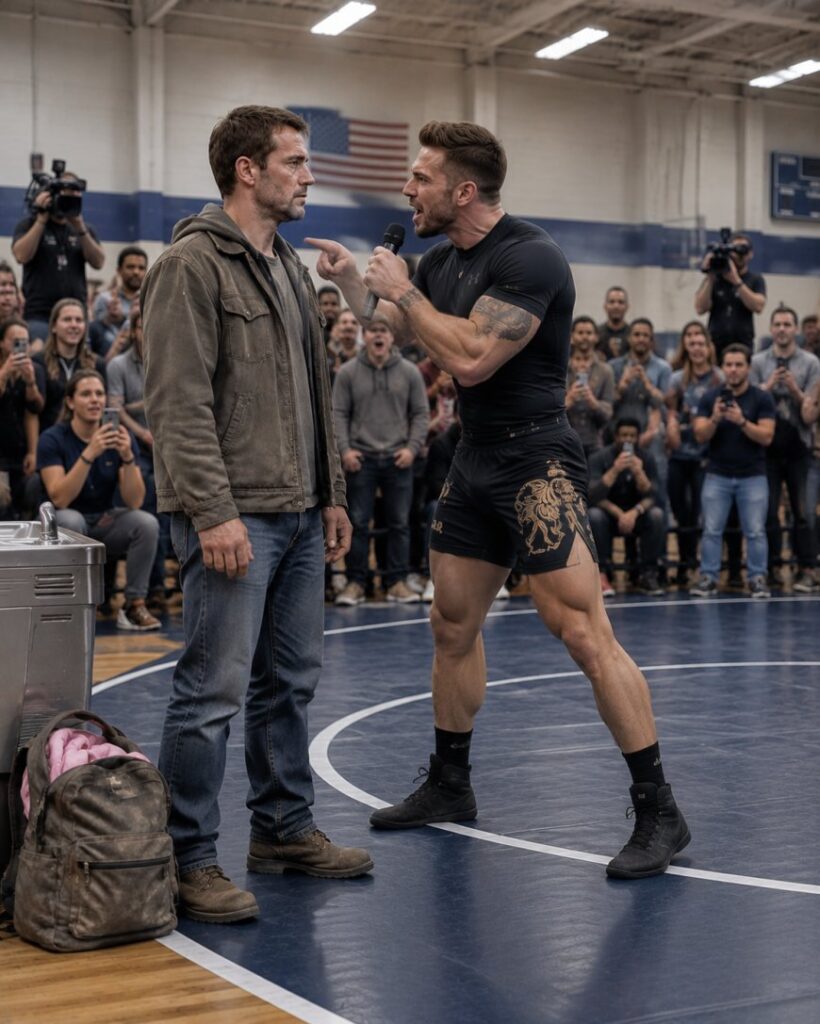
“Already on,” Lily called back.
I almost smiled.
I picked my jacket back up off the chair, and Ryan Mitchell walked out of his apartment—past the notification buzzing on his phone, past the camera people who had relocated to the corner in his absence, past the ordinary and extraordinary facts of his particular life—and took his daughter to the taco truck.
Because tonight, that was the thing that mattered most.
Tomorrow was its own territory. And I would face it the way I faced everything: one step at a time, with my eyes open and my daughter’s hand in mine.
The video hit 1.2 million views by Tuesday morning. I found out at 6:03 when my phone buzzed with a text from a number I didn’t recognize that said simply: “You’re at 1.2M. Thought you should know.”
I deleted it, made coffee, and went through the morning routine the same way I always did. Lily’s lunch. Lily’s uniform. The specific sequence of a life that didn’t pause for numbers on a screen.
But the numbers were moving.
By the time I dropped Lily at the bus stop at 7:24, three separate people on the sidewalk had looked at me with the particular expression of people who recognize a face from somewhere and are trying to place it. One of them—a man about my age, work boots, coffee in hand—said, “Hey, you’re the guy, right? From the video?”
“Have a good morning,” I said, and walked back to the truck.
I sat in the driver’s seat and looked at the steering wheel for a moment. A year ago—six months ago, even a month ago—invisibility had been something I cultivated deliberately. Not out of shame, not out of hiding, but out of the practical understanding that a man whose life runs on tight margins cannot afford the disruption of attention.
Attention costs time. Time costs everything else.
Now the attention was here, whether I wanted it or not. The question was what I did with it.
Logan Pierce called at 8:47. I let it ring twice, then answered.
“I need an answer,” Logan said. Not aggressive. Factual. “My promoter’s window closes Friday. After that, the event gets built around a different main card and we lose the slot.”
“What’s the timeline if I say yes?” I asked.
“Eight weeks to the event. Six weeks of prep time, if you want to train properly—which I’d recommend, given that you’ve been out for three years.” A pause. “I’ll cover training costs. Full access to my facility. My team. Whatever you need. The purse doesn’t change regardless of outcome.”
I was quiet.
“Mitchell,” Logan said, and his voice shifted—dropped below the transactional register into something more direct. “I’m not asking you to become a fighter. I’m asking you to do one thing, once, in a controlled environment, for a number that changes your daughter’s life in a concrete way. That’s the whole offer.”
“And if I say no?”
“Then the 20,000 was a real offer, with no strings, and you keep it, and we never talk again.”
I looked out the windshield.
“What does she need?” Logan asked.
The question landed differently than I expected it to. Not as manipulation—as a genuine question from a man who had looked inside a worn backpack and understood, in the way that occasionally happens between people who are otherwise very different, exactly what he was looking at.
“What does Lily specifically need?” Logan said. “Not generally. Not abstractly. What is the actual thing?”
I looked out the windshield. “A stable year,” I said. “Not comfort. Not wealth. Just one year where the margin isn’t so tight that one bad month changes everything.”
Logan was quiet for a beat. “The purse I’m offering covers that,” he said. “It covers more than that.”
“I know.”
“Then what’s holding you?”
I thought about how to answer that honestly. “I built a version of my life specifically designed around being present for her,” I said. “Training for six weeks, fighting in a public event, dealing with what comes after that event—that’s a disruption I need to evaluate against what it cost her.”
“That’s fair,” Logan said. “And I’ve taken a position with a youth training program here in Columbus,” I said. “It starts in two weeks. I need to honor that commitment.”
Silence on Logan’s end. Then: “Carl Hendrix.”
I paused. “You know him?”
“I know of him,” Logan said. “Good program. Real work. Nothing wrong with that.” Another pause. “The event is a Saturday night. Eight weeks from now. One night. Carl’s a professional. He’ll understand one Saturday.”
I said nothing.
“Talk to Lily,” Logan said. “Not to get her permission—but because it sounds like she’s your best thinking partner.”
“And call me by Thursday,” he said, and ended the call.
I sat in the truck for a full 60 seconds. Then I got out and went to work.
The service call ran until 11:00. I ate lunch in the truck. By 1:00 in the afternoon, my phone had logged 22 missed calls and 14 text messages from numbers I didn’t recognize. I cleared them all without listening and called Carl Hendrix.
Carl picked up immediately.
“I was wondering when you’d call,” Carl said. “You’ve seen the video.”
“Everyone’s seen the video.” Carl’s voice was dry but not unkind. “What do you need?”
“Logan Pierce has offered me an event,” I said. “Eight weeks from now. Saturday night. I want to be honest with you about it before I make any decision.”
Carl was quiet for a moment. “What does the offer look like?”
I told him. Carl absorbed it.
“That’s significant money.”
“Yes.”
“And you’re asking me what?”
“I’m asking if accepting it creates a problem with the position at Hendrix.”
Carl was quiet again. When he spoke, his voice was careful and honest, in the way I had already come to recognize as characteristic of how the man operated.





