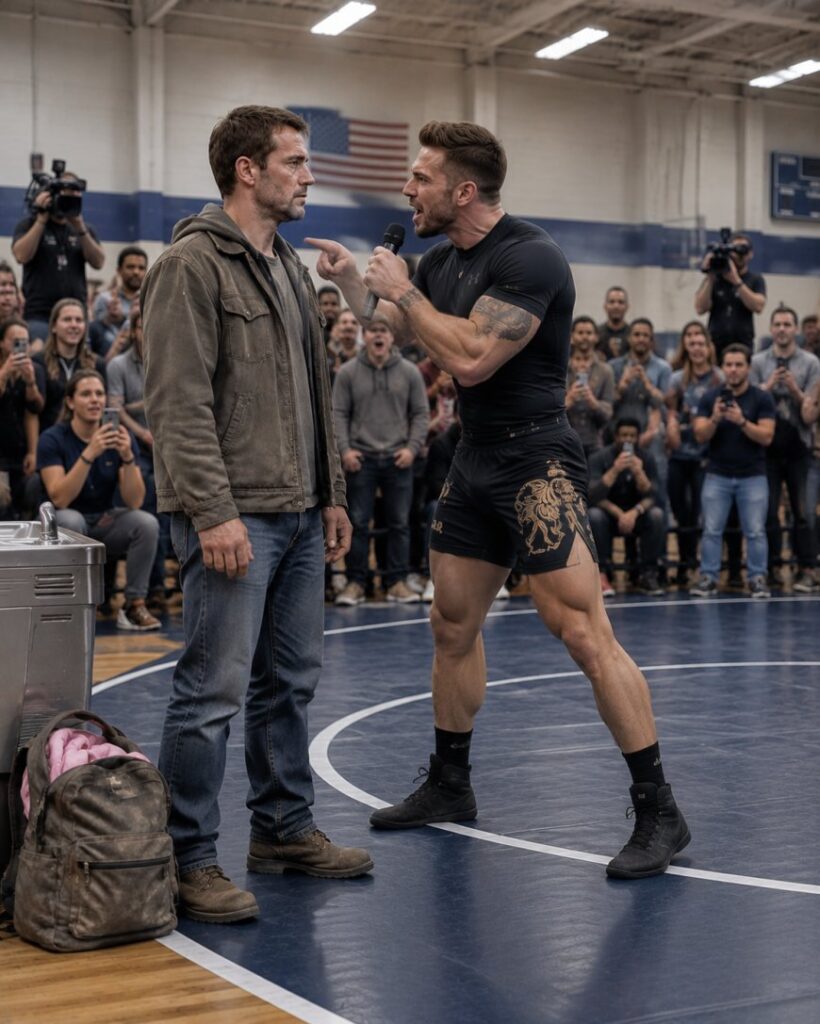
PART 2
The fight lasted 47 seconds.
Later—days later, when the footage had been reviewed and replayed and slowed down and analyzed by people who understood what they were watching—the consensus among those who knew the sport was that what happened in those 47 seconds was one of the most precise pieces of physical problem-solving any of them had witnessed in an informal setting.
Logan Pierce was not a sloppy fighter. That needs to be understood clearly before anything else. He was fast, technically sound, genuinely experienced, and he led with a combination that had ended dozens of fights before this one—a faint to the body followed by a high attack that most opponents never picked up on until it had already landed.
I picked it up before the faint was even complete.
I didn’t counter it. I didn’t meet it with force. I simply wasn’t where Logan was aiming when the commitment came through. I shifted three inches to the outside, weight already transitioning, and Logan’s follow-through carried him slightly past the point of balance he’d planned on.
That was the moment. Three inches. One beat of timing. A body that knew exactly what it was doing, even after three years of doing nothing like this.
What followed was not a brawl. It was not dramatic in the way the crowd had expected dramatic to look. There were no big exchanges, no back and forth, no moment where either man absorbed punishment and kept going.
It was quiet and geometrically precise, and it was over before most people in the audience fully registered that something was happening.
I redirected Logan’s weight, stepped into the resulting space, and took him down with a technique so clean and efficient that the crowd’s first collective response was confusion—a tiny six seconds of silence while two hundred people tried to understand why Logan Pierce was on the mat.
Logan was not a small man. He was not easy to move. He had been attempting takedown defense for four years against professionals. What I did shouldn’t have worked on someone like Logan.
It worked because I hadn’t tried to overpower him. I had simply understood, in the moment, where Logan’s weight was committed to going and given it a more direct path to the floor.
Logan was on his back. I was not on top of him in the way of someone dominating from strength. I was positioned—controlled, economical, balanced—in a way that gave Logan no efficient exit while requiring me to expend almost nothing to maintain.
Logan felt it immediately. He was experienced enough to understand what the position meant. He tested two escapes in rapid succession—the kind any trained fighter would attempt first, the kind that work against a wide range of opponents. Neither worked. Not because I overpowered them, but because I anticipated them both and was already in a different position than the one Logan was escaping from.
Logan tried a third approach. My weight shifted three inches again. Same result.
Forty-one seconds in, Logan Pierce had used a significant portion of his available energy on attempts that produced no progress, and he was beginning to breathe harder than he’d breathed in a real fight in over a year.
Six seconds later, his hand found the mat. Three quick taps.
Marcus called it immediately.
The room didn’t explode the way rooms usually do after an upset. It went completely, utterly, stunned quiet.
And in that quiet, I stood up, walked back toward my backpack, and picked it up.
I checked the time. 4:29. One minute. I shouldered the backpack and started toward the hallway.
I was almost there when Logan Pierce said, from somewhere behind me, in a voice that was stripped of performance and genuinely confused: “Wait.”
I stopped. Turned.
Logan was on his feet. Desmond was beside him, doing the job of any good trainer after an unexpected result—quiet, steady, making sure the fighter was physically fine before anything else. Logan waved him off slightly and looked across the mat at me.
The cameras were still rolling. The crowd was very still. Nobody seemed to know what the appropriate response was.
“Who are you?” Logan asked.
He wasn’t being theatrical. He was genuinely asking.
I glanced at the hallway door. Glanced back at Logan.
“Ryan Mitchell,” I said.
“Where did you train?”
I adjusted the strap of my backpack. “Marine Corps.”
“That’s not—” Logan stopped. Reorganized. “When did you last compete or train?”
“Three years ago,” I said.
Silence.
Logan looked at me—looked at the jacket, the jeans, the old backpack, the clear absence of any investment in what had just happened beyond the moment itself. He looked at the clock on the wall where I had looked twice.
“You have somewhere to be,” Logan said. It wasn’t a question.
“Yes.”
“Your daughter,” Desmond said quietly from beside Logan.
He had been the one standing nearest to where I had set down my backpack. He had seen the pink jacket inside. Had seen the small photograph tucked in the outer pocket—a little girl with my eyes holding a stuffed bear.
Logan looked at Desmond, then back at me. His expression changed. Not dramatically—Logan Pierce was not the kind of man whose face made large movements—but something shifted in his eyes that was genuine and visible to anyone paying attention.
“The money,” Logan said. He turned to his management coordinator, a woman named Sandra, who was already white-faced with the logistical implications of what had just happened. “The 20,000. It was a real offer.”
Sandra opened her mouth. Logan looked at her directly. “It was a real offer,” he repeated.
Sandra closed her mouth.
Logan turned back to me. “You’ll have a check within 48 hours. I’ll have Sandra get your information.”
I looked at him for a moment. “I appreciate that.”
“Can I—” Logan stopped again. Ran a hand over his head. “I want to ask you something, and I don’t know how to ask it without it sounding wrong. So I’m just going to say it.”





