And I kept teaching them the only thing I knew.
There’s a photograph on my dresser. It’s old. Twelve years, maybe more. It was taken at a regional title bout in Memphis. I’m in the corner of the cage behind a fighter in black and gold. Arms resting on the top rope. Watching the floor.
I didn’t know the photograph existed until the corridor footage went viral and someone with archival access found it. I didn’t know it was going to be the thing that started the whole story.
But I’m glad it exists.
Because it’s a picture of a man who didn’t know what he was going to become. Who didn’t know he was going to walk away. Who didn’t know he was going to have a daughter who would ask him questions he couldn’t answer.
Who didn’t know that fifteen years later, he’d be standing in a small room that smelled like rubber flooring and old paint, teaching people how to stand still.
Sadie asked me once why I kept it. The photograph. I told her it was a reminder.
“A reminder of what?”
“A reminder that I don’t have to be that person anymore. But I can’t pretend he never existed.”
She thought about that for a long time. Then she said, “That’s like what you teach. About stillness.”
“How so?”
“Stillness isn’t about doing nothing. It’s about knowing what you’re doing. And why.”
I looked at my daughter. Nine years old. Leah’s eyes. My stubbornness. A laugh that arrived without announcement and changed every room it landed in.
“That’s right,” I said.
And she smiled.
The headlines faded. The videos stopped circulating. Rhett Dugan served his suspension and came back to fight again, and lost, and fought again, and won. I didn’t follow it closely. I didn’t need to.
The cut clip stayed on the internet somewhere, I’m sure. Things like that never really disappear. But it stopped mattering. The full footage had been released. The truth was out. The people who needed to understand had understood.
And I went back to my life.
The maintenance manager at the community sports center. The father who knew every teacher’s name at Sadie’s school by September. The man who arrived at seven in the morning with a thermos of black coffee and didn’t leave until everything on his list was handled — and sometimes several things that weren’t on it.
The quiet man in a plain jacket who had spent years constructing a life at the precise distance from all of that.
I was still that man. But I was something else now, too.
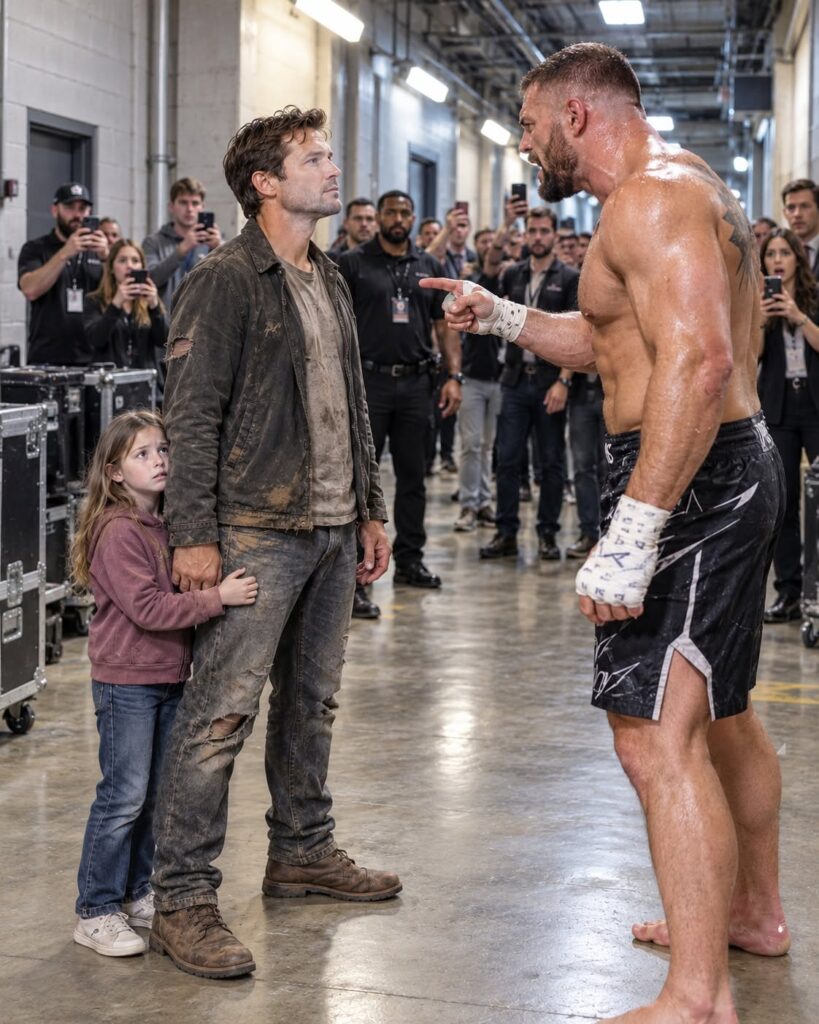
I was the man who had stepped into a corridor and made a choice. The man who had given three warnings. The man who had dropped a 230-pound fighter in five seconds and then walked away.
And I was the man who had told his daughter the truth.
That was the part that mattered.
The last time I saw Warren Pike was at the community center, six months after the corridor. He’d come to watch a session. He stood in the back with his arms crossed and his face unreadable, the way he’d always watched fighters in the gym.
After the session ended, he walked up to me and said something I hadn’t expected.
“You know what I remember most about that night?” he said.
“What?”
“The look on your face when you stepped in front of your daughter. Before any of it happened. Before the pushes. Before the warnings. Before the takedown.”
I waited.
“You looked like a man who had already decided something. Not about Rhett. About yourself.”
I didn’t say anything.
“I’ve seen a lot of fighters,” Warren said. “I’ve seen a lot of coaches. I’ve seen a lot of men who thought they knew what strength was. But I’ve never seen anyone who understood it the way you do.”
He put a hand on my shoulder.
“You’re doing good work here, Grant. Don’t stop.”
Then he walked out.
I didn’t see him again for a long time. He passed away the following year. Quietly. In his sleep. The way he would have wanted.
I went to the funeral. I stood in the back and watched the people who’d known him — fighters, coaches, friends, family — say goodbye. And when it was over, I went home and sat in my kitchen and thought about what he’d said.
You’re doing good work here. Don’t stop.
I didn’t stop.
The program is still running. Different location now, bigger space, more people. But the same principles. The same lessons. The same quiet room that smells like rubber flooring and old paint.
Sadie is older now. She’s not a little girl anymore. She trains with me still, but not the way she used to. She’s moved past the basics. She’s learning the harder things now. The things that don’t have names. The things that come from somewhere deeper than technique.
She asked me once, not long ago, if I ever regretted what I did in that corridor.
“Which part?” I asked.
“The takedown. The video. All of it.”
I thought about it. I thought about the access card that stopped working. The phone calls I didn’t answer. The way the whole world had decided who I was before I had a chance to explain.
“No,” I said. “I don’t regret it.”
“Why not?”
“Because it made me tell the truth. To you. To myself. To everyone.”
She thought about that for a moment. Then she nodded.
That was all. She didn’t need any more than that.
She never did.
I still think about that night sometimes. The noise of the arena. The look on Rhett’s face. The weight of his hand on my collar. The three seconds after he grabbed me, when I wasn’t reacting — I was observing.
I think about the moment I understood that his grip wasn’t power. It was leverage given away.





