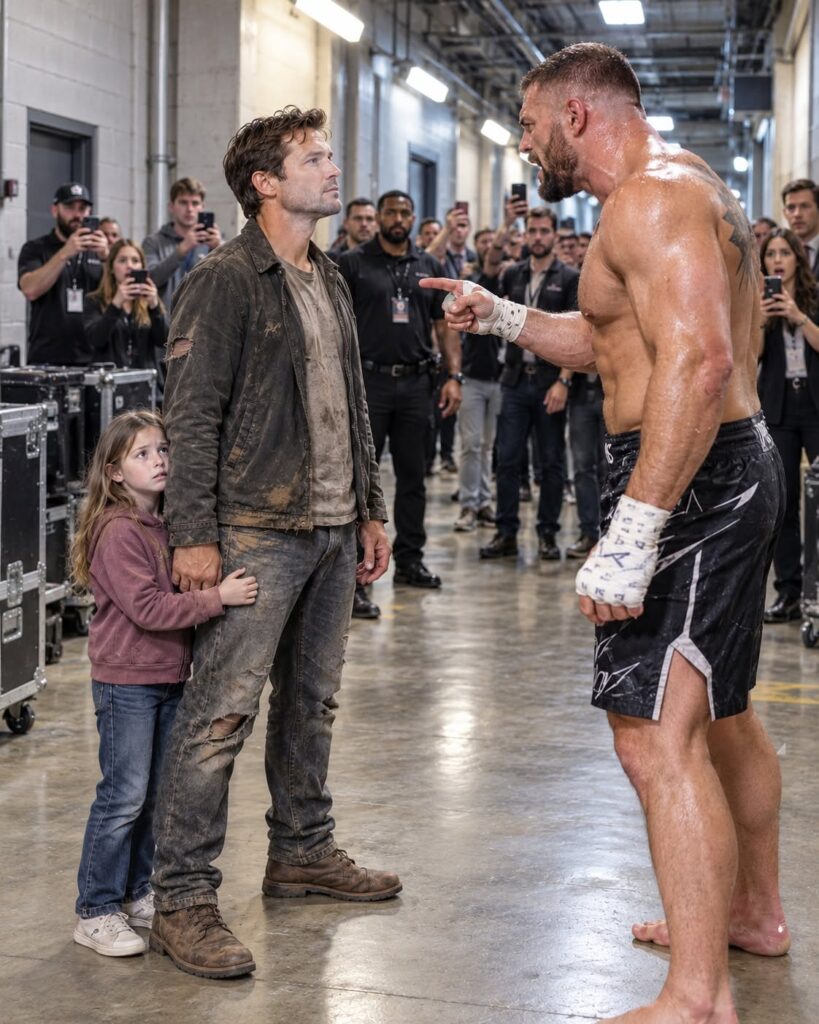
It was the sentence that ended up in every piece that ran afterward. Reproduced more than any part of the footage or any detail of the incident. Shared by people who had never heard of Rhett Dugan or Hawthorne Crown Arena and had found it entirely out of context.
I did not find this surprising.
It was the most accurate thing I had said in a long time.
The room at the community center that Warren had arranged was small and smelled like rubber flooring and old paint. It held about twenty people comfortably and had been holding twenty-three since the program’s third week.
There were no spectators. No cameras. No noise from outside. There was a mat on the floor and a whiteboard on the wall and a group of people who had come because they wanted to understand something that I had spent fifteen years learning and six years waiting to find the right use for.
PART 2
By the time I pulled into my driveway, the first clip had already found its audience.
I didn’t know that yet. I just knew that Sadie had been quiet the whole ride home — not angry quiet, not scared quiet, but the kind of quiet she got when she was filing something away. She had the stranger’s phone in her lap. I’d forgotten she was still holding it until we were halfway across the parking lot, and when I pointed it out, she looked down at it like she’d forgotten too, then handed it to me without a word. I dropped it in the cupholder between us. It sat there the whole drive, screen dark, a small black rectangle that had somehow become the most important object in our lives.
At home, I made her a sandwich she didn’t eat. I checked the doors twice. I stood in the hallway outside her room for a full minute after she said goodnight, listening to the silence, making sure she was actually in bed and not sitting up with her light on, thinking.
She was in bed. She just wasn’t sleeping. I could hear her shifting every few minutes, the creak of the mattress, the occasional sigh. I wanted to go in. I wanted to tell her something. But I didn’t know what to say that wouldn’t make it worse.
So I went to the kitchen and made coffee I wasn’t going to drink and sat down at the table.
That’s when I opened my phone.
Four clips. Four different angles. Each one roughly five seconds long. The most shared one opened with the moment my weight shifted — no context before, just the movement, then Rhett going down, then the corridor going still. The caption was three words: Who is this?
Three hundred thousand views.
I set the phone face-down on the table and stared at the wall.
By morning, it had numbers attached to it. Not the local news kind. The kind with commas and headlines and comment sections that moved so fast they became functionally unreadable within an hour. The phrase that kept appearing was some version of the same thing: single father, MMA heavyweight, 5 seconds.
Someone with archival access — some fan, some historian, some person with too much time and a search engine — had already found a photograph from twelve years earlier. A regional title bout in Memphis. I was in the corner of the cage behind a fighter in black and gold, arms resting on the top rope, watching the floor with the same quiet attention the corridor footage had captured.
The photograph circulated with a headline beneath it: Who is he?
I didn’t answer. I didn’t know how.
At 7:15, my phone rang. The sports center’s general line. I let it go to voicemail. At 7:40, it rang again. Same number. I answered this time.
The director’s voice was careful. Apologetic. Unmistakable in what it was doing.
“Grant, we’re going to need you to take some time. Just while this sorts itself out. You understand.”
I understood. I told him so. He said my access card had been deactivated as a precaution. He said it like it was a procedural thing, like a fire drill, like something that would be reversed by lunch. I said I understood again and hung up before he could hear anything in my voice that I didn’t want him to hear.
I stood at the counter with the phone in my hand and looked out the window above the sink. Gray November morning. Backyard. Rust on the bottom of the fence I’d been meaning to address before the cold set in.
I thought about the sequence of choices that had produced the last thirty-six hours. I could trace it from any direction, and every path arrived at the same place. Here. In this kitchen. No job. My daughter’s trust waiting on an explanation I hadn’t found a way to give yet.
Sadie came out at 7:50. She was already dressed, which meant she’d been awake for a while. She poured herself cereal and sat down and ate about half of it without saying anything. I made toast and put a glass of orange juice near her hand and sat across from her with coffee I was actually drinking this time.
She set her spoon down. Looked at the table. Then at me.
“You always told me not to lie,” she said. “That hiding something on purpose is the same as lying.”
She said it without accusation. That made it harder.
“So why did you hide this from me?”
I looked at my daughter. Leah’s eyes. My stubbornness. A laugh that arrived without announcement and changed every room it landed in. She was nine years old and she was asking me the question I’d been avoiding since before she was born.
“I was going to tell you,” I said. “When you were older.”
“That’s not an answer.”
“I know.”





