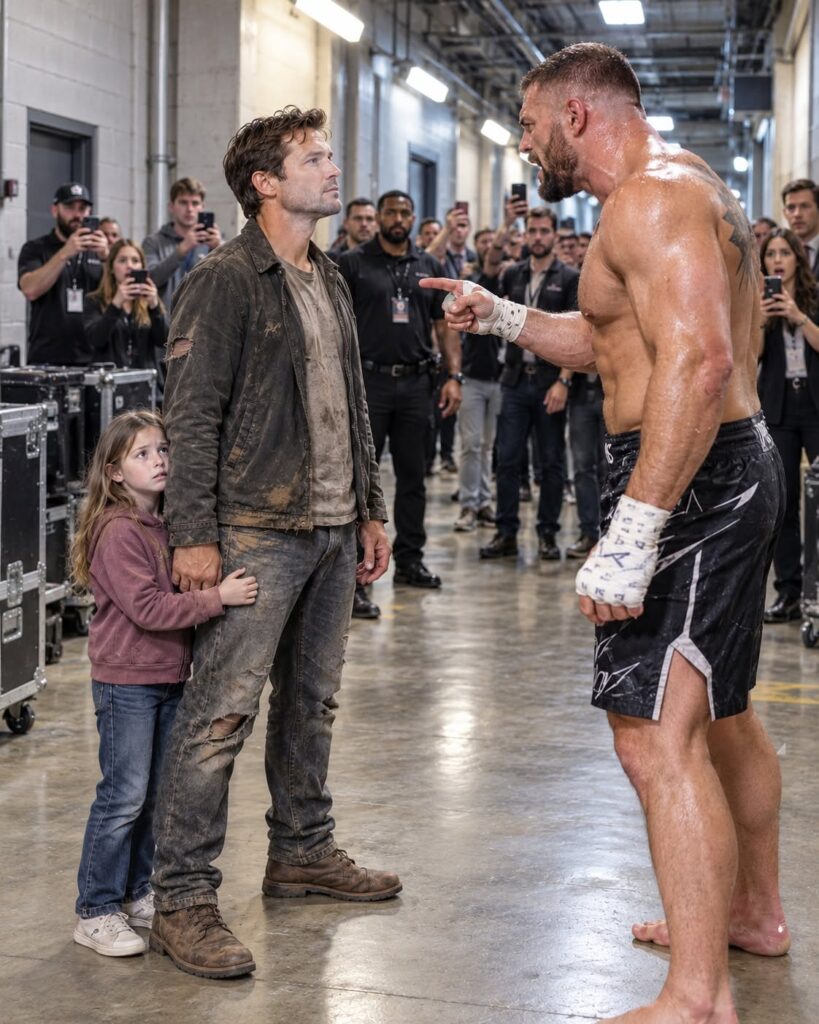
She was reading the back of the menu like it was a novel. She’d been doing that more lately — reading everything, asking questions, filing things away. The case she’d been building about who I actually was had apparently been resolved, but she’d moved on to other cases. Other people. Other mysteries.
“Dad?”
“Yeah.”
“Do you think Rhett Dugan learned anything?”
I considered the question. It was a good one. Better than most adults would have asked.
“I don’t know,” I said. “Maybe. Maybe not. Some people never learn. Some people learn too late.”
“That’s sad.”
“It is.”
She thought about that for a moment. Then she said, “But you learned.”
“I’m still learning.”
She nodded like that made sense. Then she went back to the menu, and I went back to my coffee, and the morning moved on around us like nothing had ever happened.
But something had happened. Something had changed. Not just in that corridor, not just in the arena, not just in the headlines that had come and gone.
Something had changed in the way my daughter looked at me. In the way she asked questions. In the way she waited for answers.
She wasn’t just building a case about who I was anymore.
She was building a case about who she wanted to be.
And I was starting to understand that the most important thing I could teach her wasn’t how to fight.
It was how to choose.
The community center program kept growing. Warren brought in more instructors. The county gave us a grant. A local news station did a feature on us — not about me, not about the corridor, but about the people who came to learn. The single mother who’d been followed home from work three times. The teenager who’d been jumped outside a convenience store. The elderly man who’d been robbed in his own driveway.
They came because they wanted to feel safe. They stayed because they learned something they hadn’t expected.
They learned that safety wasn’t about strength. It was about awareness. It was about understanding the space between you and the person who wanted to hurt you. It was about knowing when to move and when to stand still. When to speak and when to stay silent.
When to fight.
And when not to.
I taught them what my old trainer had taught me, fifteen years earlier, in a gym in Nashville. The opponent decides how much force to bring. You decide what to do with it when it arrives.
I taught them that the ability to hurt someone is not the same thing as a reason to do it.
I taught them that strength gives you a choice, and character is how you make it.
And I taught them that the most powerful thing in the world wasn’t a punch or a kick or a takedown.
It was stillness.
The stillness of a man who has already decided and is giving the other person every possible chance to choose differently.
Sadie started training with me that spring.
Not the way the fighters trained. Not the way I had trained Cal. She was nine years old and she wanted to learn how to be strong, and I wanted to teach her how to be safe. Those were different things, I knew, and I needed to find a way to give her both.
We started with footwork. Simple things. How to stand. How to move. How to keep your balance when someone pushes you.
She was a natural. Not because she had some hidden gift — she didn’t. But because she paid attention. She watched everything. She asked questions. She wanted to understand why something worked, not just how.
“Why do you put your hand there?” she asked, the third week we trained. She was pointing at my wrist.
“Because that’s where his leverage is.”
“So I’m not fighting his strength. I’m fighting his balance.”
“Right.”
She thought about that. Then she said, “That’s like a puzzle.”
“It is.”
“That’s what I said about grappling. When I first started watching. It’s like a puzzle two people are solving at the same time.”
I nodded. “That’s exactly what it is.”
She smiled. The small smile. The one she reserved for things that had confirmed something she already suspected.
“Dad?”
“Yeah.”
“I’m glad you taught me this.”
I didn’t say anything. I didn’t need to. We just kept training.
The following summer, Warren called me with an offer I hadn’t expected.
The national-level promotion that had reached out after the corridor — the one with the biggest numbers, the biggest names, the biggest everything — had come back. They wanted to sponsor the community center program. Full funding. Equipment. A permanent space. All they asked in return was that I let them use my name.
I told Warren I’d think about it.
I thought about it for three days. I thought about what it would mean to have my name attached to something that big again. I thought about the fighters I’d trained. The ones who’d won titles. The ones who’d gotten hurt. I thought about Cal.
And then I thought about Sadie. The way she looked at me when she thought I wasn’t watching. The way she asked questions. The way she waited for answers.
I called Warren back and told him no.
“Why?” he asked. Not arguing. Just asking.
“Because it’s not about me,” I said. “It never was.”
Warren was quiet for a moment. Then he laughed. A short, sharp laugh that sounded like something he’d been holding in for a while.
“Grant,” he said, “you might be the only person I’ve ever met who actually understands what this is supposed to be about.”
“I don’t understand it,” I said. “I’m just trying to.”
The program got the funding anyway. Warren found a different sponsor. A local foundation. Someone who wanted to help without needing their name on the door.
The room stayed small. The classes stayed free. The people kept coming.





