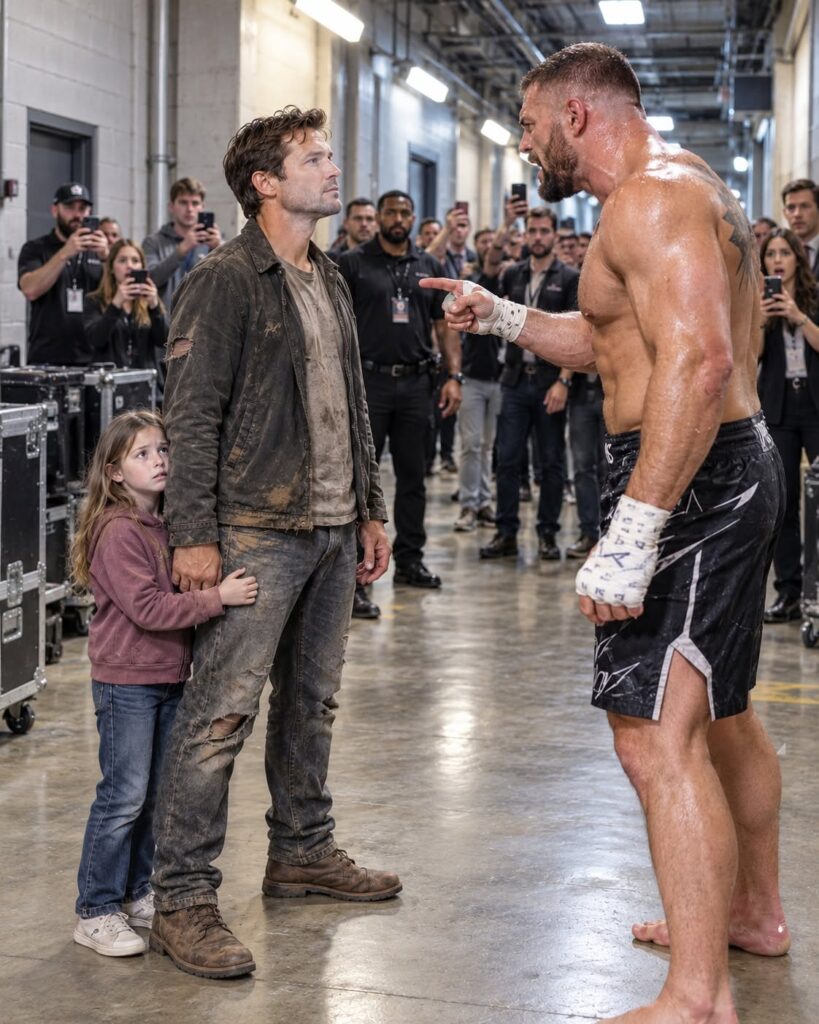
Near the end, the reporter asked why I had allowed Rhett to push me twice before doing anything — given what I was clearly capable of.
I looked past the reporter for a moment. Sadie was standing about fifteen feet away, out of the frame, wearing her coat and her backpack because we were going to get dinner after this. She met my eyes and gave me the small, specific look that meant she was paying attention.
I turned back to the reporter and said that the ability to hurt someone is not the same thing as a reason to do it.
“Strength gives you a choice,” I said. “Character is how you make it.”
The reporter wrote it down.
It was the sentence that ended up in every piece that ran afterward. Reproduced more than any part of the footage or any detail of the incident. Shared by people who had never heard of Rhett Dugan or Hawthorne Crown Arena and had found it entirely out of context.
I did not find this surprising.
It was the most accurate thing I had said in a long time.
The room at the community center that Warren had arranged was small and smelled like rubber flooring and old paint. It held about twenty people comfortably and had been holding twenty-three since the program’s third week.
There were no spectators. No cameras. No noise from outside. There was a mat on the floor and a whiteboard on the wall and a group of people who had come because they wanted to understand something that I had spent fifteen years learning and six years waiting to find the right use for.
The first session, I stood in front of them and didn’t know what to say.
I’d spent years teaching fighters. Elite athletes. People who already knew how to move, how to fight, how to win. This was different. These were parents who’d never thrown a punch. Teenagers who flinched when someone raised their voice. Women who’d been taught their whole lives that their bodies were something to be protected rather than understood.
I looked at them and realized I wasn’t there to teach them how to fight.
I was there to teach them how to stand.
“The first thing you need to know,” I said, “is that you don’t have to be stronger than someone to be safe from them. You don’t have to be faster. You don’t have to be tougher. You just have to understand what they’re giving you.”
A woman in the back row — mid-forties, tired eyes, arms crossed — spoke up. “What does that mean?”
“It means every person who tries to hurt you makes a choice. They decide how to approach you. They decide where to put their weight. They decide how close to get. And every one of those choices gives you something. An angle. A moment. A way out.”
I stepped onto the mat.
“Most people think self-defense is about fighting back. It’s not. It’s about recognizing the moment when you don’t have to.”
The program grew.
By the end of the first month, we had a waiting list. By the end of the second, we had to add a second session. Warren handled the logistics. I handled everything else.
Sadie sat at the edge of the mat on the last session of the first month. Her back straight. Her eyes moving the same way they moved when something had her full attention.
When the session ended and the room cleared, she crossed the mat toward me.
“Dad?”
“Yeah.”
“Are you going to teach me?”
I said of course I was.
She considered the next question for a moment before committing to it — the way she considered most things.
“Are you going to teach me how to do what you did? The five-second thing?”
I looked at my daughter. Leah’s eyes. My stubbornness. A laugh that arrived without announcement and changed every room it landed in.
I crouched down to her level — the way I had done since she was small enough that the distance between us required it, even though she was getting to the age where it no longer technically did.
“No,” I said.
She took that in. “Then what are you going to teach me first?”
I put a hand on her shoulder.
“How to recognize when you don’t need to.”
Sadie was quiet for a moment. Then she smiled. Not the big arriving-without-warning smile. But the smaller one she reserved for things that had confirmed something she had already suspected.
She turned and picked up her backpack from the corner where she had left it.
And I stood up and watched her go.
And the room around us was quiet and small and exactly the right size for what it was being used for.
The five seconds in that corridor were the smallest part of what had actually happened that night.
Anyone who watched the full four minutes and thirty-seven seconds understood that the real story was in the minute before the takedown. And the minute before that. The three words given one at a time. Each one a door, held open for a man who kept choosing not to walk through it.
I was not strong because I could put someone on the floor in five seconds.
I was strong because I had spent nine years building the kind of person who understood that having that ability and using it were two entirely different decisions. And that the space between those decisions was where character actually lived.
That was what Sadie had been watching all along.
She had just needed the whole story to know that’s what she was seeing.
Three months after the corridor, I took Sadie to a diner for breakfast. Just the two of us. It had become a Saturday thing. She ordered pancakes with extra syrup and I ordered coffee and eggs and we sat in a booth near the window and watched the town wake up.





