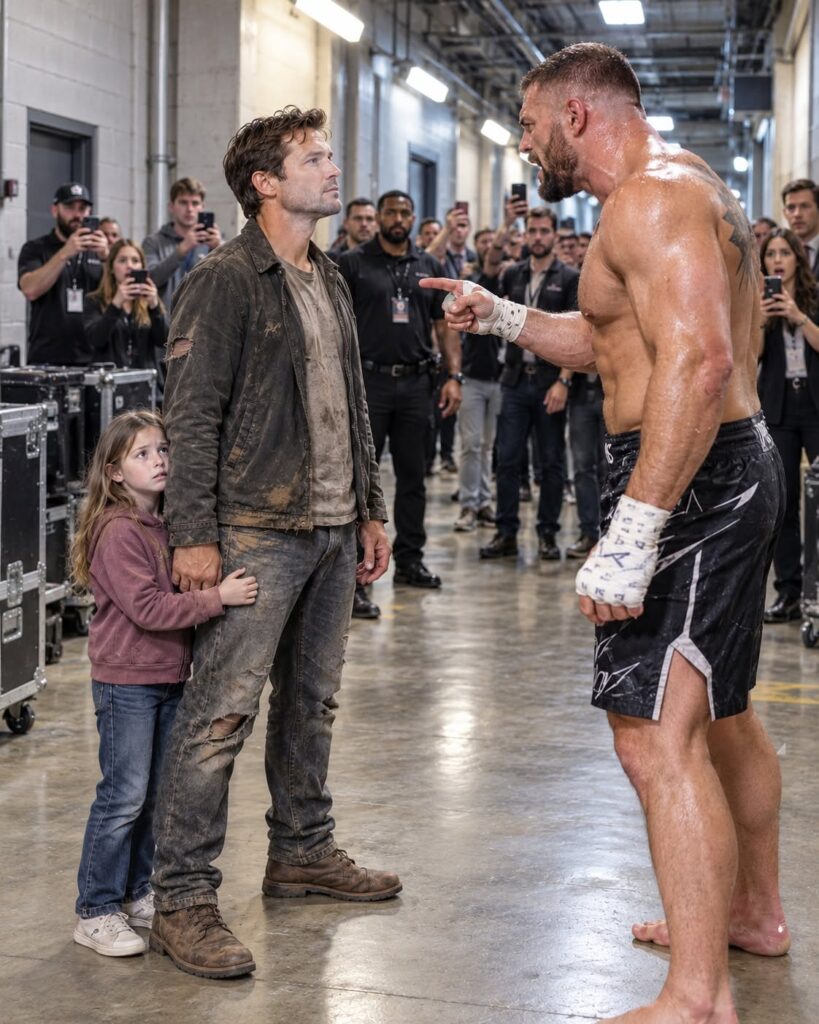
She waited. I could see her organizing what she knew, sorting it into piles, looking for the piece that didn’t fit. She’d been doing this her whole life. I’d watched her do it with teachers, with neighbors, with the world. I just never thought I’d be the one she was trying to figure out.
“I saw what you did,” she said. “I saw the whole thing. You didn’t even look scared. You just looked… like you were waiting.”
“I was.”
“For what?”
“For him to stop.”
She thought about that. “But he didn’t.”
“No.”
“So you made him.”
“I gave him three chances. He used them all.”
She was quiet for a long moment. Then she said something that stopped me cold.
“Was that the first time?”
I didn’t answer right away. I didn’t know how to answer a nine-year-old who was asking if her father had ever hurt someone before. I didn’t want to lie. I’d already done enough of that.
“No,” I said. “But it was the first time in a long time.”
She nodded slowly, like that made sense to her. Like she’d already worked out most of the answer and just needed me to confirm it.
“Okay,” she said. And then she picked up her spoon and finished her cereal.
That was it. That was the whole conversation. She went to school. I drove her. We didn’t talk about it again. But I could feel her watching me the whole way, the same way she watched fighters on television — tracking something, waiting for a pattern to emerge.
Warren Pike showed up at the house two mornings after the access card stopped working.
I heard the knock and knew before I opened the door that it wasn’t going to be a short conversation. Warren was the kind of man who did things in person when they mattered. The fact that he was standing on my porch at 8:45 in the morning with his hands in his coat pockets and no particular apology on his face told me everything I needed to know about why he was there.
I let him in.
Sadie was at the kitchen table with a bowl of cereal and a library book she wasn’t reading. She looked at Warren the way she looked at most adults who appeared in her environment without prior introduction — polite attention and complete assessment.
“This is Warren Pike,” I said. “We worked together a long time ago.”
Warren nodded at her. “I heard you’re a serious MMA fan.”
“I am,” Sadie said.
“What’s your favorite weight class?”
“Lightweight. But I like grappling better than striking.”
Warren glanced at me, then back at her. “Your dad teach you that?”
“He didn’t teach me anything,” Sadie said. “I figured it out.”
Warren smiled. It was a small smile, but it was real. “Yeah,” he said. “That tracks.”
He sat down at the table. Looked at me. Then at Sadie. Then back at me.
“There’s something you need to know,” he said.
I waited.
“The arena has a security system that covers the full length of the corridor. The footage from those cameras is sitting with the event organization’s legal team. It can be requested through the formal inquiry process.”
I looked at my hands on the table.
“Carol Finch at the sports center has already been in contact with the organization,” Warren continued. “She’s prepared to file that request the moment you give the word. She’s been waiting for two days.”
“I’m not sure I want to turn this into something larger than it already is.”
Warren let that sit for a moment. Then he said, “Grant, the question of whether it’s already large was settled without your input. The only remaining question is whether you’re going to let someone else’s version of events define it permanently.”
He said it without impatience. Not pushing. Just placing it on the table between us, the way you place something down when you want someone to actually look at it.
Sadie had stopped pretending to read her book. She was watching me.
Warren looked at her. Then back at me. And he said something I hadn’t expected.
“She deserves to hear the real reason you left. And she deserves to hear it from you. Not from an interview, not from a comment section, not from someone who’s only ever known part of the story.”
The kitchen was quiet.
“If you haven’t found a way to say it yet,” Warren said, “maybe now is when that needs to happen.”
I looked at my daughter. She looked back at me. She didn’t say anything. She didn’t need to. She’d been waiting for this longer than I had.
I told Warren he was right.
I told her about Cal Brennan.
Not as a cautionary tale. Not as a confession. But as a thing that had happened to a real person that I had been inside of and had never fully gotten outside of since.
Cal came into the gym at twenty-three with more raw talent than anyone I’d worked with up to that point. He was fast. He was strong. His instincts in the cage were the kind you couldn’t teach — they came from somewhere the technical work only organized. It didn’t create them. It just gave them somewhere to go.
I spent two years helping shape that into something Cal could deploy consistently. It was some of the best work I’d ever done. And I knew it at the time, which was part of what made what followed as difficult as it was.
The closer Cal got to the fights that actually mattered, the more the people around him began to treat concern for his physical state as something to manage rather than respond to. There was money involved. There was momentum. There was a timeline that a lot of careers depended on. And Cal himself was twenty-five years old and certain of his own indestructibility in the way that twenty-five-year-olds sometimes are when they haven’t yet been shown otherwise.





