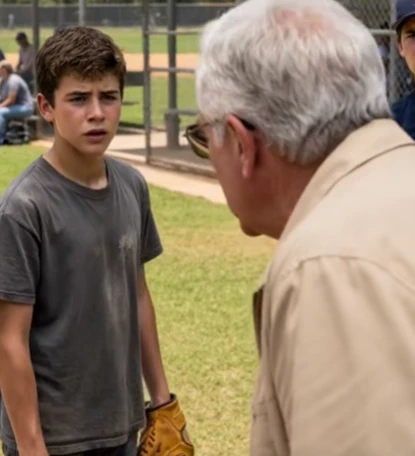
Ray considered that.
Then he nodded.
“Maybe that was the problem.”
Franklin smiled sadly.
“Maybe now there are three of us.”
Ray finally took the card from Caleb, looked at it, then handed it back to the boy.
“Your door,” he said.
Caleb held it like it was made of glass.
Over the next few weeks, things changed slowly.
Not magically.
Caleb did not become famous overnight.
No news cameras came to his house.
No professional team appeared with a suitcase of money.
Ray would not have allowed it if they had.
Instead, Caleb received proper shoes from the scholarship fund. Then a plain practice shirt. Then a schedule.
He attended his first real practice on a Tuesday evening with his heart pounding so hard he barely heard Coach Pike call his name.
Some boys still watched him differently.
A few resented him.
Preston avoided him for two practices, then finally tossed him a ball during warmups without saying anything. Caleb caught it, threw it back softly, and that was how peace began between boys who did not yet know how to use better words.
Coach Pike changed too, though not all at once.
He still loved clipboards.
Still loved rules.
Still loved families who paid on time.
But Franklin Hayes attended three practices in a row and watched him closely, and men behave differently when they know someone is measuring more than performance.
One evening, Pike pulled Caleb aside after a bullpen session.
“You’ve got talent,” he said.
Caleb waited.
“In this program, talent is not enough.”
“I know.”
Pike looked surprised.
Caleb continued, “My uncle says talent is just a tool. If you leave it in the rain, it rusts.”
Pike almost smiled.
“He says a lot, your uncle.”
“Yes, sir.”
Pike glanced toward Ray, who was dragging the infield with a small tractor.
“Did he really throw like that?”
Caleb looked at his uncle.
“He still does when his knee isn’t hurting.”
Pike nodded slowly.
“I was out of line that day.”
Caleb looked back at him.
Pike seemed to struggle with the next sentence.
“I should not have dismissed you.”
Caleb said nothing.
Pike cleared his throat.
“And I should not have let the boys mock you.”
That mattered more.
Caleb nodded.
“Thank you.”
It was not friendship.
It was not forgiveness fully formed.
But it was a crack in the wall.
By the end of summer, Caleb had become both a player and a mystery people kept trying to solve.
He pitched carefully, under Ray’s limits.
No breaking balls in games.
Strict pitch counts.
Rest days that Ray enforced like law.
Franklin supported every boundary.
When one assistant coach complained that Caleb could help win a tournament if he threw extra innings, Franklin said, “The boy’s future is not your weekend trophy.”
That sentence traveled through the program quickly.
Ray heard it and later told Franklin, “You’re learning.”
Franklin replied, “Late.”
Ray said, “Late still counts if the boy is safe.”
The real test came in August.
Gulf Coast Premier played in a regional showcase at a larger complex near Tampa. Scouts attended. College coaches stood behind backstops. Parents grew sharper and louder. Every mistake seemed to echo.
Caleb was scheduled to pitch two innings.
Only two.
Ray had agreed.
Franklin had agreed.
Coach Pike had agreed.
But in the sixth inning, with the game tied and two runners on, Pike walked toward Caleb in the dugout.
“How’s your arm?”
Caleb glanced at Ray, who stood near the fence.
“Good.”
Pike lowered his voice.
“I need one more inning from you.”
Caleb’s stomach tightened.
He wanted to say yes.
That was the dangerous part.
He wanted the ball.
He wanted to prove the fence had been wrong.
He wanted the boys to see him as more than the kid who arrived with a mower.
Ray saw the conversation and started toward the dugout.
Before he arrived, Caleb looked at Coach Pike and said, “No, sir.”
Pike blinked.
Caleb’s voice shook, but he kept going.
“I already threw what we agreed. My uncle says the first promise I keep has to be to my arm.”
For a second, Pike looked annoyed.
Then he looked toward Ray.
Then Franklin.
Then the boy standing in front of him, terrified but choosing himself.
Pike exhaled.
“You’re right.”
Caleb could hardly believe it.
Pike turned to another pitcher.
“Jensen, get loose.”
Ray reached the dugout and looked at Caleb.
“Problem?”
Caleb shook his head.
“No.”
Pike glanced at Ray.
“No problem.”
That moment did not make the crowd cheer.
Most people did not notice it.
But Franklin Hayes did.
And for him, it was the most important pitch Caleb did not throw all summer.
Gulf Coast lost the game.
Some parents complained.
Preston’s father said under his breath that winners did not baby arms.
Mrs. Ellison heard him and replied, “Losers break children to win plaques.”
He did not speak to her again.
Later, in the parking lot, Caleb sat on the tailgate of Ray’s old truck, eating a peanut butter sandwich while other families rolled coolers toward SUVs.
Franklin walked over.
“You did something hard today.”
Caleb looked confused.
“I didn’t pitch.”
“That was the hard thing.”
Ray smiled faintly.
Caleb looked down at his sandwich.
“I wanted to.”
“I know,” Franklin said. “That is why it mattered.”
Caleb watched a group of players laugh near the bus.
“Do you think they’ll still respect me?”
Ray leaned against the truck.
“If respect disappears because you protected yourself, it was never respect.”
Caleb nodded slowly.
That night, on the drive home, Ray finally told him the rest of the story.
Not all at once.
But enough.
He told Caleb about the stadium full of people waiting for a championship game he never played.
About the newspaper headline that called him selfish.
About the coach who denied everything.
About the scouts who moved on because baseball always moved on.
About working under a different name because he could not stand strangers asking why he wasted his gift.





