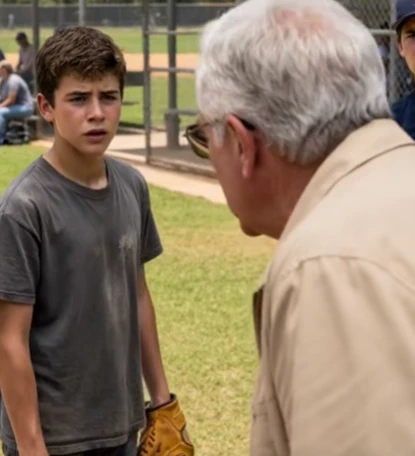
Franklin turned to him.
“Your program also has sponsors.”
“That’s for selected players.”
Franklin’s eyes sharpened.
“Select him.”
Pike looked toward the parents.
A few were watching with interest.
Others with resentment.
Preston’s mother whispered something to another woman and shook her head.
Pike lowered his voice.
“We need to consider fit. Culture. Commitment.”
Ray stepped closer.
“Say money if you mean money.”
Pike’s face hardened.
“That is not what I mean.”
Caleb looked down.
The fence had moved, but it had not disappeared.
Franklin saw it.
So did Ray.
Then a new voice spoke from behind the parents.
“I’ll cover the costs.”
Everyone turned.
A woman in a simple blue blouse stood near the bleachers. She was older, maybe in her sixties, with silver hair pinned back and a sun hat in one hand. She had been sitting quietly beside the third-base fence the entire time.
Coach Pike blinked.
“Mrs. Ellison?”
The woman stepped forward.
“My late husband created the Gulf Coast scholarship fund for players who could not afford travel fees. I have asked three times why that fund sits unused while this program buys new banners.”
Pike’s mouth opened, then closed.
Franklin looked at her with approval.
Mrs. Ellison continued, “If the boy wants to play, the fund will cover him.”
A few parents began murmuring.
Preston’s father crossed his arms.
“With all due respect, this was supposed to be an invitation-only tryout. Our kids earned their spots.”
Mrs. Ellison turned to him.
“And what exactly did they earn before their parents wrote checks?”
The man looked stunned.
She looked toward Caleb.
“That boy was outside the fence working while your sons warmed up inside it. I think he understands earning.”
Caleb’s throat tightened.
Nobody had ever said something like that about him in a place like this.
Coach Pike looked trapped.
Franklin asked Caleb, “Do you want to be evaluated properly?”
Caleb looked at Ray.
Ray did not answer.
He had promised himself he would never push the boy toward baseball.
Never use him to rewrite his own unfinished story.
Never let old pain disguise itself as ambition.
So he did the hardest thing.
He let Caleb choose.
Caleb looked back at Franklin.
“Yes, sir.”
Franklin smiled.
“Then we start with respect.”
He turned toward the dugout.
“You boys who laughed at him.”
Every player froze.
Preston looked away.
Franklin’s voice carried.
“Come here.”
No one moved at first.
Then Preston and two others walked slowly toward the mound.
Coach Pike looked uncomfortable but did not stop it.
Franklin looked at them.
“What did you call him?”
Preston’s face flushed.
No answer.
Franklin waited.
“Lawn boy,” Preston muttered.
Franklin nodded.
“Why?”
Preston shifted.
“I don’t know.”
“That’s not true.”
The boy swallowed.
“Because he was mowing.”
Franklin looked at the mower outside the fence.
“Work is not an insult. Try again.”
Preston’s eyes flicked toward his father, then back.
“Because we thought he didn’t belong here.”
Franklin nodded.
“That is the first honest thing you’ve said.”
The field stayed quiet.
Franklin pointed gently toward Caleb.
“He did belong. You just did not recognize him without a uniform.”
Preston’s face changed.
Shame, when it is real, makes a person look younger.
He turned to Caleb.
“Sorry,” he said.
Caleb studied him.
It was not a perfect apology.
It was not a movie moment.
It was a fourteen-year-old boy learning in public that cruelty sounds smaller when repeated back.
Caleb nodded once.
“Okay.”
Franklin looked at the rest of the team.
“There will be other boys in your life without the right shoes, the right bag, the right ride, or the right last name. Some of them will be better than you. Some of them will need help. Some of them will be carrying more pressure than you can see. If your first instinct is to laugh, baseball has taught you nothing.”
No parent clapped.
Not yet.
The words were too uncomfortable.
But they landed.
The evaluation resumed, but it was no longer the same tryout.
Caleb did not participate in every drill. He had no cleats, no cup, no water bottle, and no expectation that the day would become anything more than work. But Franklin took his information. Mrs. Ellison spoke with Ray. Coach Pike filled out a form with stiff politeness.
Ray signed nothing yet.
He read every line.
Twice.
When the field finally emptied, the sun had dropped lower, and long shadows stretched across the grass.
Caleb and Ray stayed behind.
The mower still waited outside the fence.
The chalk lines were scuffed now.
The parents were gone.
The fancy bats were packed away.
Franklin Hayes remained near home plate, watching the two of them.
Ray picked up the work gloves and handed them back to Caleb.
“You still have to finish.”
Caleb smiled faintly.
“I know.”
They walked back to the mower together.
For a while, neither spoke.
Then Caleb said, “Why didn’t you tell me?”
Ray looked across the empty field.
“Because old stories have hooks.”
“What does that mean?”
“You tell one part, and it pulls out another. Then another. Pretty soon you’re bleeding from places you thought healed.”
Caleb looked down at his gloves.
“Did you ever want to go back?”
Ray took a long breath.
“Every day for the first five years. Then less. Then I met you.”
Caleb looked at him.
Ray smiled softly.
“Your mama needed help. You needed someone to throw to. And I needed a reason not to hate the game.”
Caleb’s eyes filled again.
Ray gently bumped his shoulder.
“Enough crying today. You’ll dehydrate.”
Caleb laughed, wiping his face.
Franklin walked over slowly.
“I’m leaving my card,” he said.
Ray looked at it but did not take it.
Franklin held it out to Caleb instead.
“This is not a contract. Not a promise. Just a door.”
Caleb took the card carefully.
Franklin turned to Ray.
“I should have done more back then.”
Ray looked at the old scout.
“You were one man.”
“So were you.”





