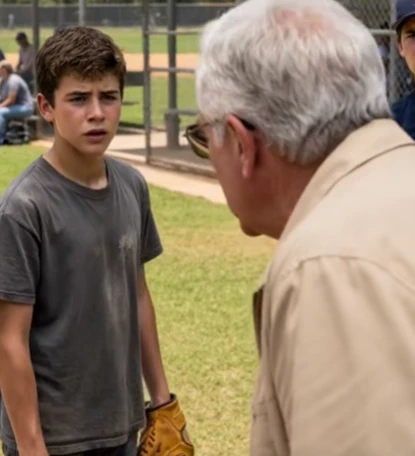
“I remember everyone who stood behind a fence and told me I was going to be rich.”
A few parents shifted uncomfortably.
Franklin nodded as if accepting the blow.
“You were special.”
Ray looked toward Caleb.
“He is a child.”
“I know.”
“No,” Ray said sharply. “You know arms. You know radar numbers. You know draft boards. You don’t know what happens when a boy starts believing strangers before he believes himself.”
The field was silent.
Coach Pike seemed uncertain whether to interrupt.
Franklin lowered his voice.
“I searched for you.”
Ray’s expression changed.
“Why?”
“Because one day you were there, and the next day every person who had promised to protect you said they had no idea where you went.”
Ray’s hand tightened around the hose.
“They knew enough.”
Caleb stepped closer.
“What does that mean?”
Ray looked at him, and the anger left his face.
In its place came the tired love of a man who had hoped to keep a child from inheriting old pain.
“It means adults made promises they had no right to make,” Ray said.
Preston whispered to another boy, “This is weird.”
Franklin heard him.
He turned toward the dugout.
“It is history.”
The boy went quiet.
Coach Pike cleared his throat.
“Mr. Hayes, this is an invite-only evaluation. We can’t just stop everything for a groundskeeper’s nephew.”
Ray’s eyes hardened.
“He is not asking you for anything.”
Caleb looked down.
That was true.
He was not asking.
He had learned not to ask for things that cost money.
Tournaments cost money.
Uniforms cost money.
Private lessons cost money.
Travel teams cost money.
Even opportunity seemed to have a price tag attached.
But Franklin Hayes looked at Caleb like the fence did not exist.
“Do you want to throw?” he asked.
Caleb’s heart jumped.
Ray answered before he could.
“No.”
Franklin did not look away from Caleb.
“I asked him.”
Ray’s voice lowered.
“And I said no.”
The old scout studied Ray carefully.
“You’re still running.”
Ray stepped closer to the fence.
“I’m still protecting.”
“From what?”
Ray laughed once, without humor.
“From men who see a boy throw one ball and immediately start dividing up his future.”
The words hit several fathers near the fence harder than they expected.
Franklin nodded slowly.
“You’re not wrong.”
That surprised Ray.
Franklin continued, “But hiding him behind a mower does not protect him either.”
Ray looked at Caleb.
The boy stood between worlds.
One hand still dirty from work.
One heart pulled toward the field.
His face was careful, but his eyes were not.
His eyes were full of a hunger Ray recognized too well.
The hunger to stand on a mound and discover that your whole body had been built for one impossible motion.
Ray looked away first.
Coach Pike crossed his arms.
“This is wasting time. If the kid isn’t registered, he can’t participate.”
Franklin turned.
“Who invited me here?”
Pike blinked.
“The program did.”
“To evaluate talent.”
“Yes.”
Franklin looked back at Caleb.
“I found some.”
Pike’s face tightened.
“Sir, with respect, he isn’t dressed, he isn’t insured through the session, and he isn’t part of this group.”
A few parents nodded.
One mother whispered, “That’s fair.”
Another father said, “Rules are rules.”
Ray took that opening.
“You heard them,” he said to Caleb. “Come on. We’ve got work.”
Caleb’s face fell so quickly that only someone who loved him would have seen it.
Ray saw it.
That was the problem.
Franklin saw it too.
He put one hand on the fence.
“Raymond, when you disappeared, people told stories. Some said you got scared. Some said you took money. Some said you ruined your own life.”
Ray’s face went still.
Franklin continued, “I never believed them.”
Ray’s voice was barely audible.
“You should have.”
“No.”
“You don’t know what happened.”
“I know enough to know shame has kept you quiet longer than truth ever should.”
Ray looked at him then.
A long, hard look.
The kind of look men share when the past is standing between them, carrying names neither wants to say first.
Caleb whispered, “Uncle Ray?”
Ray closed his eyes.
Then he opened them and looked at the boy he had raised.
“The night before that championship,” Ray said, “my mother got sick.”
Caleb’s expression shifted.
“My grandma?”
Ray nodded.
“She had been hiding it. Hospital bills. Medicine. Missed work. Everything. I was seventeen. Scouts were coming. Reporters were calling the house. Coaches were telling me I had to think about the future.”
He glanced at Franklin.
“Your future,” he said, not unkindly.
Franklin lowered his eyes.
Ray continued, “That night, a man came to our house. Said he represented people who could help. He offered money. Enough to cover treatment. Enough to move us. All I had to do was lose control for one inning in the championship.”
The parents behind the fence went quiet.
Even the boys understood that much.
Caleb’s voice cracked.
“Did you?”
Ray looked at him at once.
“No.”
The answer came so fast it almost hurt.
“No, Caleb. I didn’t.”
He took a breath.
“I went to my coach. Told him what happened. Thought he’d protect me. Instead, he asked how much they offered. Then he told me if I said anything, the whole program would be investigated, the game would be ruined, and my mother’s name would be dragged through the papers.”
Franklin’s face had gone pale.
Ray looked at him.
“So I left.”
Franklin whispered, “You should have come to me.”
“I was seventeen.”
The simple sentence quieted everyone.
Ray continued, “I packed a bag, took my mother to my cousin’s place up north, and disappeared before anyone could use me, blame me, or make me choose between a game and the only family I had.”
Caleb’s eyes filled.
“You gave it all up?”
Ray gave a sad smile.
“No. I lost it before I understood what it was.”
Franklin stepped closer.
“I’m sorry.”
Ray nodded once.
“I believe you.”





