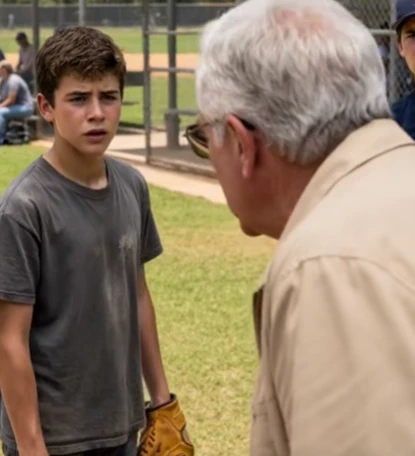
Coach Pike shifted awkwardly.
The boys in the dugout were no longer laughing.
Preston looked at the dirt.
Caleb wiped his face quickly with the back of his glove.
Ray noticed.
“Don’t you cry over my old story,” he said softly.
Caleb looked at him.
“I’m not.”
But he was.
And Ray knew it.
Franklin spoke gently.
“That question I asked your nephew was not about stealing him from you. It was about knowing whether his arm came from instruction or accident.”
Ray looked at him.
“And?”
“It came from love.”
Ray’s jaw tightened.
Franklin turned toward Coach Pike.
“Set up a catcher.”
Pike hesitated.
“Mr. Hayes—”
“Set up a catcher,” Franklin repeated.
The old scout’s voice had changed.
Not louder.
Heavier.
The kind of voice that reminded everyone that he had spent forty years telling powerful baseball men when they were wrong.
Coach Pike glanced toward the parents, then the players.
His pride fought with his fear of looking foolish in front of Franklin Hayes.
Finally, he motioned to the catcher.
“Gear up.”
Ray’s hand shot out and caught Caleb’s shoulder.
“No one is making you do this.”
Caleb looked at the field.
Then at the boys who had mocked him.
Then at the coach who had waved him away.
Then at Franklin.
Then at his uncle.
“I know,” Caleb said.
His voice was quiet.
“But I want to.”
Ray held his gaze.
There were a hundred warnings in his face.
About pressure.
About adults.
About talent becoming a product.
About how the thing you love can turn into something people use to measure your worth.
Caleb understood only some of it.
But he understood the most important part.
His uncle was afraid because he loved him.
“I’ll only throw,” Caleb said. “That’s all.”
Ray slowly let go.
Caleb walked through the gate.
The field felt different under his shoes.
He had stepped onto diamonds before, but usually after everyone left. The grass then was empty. Forgiving. Quiet.
Now every parent watched.
Every player watched.
Every coach watched.
The sun pressed hot against the back of his neck.
He looked down at his clothes.
Faded shirt.
Dusty sneakers.
Work gloves.
He pulled the gloves off and set them near the fence.
Preston’s expensive cleats stood a few yards away.
For the first time, Caleb did not look away from them.
Coach Pike handed him a baseball with reluctant fingers.
“Five pitches,” he said.
Franklin corrected him.
“Ten.”
Pike’s mouth tightened.
“Ten.”
The catcher crouched behind home plate.
Caleb stepped onto the mound.
Not the bullpen.
The mound.
The place he had dreamed about from outside fences.
It felt higher than it looked.
Ray stood just beyond the gate, arms folded, face unreadable.
Franklin stood beside him.
“Does he know how to warm up?” Franklin asked quietly.
Ray almost smiled.
“He knows how to listen to his arm.”
On the mound, Caleb rolled the ball in his hand.
He had no uniform number.
No matching belt.
No clean hat.
No father filming behind the fence.
But he had evenings under lights after everyone went home.
He had Uncle Ray saying, “Balance before power.”
He had buckets of worn baseballs with loose seams.
He had heat, mosquitoes, silence, and thousands of throws nobody clapped for.
He looked in.
The catcher gave no sign.
Caleb breathed out.
Then he threw.
The first pitch missed outside.
But it carried.
The catcher caught it and looked at his glove.
Coach Pike glanced toward the radar gun held by an assistant.
“Eighty-three,” the assistant said.
Several parents straightened.
At fourteen, eighty-three did not sound like a lawn boy.
Caleb took the ball back.
Second pitch.
Strike.
“Eighty-four.”
Third pitch.
A little high.
“Eighty-four.”
Franklin watched the arm action.
Loose.
Clean.
No violence.
No forced motion.
That was what made him stand still.
Velocity could be trained.
Movement could be refined.
But some arms looked like they were fighting the body.
Caleb’s arm looked like water finding downhill.
Ray watched too.
Proud and terrified.
The fourth pitch came in harder.
The catcher’s glove popped.
“Eighty-six,” the assistant said, almost unwillingly.
A murmur ran through the fence.
Preston’s father stood.
Coach Pike removed his sunglasses.
“Throw a breaking ball,” he called.
Ray snapped, “No.”
Everyone looked at him.
Ray stepped inside the gate.
“He’s not throwing breaking balls cold for your entertainment.”
Pike flushed.
“It’s an evaluation.”
“He is fourteen.”
Franklin nodded.
“Fastballs only for now.”
Caleb looked relieved.
Not because he could not throw one.
Because his uncle had stepped in before anyone could take too much.
He threw five more pitches.
Three strikes.
One high.
One inside that made the catcher shift fast and laugh nervously.
The final pitch was the best.
Eighty-seven.
Right at the knees.
The field went silent again.
Not shocked like before.
Aware.
The kind of silence that arrives when people realize they have been looking at someone without seeing him.
Caleb stepped off the mound.
His face was flushed.
His hair stuck to his forehead.
He did not smile until Ray walked toward him.
Then he smiled like a child.
Ray placed one hand on the back of his neck.
“Arm?”
“Good.”
“Shoulder?”
“Good.”
“Head?”
Caleb looked around.
“Loud.”
Ray nodded.
“That’s honest.”
Franklin approached.
“Caleb,” he said, “you have a gift.”
Ray’s hand stayed on Caleb’s shoulder.
Franklin noticed and chose his next words carefully.
“A gift is not a debt. You don’t owe it to me, this coach, those parents, or anyone behind a fence.”
Caleb listened.
“But if you want to learn what it can become, you deserve that chance.”
Coach Pike stepped forward with a forced smile.
“Well, this is certainly unexpected. Caleb, we may be able to get you into our development group. There are fees, of course, but perhaps—”
Ray laughed.
It was not loud.
But it cut.
“There it is.”
Pike looked offended.
“Excuse me?”
“You saw one throw and found a price tag.”
Pike’s cheeks reddened.
“Our program has costs.”





