Because her mother had said them countless times when Maya was little.
Now she said them with no memory of having ever taught her daughter to draw.
Maya gently took her hand.
“Thank you, Mom.”
For a few seconds, they sat together in silence.
Then her mother looked at the portrait again.
“She has kind eyes.”
Maya began to cry.
Her grandmother stepped closer.
The woman reached toward Maya’s face.
“Oh, honey. Why are you crying?”
Maya shook her head.
“It’s nothing.”
Her mother squeezed her hand.
“Don’t cry. You’re safe here.”
Maya closed her eyes.
It was something her mother used to say when she was a child.
She did not know whether the words came from memory or instinct.
She did not know whether her mother recognized anything about the moment.
But she held on to her hand.
And for the first time in a long while, she stopped trying to make her mother remember.
She simply stayed beside her.
The Exhibition
Three weeks later, the Westbridge winter exhibition opened to the public.
The academy’s main gallery was filled with visitors, students, teachers, and local artists.
Paintings covered the walls.
Sculptures stood beneath carefully positioned lights.
Photography collections occupied the adjoining rooms.
Near the center of the portrait gallery hung Maya’s charcoal drawing.
It had a simple black frame.
Beneath it was a small label.
“Before She Forgot Me”
Charcoal on Paper
Maya Bennett
There was no long explanation.
No dramatic biography.
No description of the illness.
Maya had chosen to let the portrait speak for itself.
Visitors stopped in front of it throughout the evening.
Some admired the shading.
Others commented on the expression.
One woman stood there for nearly ten minutes before quietly wiping her eyes.
Maya watched from across the room.
Her grandmother stood beside her.
“Are you nervous?” she asked.
“A little.”
“Why?”
Maya looked toward the portrait.
“Because people are looking at her.”
Her grandmother smiled.
“That’s what you wanted, isn’t it?”
Maya considered the question.
Then she nodded.
“Yeah.”
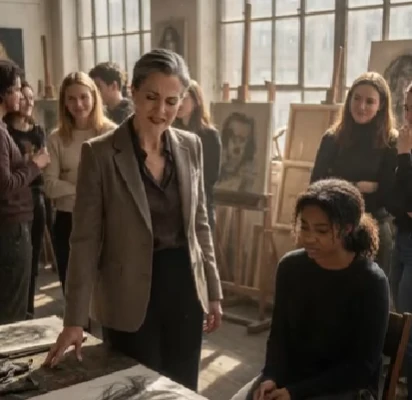
A few minutes later, Professor Whitmore approached.
She wore a dark blazer and carried an exhibition program.
“Maya.”
“Professor.”
Whitmore looked toward the portrait.
“The selection committee spent a long time discussing your work.”
Maya felt her stomach tighten.
“Is that bad?”
“No.”
The professor smiled.
“They were particularly interested in the expression.”
Maya glanced toward the drawing.
Whitmore continued.
“One of the judges said the portrait felt like someone listening.”
Maya covered her mouth.
Her grandmother turned away, already crying.
The professor looked at her gently.
“I thought you should know.”
What the Teacher Finally Understood
Later that evening, after most visitors had left, Whitmore remained in the gallery.
She stood before Maya’s portrait.
For years, she had believed that the most important responsibility of an art teacher was to identify weaknesses and correct them.
She still believed that technical discipline mattered.
She still believed that students needed honest criticism.
But she now understood something she had overlooked.
Honesty did not require humiliation.
Precision did not require cruelty.
And authority did not excuse careless assumptions.
A teacher could challenge a student without embarrassing them.
A teacher could demand excellence without questioning their integrity.
A teacher could recognize technical imperfections while still respecting the intention behind a work.
Whitmore looked at the portrait again.
The woman’s head tilted slightly.
Her smile was uneven.
Her eyes seemed warm.
The very details Whitmore had initially criticized were now the details she remembered most clearly.
She thought about Maya standing beside the table, trying to explain why the face mattered.
She remembered the girl’s shaking voice.
And she remembered the question she had been unable to answer.
“Would you have believed I made it myself?”
Whitmore lowered her eyes.
She could not undo that afternoon.
But she could choose to teach differently.
The following semester, she changed the format of her critique sessions.
Before offering technical criticism, she began asking students one question.
“What were you trying to preserve?”
Sometimes the answer was a memory.
Sometimes it was an emotion.
Sometimes it was nothing more complicated than a particular quality of light.
But she listened.
And the classroom gradually became a place where students could explain their intentions without fearing that vulnerability would be used against them.
The Girl Who Refused to Let a Memory Disappear
Maya did not become famous overnight.
No major gallery offered her a contract the next morning.
No wealthy collector arrived with an extraordinary check.
Her life remained complicated.
She still helped her grandmother with household expenses.
She still visited her mother.
She still struggled with difficult assignments and occasionally received disappointing grades.
But something had changed.
She no longer believed that every criticism meant she was incapable.
She had learned that her work could be imperfect and still meaningful.
She had learned that speaking up did not require shouting.
And she had learned that she did not need to reveal every painful part of her life to deserve basic respect.
The portrait eventually returned home after the exhibition.
Maya hung it above her desk.
Every morning, before leaving for school, she looked at it.
Sometimes she noticed a flaw she wanted to correct.
A shadow that could have been softer.
A line that could have been more precise.
A proportion that might have been adjusted.
But she never changed it.
Not because she believed it was perfect.
Because it belonged to a particular moment in her life.
A moment when she had been terrified of forgetting.
A moment when she had gathered fragments of memory and turned them into something she could hold.
The drawing did not restore her mother’s memories.
It did not cure her illness.
It did not return their family to the way things had been.
But it preserved something that mattered.
And that was enough.
The Moment Everyone Remembered
Years later, some of the students who had been present during that classroom confrontation would remember the portrait.
Others would remember the professor’s laughter.





