The Assignment That Changed Everything
Three weeks before the confrontation, Whitmore announced the final portrait project.
Each student would create a large charcoal drawing of a human face.
The portrait had to demonstrate anatomical accuracy, controlled shading, and emotional expression.
The work would account for forty percent of the semester’s final grade.
Students were allowed to select their own subjects.
Most chose professional models or carefully lit photographs.
One student hired a photographer to create reference images.
Another used a portrait of her father taken during a family vacation in Italy.
Maya chose her mother.
Not the woman her mother had become.
Not the tired patient sitting beside a hospital window.
She wanted to draw the woman she remembered from childhood.
The woman who danced in the kitchen while making breakfast.
The woman who braided Maya’s hair before school.
The woman who sang terribly but enthusiastically during long car rides.
The woman who used to say, “If you look closely enough, every face tells you a story.”
There was only one problem.
Maya no longer had a clear photograph of her mother from those years.
Most of their family photographs had been lost during a move.
The remaining pictures showed her mother after the illness had already begun changing her appearance.
So Maya decided to draw from memory.
At first, she thought it would be easy.
She remembered her mother’s eyes.
Her smile.
The way her hair framed her face.
But when she sat down with a blank sheet of paper, she discovered something terrifying.
The details were fading.
She could remember her mother’s voice more clearly than the shape of her nose.
She remembered the warmth of her hand but struggled to recall the exact curve of her lips.
Some nights, she stared at the paper for hours without drawing a single line.
Other nights, she worked until sunrise.
She erased entire sections.
Started over.
Changed the eyes.
Redrew the mouth.
Then erased it again.
Her grandmother occasionally found her asleep at the kitchen table, charcoal dust covering her fingertips.
One morning, she placed a blanket over Maya’s shoulders and studied the unfinished portrait.
“That’s your mother,” she whispered.
Maya opened her eyes.
“Does it look like her?”
Her grandmother was quiet for a long time.
Then she touched the edge of the paper.
“It looks like the way she looked at you.”
Maya began to cry.
It was the first time in weeks she believed she might finish the drawing.
Eleven Nights and One Face
By the final week, Maya had stopped answering messages from her classmates.
She went to school, came home, helped her grandmother prepare dinner, and returned to the portrait.
She worked beneath a small desk lamp.
The apartment was quiet except for the refrigerator humming in the kitchen and the occasional sound of traffic outside.
She paid particular attention to the eyes.
Her mother had always looked at her with an expression Maya could never fully describe.
It was not simply happiness.
Not exactly pride.
It was a kind of tenderness mixed with worry, as though her mother understood that the world could be difficult but wanted Maya to feel safe inside it.
Maya tried to capture that expression.
She shaded beneath the eyes.
Softened the cheekbones.
Adjusted the shadows near the mouth.
Then she stepped back.
Something was missing.
She returned to the drawing.
Hours passed.
At two in the morning, her grandmother entered the room.
“Maya, sweetheart. You need sleep.”
“Just one more thing.”
“You said that yesterday.”
Maya smiled faintly.
Her grandmother looked at the portrait.
For several seconds, she said nothing.
Then she sat down.
“Your mother used to tilt her head when she listened to you,” she said.
Maya looked up.
“What?”
“When you were little. You talked so fast she could barely follow you. She’d tilt her head just a little, like this.”
Her grandmother demonstrated.
Maya stared at her.
Then she turned back to the portrait.
She made one small adjustment.
A slight angle.
Barely noticeable.
But suddenly, the face seemed alive.
Maya dropped the charcoal.
Her grandmother covered her mouth.
“Oh, baby.”
Maya’s eyes filled with tears.
“That’s her.”
For the first time since beginning the assignment, Maya felt that she was looking at her mother again.
Not a perfect photograph.
Not an exact reproduction.
But something she had feared was gone forever.
A memory made visible.
She carefully covered the drawing with protective paper.
And the next morning, she carried it to Westbridge.
The Critique Begins
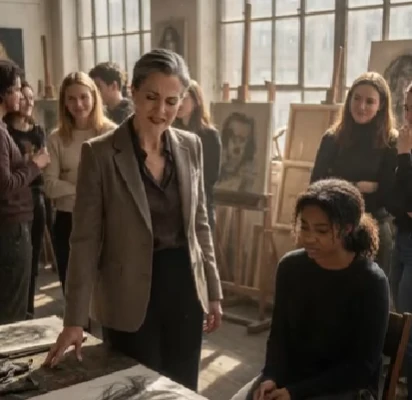
The studio was crowded when Maya arrived.
Sunlight streamed through the enormous windows, illuminating floating dust and the rows of easels.
Students gathered around the main worktable.
Finished portraits lay across the surface.
Whitmore moved from one drawing to another, offering observations.
“Excellent tonal control.”
“Strong composition.”
“Your proportions need work.”
“Better. Much better.”
When she reached Maya’s portrait, she stopped.
She looked down.
Then she looked at Maya.
“Miss Bennett.”
“Yes, Professor?”
“Would you explain what I’m looking at?”
“A portrait.”
Whitmore raised an eyebrow.
“I can see that.”
A few students smiled.
Maya swallowed.
“It’s someone important to me.”
“That is not what I asked.”
The professor pointed toward the face.
“Your reference material?”
“I didn’t use a photograph.”
Whitmore paused.
“You didn’t use a photograph?”
“No.”
“A live model?”
“No, ma’am.”
“Then what exactly did you use?”
Maya looked at the drawing.
“My memory.”
The professor stared at her.
Then she laughed.
Not loudly at first.
Just a short, disbelieving sound.
But the room was quiet enough that everyone heard it.
“Your memory?”
Maya nodded.
Whitmore looked toward the other students.
“Class, this is why we discuss the importance of reliable references.”
Maya felt her face grow hot.
The professor continued.
“Memory is notoriously unreliable. Particularly when you’re attempting anatomical precision.”
She gestured toward the portrait.
“Look at the eyes. The proportions. The unusual softness around the mouth.”
Maya wanted to explain.
But Whitmore was already speaking again.
“This is what happens when emotional attachment interferes with objective observation.”





