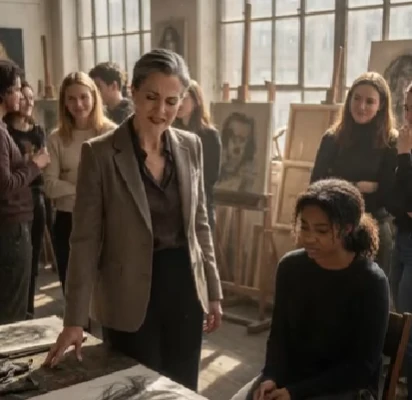
A tear fell onto the wooden table.
“So I started drawing what I could remember.”
She looked toward the professor.
“Every night, I tried again. Sometimes I’d draw her eyes, and they wouldn’t look right. Sometimes I’d finish the whole face and realize it looked like a stranger.”
She gave a small, painful laugh.
“I thought that meant I wasn’t good enough.”
Whitmore looked down.
Maya continued.
“Then my grandma told me something. She said my mother always tilted her head a little when she listened to me.”
She pointed toward the portrait.
“That’s why her face isn’t perfectly symmetrical.”
The professor’s eyes moved toward the angle of the woman’s head.
“And the mouth?” Whitmore asked quietly.
Maya looked surprised by the question.
“She smiled more on one side.”
The professor studied the drawing again.
For the first time, she seemed to be looking at it differently.
Not as a collection of technical decisions.
But as a person.
The Question That Broke the Silence
Whitmore took a slow breath.
“Why didn’t you tell me?”
Maya looked at her.
The question seemed almost impossible to answer.
“Would it have changed anything?”
The professor said nothing.
Maya continued.
“If I’d told you she was sick, would the drawing have been better?”
Whitmore looked down.
“No.”
“Would the proportions have been more correct?”
“No.”
“Would you have believed I made it myself?”
That question remained unanswered.
Maya nodded slowly.
“That’s why.”
The room was completely silent.
Then Maya said something that made several students begin to cry.
“I didn’t want you to give me a good grade because you felt sorry for me.”
Her voice shook.
“I wanted you to look at the drawing.”
She glanced at the portrait.
“Just look at it.”
Whitmore stood motionless.
Maya took another breath.
“I know it isn’t perfect. I know there are mistakes. I know I still have a lot to learn.”
She looked directly at the professor.
“But I drew the only face in the world I was afraid of losing.”
No one laughed.
No one reached for a phone.
No one whispered.
For the first time that afternoon, the entire class seemed to understand why the portrait mattered.
The Professor Looked Again
Eleanor Whitmore had spent more than two decades evaluating art.
She knew how to identify weak compositions.
She could recognize careless shading from across a room.
She had trained herself to notice errors before anything else.
But as she looked down at Maya’s portrait, she realized that she had spent the entire critique searching for what was wrong.
She had not asked what the artist was trying to communicate.
She had not considered why certain details might have been preserved deliberately.
And she had accused a student of dishonesty without evidence.
Whitmore moved closer to the table.
“May I?” she asked.
Maya hesitated.
Then she nodded.
The professor carefully lifted the drawing.
She examined the eyes.
The slightly uneven smile.
The gentle tilt of the head.
The delicate shadows around the cheeks.
For several seconds, she did not speak.
Then she placed the portrait down.
“Your mother has very kind eyes.”
Maya’s face crumpled.
“She did.”
Whitmore looked at her.
“I’m sorry.”
The words were quiet.
Almost too quiet for the students near the windows to hear.
Maya stood still.
The professor continued.
“I was wrong to question whether you created this work without evidence. And I was wrong to dismiss the choices you made before understanding them.”
Maya looked down.
Whitmore glanced toward the class.
“Technical criticism has a place in art education. But criticism without curiosity can become something else entirely.”
She turned back to Maya.
“I forgot that today.”
An Unexpected Request
The professor stood beside the portrait for another moment.
Then she asked, “Would you allow me to keep this on display during the student exhibition?”
Maya blinked.
“What?”
“The winter exhibition. I’d like this portrait to be included.”
Several students exchanged surprised looks.
Whitmore continued.
“I won’t promise it an award. The exhibition has an independent selection committee.”
She paused.
“But I believe this work deserves to be considered.”
Maya looked at the drawing.
For weeks, she had imagined taking it home and hanging it above her mother’s old desk.
She had never expected anyone else to want to see it.
“Can I think about it?”
“Of course.”
Maya hesitated.
“There’s something I need to do first.”
Whitmore nodded.
“What is it?”
Maya touched the portrait.
“I want to show it to my mom.”
The professor said nothing.
Maya gave a small smile.
“Even if she doesn’t recognize herself.”
The Visit
Two days later, Maya carried the portrait into a long-term care facility on the other side of the city.
Her grandmother walked beside her.
They passed a nurses’ station, turned down a quiet hallway, and stopped outside a room with pale yellow curtains.
Maya’s mother sat near the window.
Her hair had grown thinner.
Her movements were slower.
She was looking at a small bird perched on the railing outside.
“Hi, Mom,” Maya said.
The woman turned.
She smiled politely.
“Hello, sweetheart.”
Maya felt the familiar ache in her chest.
Her mother used that word with almost everyone now.
Sweetheart.
It had once belonged to Maya.
Now it belonged to strangers too.
Maya sat beside her.
“I brought you something.”
Her mother looked curious.
Maya carefully removed the protective paper.
The charcoal portrait appeared beneath it.
For a moment, her mother did not react.
She simply stared.
Then she leaned forward.
Her eyes moved across the drawing.
The hair.
The cheeks.
The mouth.
Finally, she touched the edge of the paper.
“That’s a pretty lady,” she whispered.
Maya smiled through her tears.
“Yeah.”
Her mother continued looking.
“She looks happy.”
Maya nodded.
“She was.”
The woman studied the portrait for another moment.
Then she looked at Maya.
“Did you make this?”
“Yes.”
Her mother smiled.
“You’re very talented.”
Maya lowered her head.
Those words should have made her happy.
And they did.
But they also hurt.





