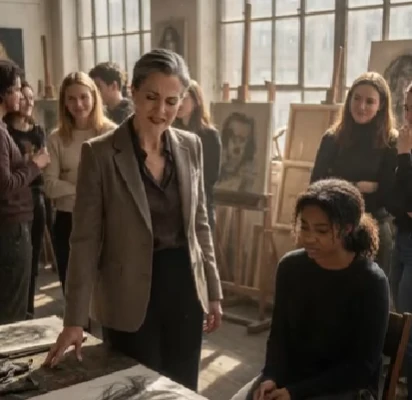
Someone near the windows laughed nervously.
Maya stared at her hands.
The professor leaned closer.
“And I must ask whether you actually produced this yourself.”
That question hurt more than the criticism.
Maya looked up sharply.
“I did.”
Whitmore tilted her head.
“Then perhaps you’d like to explain how a student who struggles with basic proportional exercises suddenly produces this level of detail.”
Maya’s voice became firmer.
“I worked on it every night.”
“That doesn’t answer my question.”
“Yes, it does.”
The room went still.
It was the first time most of the students had heard Maya challenge the professor.
Whitmore straightened.
“Excuse me?”
Maya’s heart was pounding.
But she did not look away.
“I drew it myself.”
The Drawing Turned Upside Down
Whitmore reached toward the portrait.
“Then let’s examine it properly.”
She lifted the paper from the table.
Maya instinctively reached forward.
“Please be careful.”
The professor stopped.
“Miss Bennett, I have handled artwork for longer than you’ve been alive.”
“I know. It’s just—”
“Sit down.”
Maya slowly withdrew her hand.
Whitmore turned the portrait slightly, studying the charcoal work beneath the light.
For a moment, her expression became more serious.
The shading was delicate.
The transitions between light and darkness were controlled.
The eyes had an unusual emotional depth.
But instead of acknowledging those qualities, she focused on what she considered inconsistencies.
“The face isn’t perfectly symmetrical.”
Maya whispered, “It wasn’t supposed to be.”
“The left side is different from the right.”
“Yes.”
“Then why didn’t you correct it?”
Maya took a breath.
“Because people aren’t perfectly symmetrical.”
Whitmore’s expression hardened.
“Are you suggesting I don’t understand portraiture?”
“No.”
“Then perhaps you should listen instead of arguing.”
She placed the portrait back on the table.
In the process, the paper rotated, leaving the woman’s face upside down from Maya’s position.
Maya immediately reached out to straighten it.
Whitmore moved her hand away.
“Leave it.”
Maya froze.
The professor looked around the room.
“This is a valuable lesson. Emotional investment can make an artist blind to technical weaknesses.”
A student near the back shifted uncomfortably.
Another lowered her phone.
Maya stared at the upside-down portrait.
For eleven nights, she had carefully protected the paper from damage.
She had carried it through the rain beneath her jacket.
She had refused to eat near it.
She had worked with aching fingers because she was terrified that one day she would no longer remember her mother’s face.
And now it lay upside down on a classroom table while people discussed it as though it were nothing more than a failed assignment.
Something inside her changed.
Not into anger.
Into determination.
The First Time Maya Raised Her Voice
“Professor Whitmore.”
The words were quiet.
Whitmore continued speaking.
“One of the fundamental problems with this approach—”
“Professor.”
The older woman turned.
“What is it now?”
Maya stood.
Her chair scraped against the wooden floor.
Every student looked toward her.
For a moment, Maya struggled to find the words.
She had rehearsed explanations in her head for years.
Why she missed assignments when her mother was hospitalized.
Why she sometimes looked exhausted.
Why she rarely spoke about her family.
Why she could spend hours drawing a stranger’s face but avoided talking about the person she loved most.
She had never known how to explain any of it.
Now, standing in front of the entire class, she realized she could no longer remain silent.
“You asked why I didn’t use a photograph.”
Whitmore folded her arms.
“Yes.”
“Because I don’t have one.”
The professor frowned.
“Surely you have access to a family photograph.”
“Not one from when she looked like that.”
A small silence followed.
Whitmore glanced at the drawing.
“Who is she?”
Maya swallowed.
“My mother.”
The professor’s expression softened slightly, but her voice remained professional.
“Then you should have asked her to sit for you.”
Maya closed her eyes.
For a second, she could not speak.
When she opened them again, tears were gathering.
“She can’t.”
Whitmore hesitated.
“Why not?”
“Because she doesn’t remember who I am.”
No one moved.
The room seemed to shrink around those words.
Maya looked at the portrait.
“My mom got sick when I was fourteen. At first, she forgot little things. Then she started forgetting bigger things.”
Her voice trembled.
“One day, she forgot my birthday.”
She took a breath.
“Then she forgot my name.”
Someone near the windows lowered their head.
Maya continued.
“Last year, I went to visit her, and she asked me if I worked at the hospital.”
Whitmore’s arms slowly fell to her sides.
Maya wiped her cheek.
“She looked right at me. Right into my face. And she didn’t know I was her daughter.”
The professor opened her mouth.
But nothing came out.
The Face She Was Afraid to Forget
Maya stepped toward the table.
She gently turned the portrait upright.
For several seconds, she simply looked at it.
Then she spoke again.
“When I was little, my mom used to draw with me.”
Her voice was steadier now.
“She wasn’t a professional artist. She worked long shifts at a nursing home. Most nights, she came home exhausted.”
Maya smiled through her tears.
“But she would still sit beside me with a pencil.”
The other students listened without interrupting.
“She taught me how to look at faces. She said the most important part of a portrait wasn’t making someone beautiful.”
Maya touched the corner of the paper.
“She said it was making someone recognizable to the people who loved them.”
Whitmore stared at the drawing.
Maya continued.
“When she got sick, I started drawing her more often. At first, I thought I was just practicing.”
Her voice cracked.
“But then I realized something.”
She looked around the room.
“I was forgetting her.”
Nobody spoke.
“I could remember what she sounded like when she laughed. I could remember how she hugged me. I could remember the songs she played in the kitchen.”
Maya pressed her lips together.
“But I couldn’t remember her face clearly anymore.”





