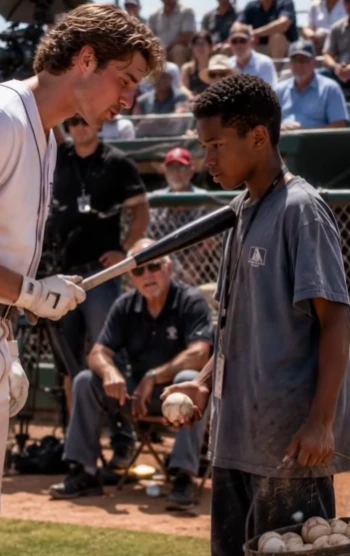
“I will not tell you that one pitch makes you special. It does not. Your mechanics need work. Your balance is poor. You could injure your arm if you keep landing that way.”
Noah looked down at his sneakers.
“They slip.”
“You need proper shoes.”
Angela’s shoulders tightened.
Raymond continued.
“You also need to grow. You need school. You need rest. And you need adults who care more about you than the attention your arm might bring.”
Noah looked at his mother.
Angela’s eyes filled, but she did not look away.
Raymond reached into his pocket and placed a business card on the bench.
“I run a nonprofit pitching program in Tempe. No fees. No agents. No showcase promises. Parents attend every session.”
Angela did not touch the card.
“What do you get?”
“A chance to do one thing better than I did before.”
“And if Noah says no?”
“Then I leave him alone.”
Noah looked at the card.
“Can you teach me Dad’s pitch?”
Raymond shook his head.
“No.”
Noah’s face fell.
“You already know the pitch. I can teach you how not to let it hurt you.”
Angela picked up the card.
She did not agree.
But she did not throw it away.
On Field Four, Tyler Vance faced Isaac Moreno with no music, no announcer, and no camera crew.
Only six scouts stood behind the fence.
Isaac was small for his age, with a loose left-handed delivery and dust across both knees.
He had heard what happened on the main field.
Everyone had.
He looked at Tyler with caution.
“You sure you want to do this?”
Tyler stepped into the box.
“No.”
Isaac almost laughed.
“Then why are you here?”
“Because I should’ve been here this morning.”
Isaac nodded toward Grant, who had finally followed and now stood behind the backstop.
“Your dad said I was dangerous.”
“He says a lot of things.”
Isaac threw the first pitch.
A fastball outside.
Tyler took it.
The second pitch was another fastball.
Tyler drove it into the left-field fence.
The sound was sharp and violent.
For one second, the old confidence returned.
Grant clapped.
“That’s you!”
Isaac received another ball.
His catcher gave the sign.
The third pitch began on the outside edge.
Tyler recognized changeup and waited.
It faded beneath his barrel.
Strike one.
The next pitch looked the same.
Tyler committed early and rolled it weakly toward second base.
Calvin Reed made a note.
Tyler asked for another at-bat.
Isaac struck him out.
Then again.
Then induced another weak ground ball.
Tyler’s weakness was real.
So was his effort.
He stopped making excuses.
After each swing, he asked Isaac what he had seen.
The scouts noticed that too.
By sunset, Tyler’s projected draft status had fallen dramatically.
Two sponsors suspended negotiations.
The streaming company paused the documentary.
Grant’s private training partnership lost its main investor after the video of Noah went viral.
Headlines described Tyler as an entitled prospect exposed by a ball boy.
Some were crueler than necessary.
The internet did what crowds often did.
It turned one person into a hero and another into a target.
Noah did not enjoy it.
Strangers discovered Angela’s name and contacted the concession company.
Reporters waited outside their apartment complex.
People offered donations, equipment, travel-team spots, and interviews.
Several wanted Noah to demonstrate the Falling Star on camera.
Angela refused all of them.
Raymond supported her decision.
He visited once, bringing no scout and no contract.
Only a pair of properly fitted cleats.
Angela made him leave them unopened for a week.
Then Noah joined the Tempe program.
His first session took place on a dusty community field with twelve other children.
No cameras attended.
Raymond did not allow Noah to throw the Falling Star for a month.
He rebuilt the boy’s delivery from the ground up.
Balance.
Foot placement.
Shoulder alignment.
Safe repetition.
Noah hated it.
“Dad let me throw it,” he complained.
“Your father developed it after his body matured.”
“I can already do it.”
“You can also run across a freeway. Ability is not permission.”
Noah glared at him.
Raymond smiled.
“That glare looks like Marcus.”
Angela watched every session from the bleachers.
Slowly, she allowed herself to hope again.
Not for professional baseball.
For something smaller and safer.
That Noah could love the game without being consumed by it.
Tyler’s summer changed too.
His invitation to the national all-star event was withdrawn.
His elite academy removed him from its promotional campaign.
Several teammates stopped calling when the cameras disappeared.
Grant blamed Raymond, Noah, the showcase, the media, and eventually Tyler himself.
“If you had simply left the field when I told you, we could have controlled it,” Grant said one night.
Tyler sat in the indoor batting cage, staring at a machine loaded with changeups.
“You still think the problem was the video.”
“The video cost you millions.”
“My swing cost me the ranking.”
“Rankings change.”
“The way I treated Noah cost me everything else.”
Grant shook his head.
“You apologized. What more do people want?”
Tyler looked at him.
“Maybe they want to know whether I meant it.”
“Meaning does not matter. Perception matters.”
For the first time, Tyler understood how completely his father believed that.
Grant did not see people.
He saw reactions.
He did not see baseball.
He saw leverage.
Tyler stood.
“I’m training with Coach Ramirez.”
Grant’s face tightened.
Luis Ramirez was the high school assistant coach Grant had pushed aside two years earlier for criticizing Tyler’s plate discipline.
“No, you’re not.”
“I already called him.”
“You have professional trainers.”
“I have trainers you pay to agree with you.”
Grant stepped closer.
“Everything you have came from me.”
Tyler looked around the private facility.
The cameras.
The branded equipment.
The enormous photograph of his swing mounted on the wall.
“Then maybe I need to find out what I have without you.”
Grant’s face went cold.
“If you walk away from my program, I stop managing you.”
Tyler picked up his equipment bag.





