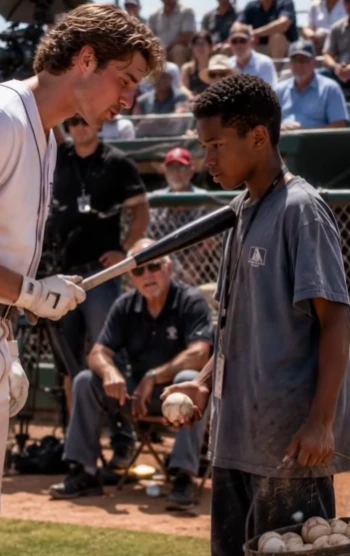
He tried to recover.
“I meant competitively.”
“No, you didn’t.”
Grant lowered his voice.
“Tyler.”
“You taught me to talk to him like that.”
“I taught you not to let distractions interfere with your goals.”
Tyler looked at Noah.
A twelve-year-old wearing worn sneakers and carrying a bucket had revealed more truth about him in three pitches than years of curated showcases.
“You taught me people only mattered if they could help me.”
Grant’s jaw tightened.
“And that lesson gave you everything.”
Tyler removed the white batting gloves from his hands.
He dropped them onto the dirt.
“No. It gave me a highlight reel.”
He walked toward the dugout.
Grant followed.
“Where are you going?”
“To face Moreno.”
Melissa Kane looked up.
“Isaac Moreno is throwing on Field Four.”
“Then that’s where I’m going.”
“There are no cameras there,” Grant said.
Tyler looked back.
“That’s the point.”
He left the main field.
At first, no one moved.
Then three scouts closed their tablets and followed him.
Calvin Reed went next.
Within a minute, nearly half the scout section was walking toward Field Four.
The cameras stayed behind.
Grant stood alone near home plate.
The showcase he had designed around his son’s image continued without him.
Raymond watched Tyler leave.
“He may still have a chance,” Dale said.
Raymond nodded.
“If he learns to fail honestly.”
Noah looked toward Field Four.
“Will he hit that pitcher?”
“Probably not,” Raymond said.
Noah almost smiled.
Angela touched her son’s shoulder.
“We’re going home.”
Raymond put his hat back on.
“May I come with you?”
Angela’s expression closed again.
“No.”
“Then give me ten minutes.”
“You had twenty-two years.”
Noah looked between them.
“You really knew Dad?”
Raymond’s answer came softly.
“Yes.”
Angela closed her eyes.
For years, she had hidden parts of Marcus’s baseball life from Noah.
Not because she was ashamed.
Because hope had hurt their family once before.
Marcus’s dream had pulled him across minor-league towns, temporary contracts, shared apartments, and promises that vanished after injuries.
Angela had watched him work night shifts to afford travel.
She had watched scouts praise his pitch while teams questioned his size.
She had watched one organization use him in an unofficial workout, then deny responsibility when he injured his hand.
When Marcus finally returned home, baseball had become a word they avoided.
He married Angela two years later.
Noah was born.
Marcus worked as a delivery driver and coached his son quietly in public parks.
Then, when Noah was eight, Marcus died in a highway accident during a winter storm.
Afterward, Angela packed his baseballs into a closet.
Noah found them anyway.
He found notebooks filled with grips, diagrams, and handwritten observations.
He found an old video of Marcus throwing to a catcher under weak stadium lights.
He taught himself from those fragments.
Angela had known.
She simply had not asked him to stop.
“Ten minutes,” she told Raymond.
They met in an empty equipment room beneath the stands.
The concrete walls muted the noise from the showcase.
Noah sat on a wooden bench with the baseball still in his hands.
Raymond stood near the door.
Angela remained between them.
“In 2004,” Raymond began, “I was scouting an independent-league game in El Paso. Your father entered in the seventh inning.”
Noah listened without blinking.
“He threw eighty-three miles per hour,” Raymond continued. “No team was looking for an eighty-three-mile-per-hour right-hander. Half the scouts left.”
“You stayed,” Noah said.
“I stayed because the first hitter swung before the ball moved.”
Raymond looked at the baseball in Noah’s hands.
“The pitch looked slow and ordinary until it reached the plate. Then it fell away from the barrel. Marcus struck out five hitters in two innings.”
Angela’s face showed no surprise.
She knew that story.
Raymond continued.
“I arranged a private workout with the Arizona Scorpions organization. Their development director wanted Marcus to sign.”
Noah leaned forward.
“What happened?”
Raymond looked toward Angela.
She answered.
“They changed the workout.”
Raymond nodded.
“The club wanted to see whether Marcus could throw the pitch harder. Their pitching coordinator altered his grip and told him to snap his wrist violently.”
Angela’s voice became tight.
“Marcus said it hurt.”
“They told him discomfort was normal.”
“Then his hand went numb.”
Raymond removed his glasses.
“He damaged a nerve near his wrist. The team physician called it a preexisting issue. The organization withdrew the offer.”
Noah looked down at his own fingers.
“Could he still pitch?”
“Not the same way.”
“Did you help him?”
The question was simple.
Raymond deserved it.
“Not enough.”
Angela folded her arms.
“You wrote one letter.”
“I wrote more than one.”
“To baseball people.”
“Yes.”
“Not to us.”
Raymond accepted that.
“I believed I could fix it inside the system. I thought if I found another team or proved negligence, Marcus would get another opportunity.”
“But he didn’t.”
“No.”
“You stopped calling.”
Raymond’s voice lowered.
“Marcus told me to.”
Angela looked surprised.
“He said he was done being someone’s broken discovery. He asked me not to bring scouts into his life again.”
Noah gripped the baseball.
“Then why are you here?”
“Because I saw his pitch.”
“That doesn’t mean I want scouts.”
“No. It doesn’t.”
Raymond sat on the opposite bench.
“I came to Desert Crown because I heard the showcase was being manipulated for Tyler Vance. I did not expect to see you.”
Angela studied him.
“How did you know Tyler’s events were manipulated?”
“Patterns.”
He explained the withdrawals, selected pitchers, edited footage, and restricted competition.
Raymond had attended because he wanted to see whether Tyler’s talent was real beneath the promotion.
It was real.
Tyler’s bat speed, coordination, and strength were exceptional.
But his weakness had been hidden so carefully that it had never been trained.
Noah’s pitch had exposed both the hitter and the machinery surrounding him.
Raymond looked at Noah.
“I will not promise you a professional career.”
Angela’s expression softened by a fraction.





