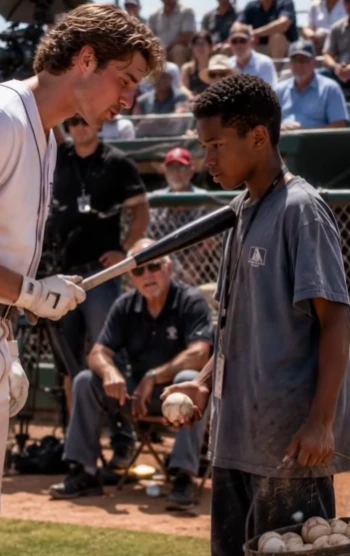
Tyler turned.
“Dad.”
Grant kept his eyes on Raymond.
“This is a circus.”
Raymond nodded.
“It became a circus when your son pointed a bat at a twelve-year-old and invited the cameras to watch him fail.”
The camera operator lowered his lens slightly.
Grant looked toward the production manager.
“Stop recording.”
The production manager hesitated.
Grant had hired the crew to film a promotional documentary, but the showcase organizers also had their own broadcast cameras running.
Even if Grant’s crew stopped, the moment already belonged to the crowd.
Phones filled the stands.
Tyler’s mockery had been captured from multiple angles.
So had his three missed swings.
Tyler looked toward the scouts.
He saw whispering.
Tablets opening.
Notes changing.
The afternoon had been designed to confirm everything people believed about him.
Now every certainty was being reconsidered.
He pointed at Noah.
“He’s throwing illegally.”
Noah’s eyes widened.
Raymond looked at the catcher.
“Check the ball.”
The catcher rolled it across the dirt toward him.
Raymond inspected the surface.
No cuts.
No foreign substance.
No raised seams.
He tossed it to the home-plate umpire, who examined it as well.
“Ball is clean,” the umpire said.
Tyler removed his helmet.
“Then he’s twisting his wrist.”
“That is generally how pitching works,” one scout muttered.
A few people laughed.
This time, the laughter was directed at Tyler.
His face reddened.
Noah heard it and felt no pleasure.
Five minutes earlier, Tyler had been surrounded by teammates.
Now they stood farther away.
People often changed sides quickly when humiliation changed direction.
Noah understood that instinct.
He had seen children at school laugh at someone simply to avoid being chosen next.
He did not want Tyler’s place in the circle.
He wanted to leave.
He stepped off the mound.
“I’m done.”
Raymond watched him.
“You don’t have to throw another pitch.”
Grant seized the moment.
“Good. Clear the field.”
But Raymond was not finished.
He addressed the scouts.
“Pull Tyler’s full swing data. Not the highlight package. Every recorded at-bat from the last eighteen months.”
Grant’s face changed.
“That data is private.”
“Game footage is not.”
“You have no authority to demand anything.”
Raymond looked toward a man seated in the center of the scouting section.
“Cal?”
Calvin Reed, national scouting director for the San Diego Mariners, stood slowly.
“We already have it.”
Grant swallowed.
Calvin lifted his tablet.
“Our analysts flagged something two weeks ago.”
Tyler stared at him.
“What?”
Calvin hesitated.
Raymond answered.
“Your front side commits before you identify the final movement.”
“That’s how power hitters generate torque.”
“That’s how batting-practice hitters generate power,” Raymond said. “Professional pitching punishes decisions made too early.”
Grant stepped between them.
“Tyler has hit ninety-six-mile-per-hour fastballs over four hundred feet.”
“No one doubts his bat speed.”
“He has seven home runs in televised events.”
“Against pitchers selected for him.”
“That is a lie.”
Raymond looked toward the showcase director, Melissa Kane.
She had been standing near the dugout with a clipboard against her chest.
Until that moment, she had hoped the confrontation would end without involving her.
It would not.
“Melissa,” Raymond said, “who selected today’s pitchers?”
Her eyes moved toward Grant.
The answer was visible before she spoke.
“The showcase committee reviewed recommendations.”
“Whose recommendations?”
“Several advisors.”
“Was Grant Vance one of them?”
Melissa looked at the cameras.
“Yes.”
The scouts began talking at once.
Grant’s voice rose.
“I recommended pitchers who would provide a competitive and safe evaluation.”
“Did you reject Isaac Moreno?” Raymond asked.
Melissa’s head lifted.
Grant went still.
Isaac Moreno was a sixteen-year-old left-hander from New Mexico whose best pitch was a fading changeup.
He had originally been listed to face Tyler during the showcase.
His family had driven seven hours to attend.
That morning, they were told Tyler’s session had been reorganized and Isaac would pitch on a secondary field with no camera crew and only two scouts present.
Melissa looked down.
“Yes.”
“Why?”
“Mr. Vance said Moreno’s control created an injury risk.”
A scout near the aisle stood.
“Moreno has walked six hitters all season.”
Another added, “Best control in the Southwest.”
Grant looked toward Tyler.
His son’s face had gone pale.
“I did that to protect you,” Grant said.
Tyler’s voice was low.
“From what?”
“From a meaningless at-bat that could be misinterpreted.”
“You said he wasn’t good enough.”
“He isn’t.”
“Then why didn’t you let me face him?”
Grant did not answer.
Tyler looked toward the mound where Noah had stood.
The truth was beginning to form.
Not a single truth.
Several.
His father had managed his opponents.
His highlight videos had removed his worst swings.
Showcases had been arranged to emphasize fastballs and predictable breaking balls.
Every time Tyler struggled against a pitcher with late movement, Grant described the result as fatigue, poor lighting, a bad umpire, or an irrelevant exhibition.
Tyler had believed him because belief felt better than doubt.
A phone rang in the scout section.
Then another.
Calvin Reed stepped away to answer his.
Two scouting directors began speaking urgently to their offices.
The most important event of Tyler’s summer had changed in less than five minutes.
Before Noah’s first pitch, Tyler had been projected as a top-ten selection in the professional draft two years later.
Brands were discussing endorsement agreements.
A national training academy wanted to build a youth program around his name.
A streaming company had approved a documentary following his senior season.
Now the footage showed him humiliating a twelve-year-old worker and failing to hit a pitch scouts had reason to believe his team had deliberately avoided.
The problem was not three swings.
The problem was credibility.
Every number attached to Tyler Vance suddenly required inspection.
Every opponent.
Every event.
Every edited video.
Every unexplained withdrawal.
Tyler looked toward Calvin Reed.
“Mr. Reed.”
Calvin ended his call.
“Tyler.”
“Does this change your evaluation?”
Calvin chose his words carefully.
“It changes what we need to evaluate.”
“That’s not what I asked.”
“No,” Calvin said. “It isn’t.”
Tyler’s grip tightened around the bat.





