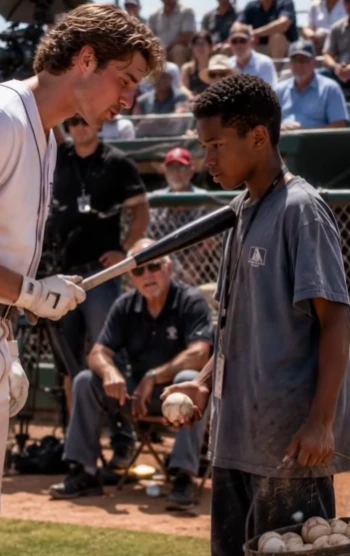
He had spent years throwing into an old mattress behind their apartment building, waiting until she left for work because he knew the sound bothered their downstairs neighbor.
He watched baseball videos at the public library.
He drew strike zones in school notebooks.
He repaired cracked baseballs with electrical tape.
Angela had refused to let herself call it talent.
Talent required money.
Travel teams.
Private coaches.
Equipment.
Transportation.
Time.
They had none of those things.
But standing on that mound, Noah looked more like Marcus than he ever had before.
Not in his face.
In his stillness.
Marcus had always become still before he threw.
As if the entire world had to move first.
Angela nodded once.
“One more.”
Tyler returned to the box.
He dug his cleats into the dirt with unnecessary force.
The catcher gave no sign.
Noah did not need one.
He raised his hands.
His motion was small and unpolished. His front knee lifted too low. His shoulders opened early. His worn sneaker slipped slightly as his foot came down.
The baseball left his hand at no more than sixty miles per hour.
Tyler waited longer this time.
He had decided the first two pitches had fooled him because he had swung too early.
The ball approached like a weak changeup.
Then, less than eight feet from the plate, it moved down and away from the barrel.
Tyler tried to stop his swing.
He could not.
The bat passed over the ball.
The catcher caught it near the dirt.
Three pitches.
Three misses.
Noah lowered his arm.
Raymond looked toward the scouts.
Several were already typing on tablets.
One had lifted a radar device, then lowered it in confusion.
The pitch was not impressive by ordinary measurements.
It was slow.
Its spin rate was not extreme.
Its early path looked hittable.
But the final movement came too late for a hitter to adjust.
Raymond had seen that movement only once before.
Twenty-two years earlier.
On a minor-league field outside El Paso.
Marcus Ellis had been twenty-one then.
Unknown.
Undrafted.
Working nights at a tire warehouse while trying to keep his baseball career alive.
He could not throw ninety-five miles per hour.
He was not tall enough to impress scouts.
His uniform never fit correctly because he had purchased it used from another player.
But he possessed one pitch that made professional hitters look helpless.
Marcus called it the Falling Star.
It began like a straight changeup.
Then the grip and pressure from his ring finger caused the ball to lose stability near the plate.
It did not break in a smooth, predictable arc.
It drifted late.
Every pitch moved slightly differently.
Raymond had believed Marcus could reach the major leagues with it.
Then the pitch disappeared.
So did Marcus.
And Raymond had spent two decades wondering why.
Tyler stepped out of the box again.
“This mound is terrible.”
Dale Mercer frowned.
“The mound was rebuilt last month.”
“The kid is not even pitching from the rubber.”
Noah looked at his feet.
He had placed his heel two inches in front of it because his shoes could not grip the worn landing area.
Tyler pointed.
“That changes the distance.”
“By two inches,” Raymond said.
Grant Vance came onto the field.
“That’s enough.”
He addressed Raymond with the careful impatience of someone speaking to an older man he did not yet recognize.
“This showcase has a schedule. My son is supposed to face selected pitchers, not concession workers.”
Raymond looked at him.
“Your son invited the boy onto the mound.”
“He was joking.”
“Noah wasn’t.”
Grant turned toward Angela.
“You need to take your child back to wherever he was assigned.”
Angela stepped between him and the mound.
“My son has a name.”
Grant glanced at the media crew.
He lowered his voice.
“I understand that. But this is a professional evaluation environment.”
Raymond gave a dry laugh.
“No, it isn’t.”
Grant’s face tightened.
“Excuse me?”
“A real evaluation environment does not protect one hitter from every pitch he dislikes.”
The scouts began looking toward one another.
Grant looked at their faces and understood the danger.
Raymond Cross was no ordinary spectator.
“Who are you?” Grant asked.
Raymond reached into his shirt pocket and removed an old leather credential holder.
The badge inside was faded.
RAYMOND CROSS — SPECIAL ADVISOR, NATIONAL BASEBALL SCOUTING COUNCIL
Grant’s confidence shifted.
Not much.
But enough.
Raymond had not worked full-time for a team in years, yet his opinion still carried weight.
He had built a reputation on seeing what numbers missed.
When Raymond Cross told a scouting director to watch someone, that director watched.
Grant adjusted his tone.
“Mr. Cross, I respect your career. But Tyler has been evaluated by every major organization in the country.”
“Against what pitches?”
Grant frowned.
“Against elite pitching.”
“Velocity?”
“Of course.”
“Sliders?”
“Yes.”
“Curveballs?”
“Yes.”
“Late-action changeups?”
Grant did not answer immediately.
Raymond looked toward the scouts.
“Has anyone here seen Tyler face a true late-action changeup this summer?”
A scout from a National League organization checked his notes.
“Not at the events I attended.”
Another spoke.
“His team skipped the Phoenix session with two changeup specialists.”
Grant crossed his arms.
“He had shoulder tightness.”
“He is a hitter,” Raymond said.
“His throwing shoulder.”
“He played center field the following morning.”
Tyler looked at his father.
Grant ignored him.
Raymond stepped closer to the plate.
“Three months ago, Tyler withdrew from the Chandler invitational after the opposing starter was changed.”
“That was a scheduling issue.”
“The replacement pitcher threw a split-change.”
Grant’s voice hardened.
“You are building a conspiracy around three swings against a child.”
“No,” Raymond said. “I’m asking why the most promoted hitter in the country has been kept away from the one kind of pitch he cannot recognize.”
Tyler slammed the end of his bat against the dirt.
“I can recognize it.”
Raymond pointed toward Noah.
“Then face him again.”
Grant moved quickly.
“No.”
The word came too fast.
Everyone heard it.





