But I sat there for a long time after he went to bed.
Thinking about Claire. About the promise in that hospital room four years ago. About the fear I had carried for so long—that the parts of me capable of surviving certain kinds of darkness were incompatible with the father I wanted to be.
What I understood now was that capability and character were never the same thing. What a person could do and what a person chose to do existed in entirely separate registers.
The one that mattered—the one Caleb would carry into the rest of his life—was the one I had been quietly choosing every single day.
Caleb didn’t need to become a fighter.
He had needed to believe he was worth defending.
And that belief had been in my power to give all along.
Marlene and I became friends over the following year. Not in any complicated way. Just two people who understood something about the world and had found a shared purpose.
She asked me once, after a Saturday class, whether I had ever considered going back.
“Back where?”
“To what you used to do. You clearly have the skills. There are private companies that would pay a lot of money for someone like you.”
I shook my head. “That part of my life is over.”
“Why?”
“Because I made a promise. To my wife, before she died. She asked me to make sure our son grew up knowing more about kindness than combat.”
Marlene nodded slowly. “And you’re keeping it.”
“Every day.”
She was quiet for a moment. Then: “The best instructors I’ve ever met are the ones who know what violence actually costs. The ones who have seen it up close. They’re the ones who teach restraint. Control. Not because they’re afraid of conflict, but because they understand what happens when it goes too far.”
I looked at her. “Is that why you do this?”
She smiled. “Part of it. The other part is that I like kids. And I like the look on their faces when they realize they’re stronger than they thought.”
A year after the fight, a documentary crew reached out. They wanted to tell the story—not just the fight, but everything around it. The bullying. The school’s failure. The culture of Bryce’s gym. The aftermath.
They wanted to interview me, Caleb, Marlene, some of the parents who had been there that night.
I said no. They asked again. I said no again.
Then Caleb asked me about it.
“Dad? Why don’t you want to talk to them?”
We were in the truck, driving home from a Saturday class. The sun was setting over the Jacksonville skyline.
“Because it’s not a story,” I said. “It’s just something that happened.”
“But people want to know. They want to understand.”
“Why?”
He thought about it. “Because maybe it helps them. Maybe it shows them that you don’t have to be a fighter to stand up for yourself. Maybe it shows them there’s another way.”
I was quiet for a long moment.
“You really think that?”
“Yeah,” he said. “I do.”
I looked over at him. Twelve, turning thirteen in a few months. Small for his age, still. But not small in the way he used to be.
Not small in the way that made him a target.
“Okay,” I said. “If you want to do it, we’ll do it. But you have to understand—once it’s out there, it’s out there. You can’t take it back.”
He nodded. “I know.”
“Are you sure?”
He looked at me. “I’m sure.”
The documentary aired six months later. It was called The Quiet Man: A Story of Restraint.
It wasn’t a blockbuster. It wasn’t viral. It was a small, thoughtful piece about a father, a son, and a promise.
Caleb went first. He talked about the bullying. The bruise shaped like a handprint. The way his father had stood still while the insults landed.
The moment he called out “Dad, don’t be him” and watched his father stop.
“I wasn’t scared,” Caleb said on camera. “I knew he would make the right choice. He always does.”
Marlene talked about teaching children to stand up for themselves without becoming aggressors. About the difference between strength and violence. About the children she had seen transformed by learning they were worth defending.
Some of the parents from that night talked about their regret. Their shame. The way they had rationalized their inaction until the video forced them to see what they had allowed.
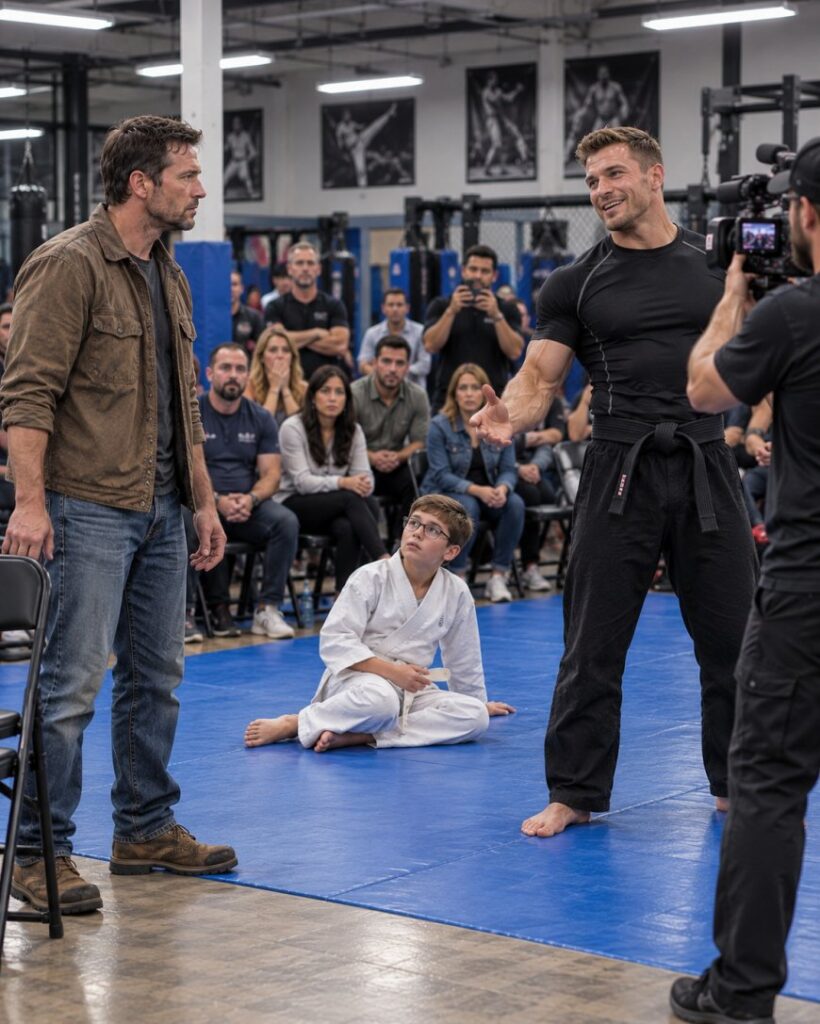
Then they interviewed me. We sat in the viewing area of Marlene’s gym—the same place where I had spent so many hours watching Caleb learn to stand differently.
The camera was small and unobtrusive. The interviewer was patient.
“Mr. Mercer, why did you sign that waiver?”
I thought about it. Really thought about it. Not the answer I had given the reporter in the parking lot. The real one.
“Because my son was watching,” I said. “And I wanted him to understand that there are some things worth standing up for. Even when it costs you something.”
“What did it cost you?”
I considered. “It cost me the illusion that I could keep that part of my life separate. The training. The skills. The things I learned in places I can’t talk about. I spent four years trying to bury all of it.”
I paused. “Because I was afraid that if my son saw what I was capable of, he would think that’s what it meant to be strong.”
“And what did he see?”
I looked at the camera. Not at the interviewer. At the camera.
“He saw me choose. He saw me decide that the most important thing wasn’t winning. It was control. Restraint.”
I let that settle for a moment. “Showing him that strength isn’t about how hard you can hit. It’s about how much you can hold back.”
The interviewer nodded. “What do you want people to take away from this story?”





