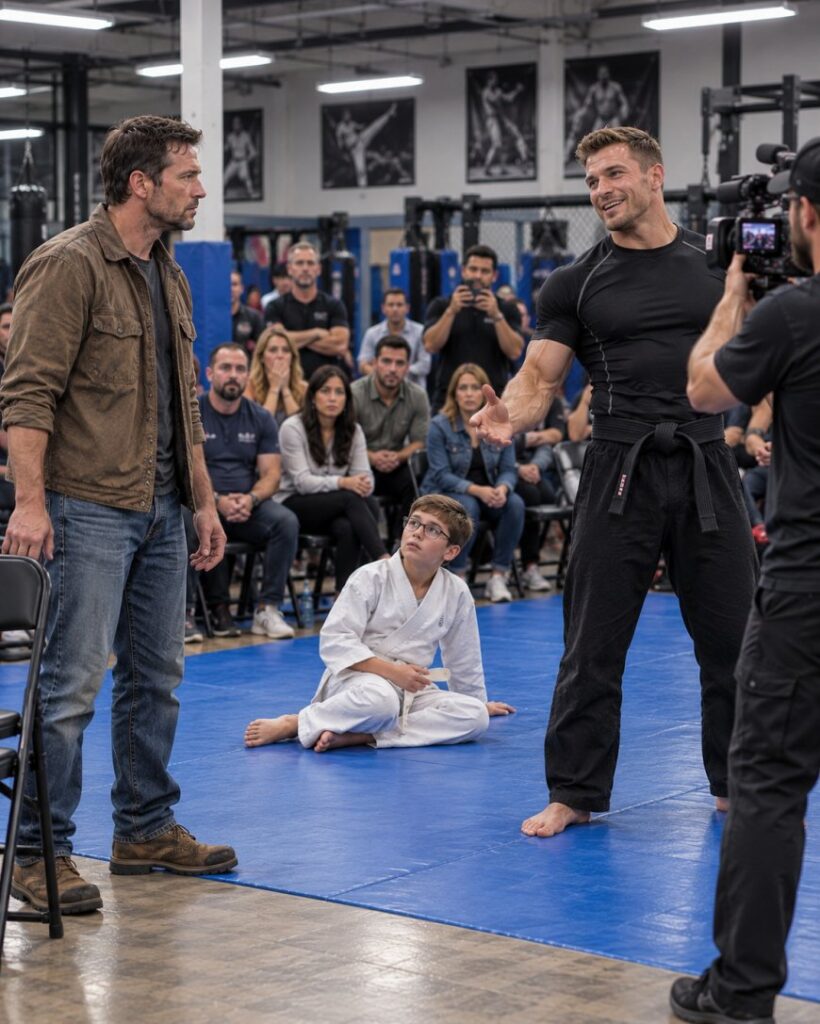
He didn’t understand why I had waited. His confusion was genuine, not accusatory.
“Knowing you can hurt someone and choosing not to are the same skill running in opposite directions,” I said. “The second direction is harder.”
He waited.
“The person with the most strength in a conflict isn’t the first one to use it. It’s the last one who needs to. The space between those two moments is where character holds or it doesn’t.”
Caleb didn’t answer right away. He looked at my face—the old scars, the calm, the complete absence of satisfaction in any of it—and nodded in the slow inward way of someone filing something away rather than simply agreeing.
I picked up the liability waiver from the front counter. Folded it once. Tore it in half along the fold. Set the two pieces back on the counter without ceremony.
Then I turned to the parents along the wall. The ones who had watched Caleb get thrown. Heard what was said into the cameras about what kind of father raised what kind of son. And stayed in their seats and said nothing.
“The next time a child in this room is treated the way my son was treated tonight,” I said, “the answer is not to wait for someone else to decide the moment is serious enough to act.”
I said it without anger. Which made it land harder than anger would have.
Then I picked up Caleb’s gym bag, slung it over my shoulder, and the two of us walked toward the exit without looking back.
The ambulance arrived eleven minutes later.
The parking lot was dark and quiet, the kind of Florida night that holds heat long after the sun goes down. Caleb walked beside me without speaking, his gym bag strap clutched in both hands, his eyes on the pavement.
I unlocked the truck. We got in. I started the engine, and for a long moment neither of us said anything. The air conditioning kicked on, blowing warm air that would turn cold in another minute.
“Dad?”
“Yeah.”
“Are you okay?”
I looked over at him. Twelve years old. Small for his age. Glasses slightly bent from where one of those boys had knocked them sideways. The same jaw I had seen in the kitchen that Tuesday afternoon.
“I’m okay.”
“You’re bleeding.”
I looked down. A small cut on my shoulder where Bryce’s illegal kick had clipped me. I hadn’t noticed. I touched it. Barely a scratch.
“It’s nothing.”
Caleb nodded slowly. Then: “I’ve never seen you do that before.”
I didn’t answer right away. I put the truck in reverse and pulled out. The gym’s lights were still on behind us. Through the glass front I could see people moving around—someone crouched beside Bryce, someone else on a phone.
“There’s a lot I haven’t shown you,” I said finally.
“I know,” Caleb said. “Mom told me once. When I was little. She said you used to do important things. Things you couldn’t talk about.”
My throat tightened. Claire. Of course she had. She had always understood more than I gave her credit for.
“She said you were a hero,” he went on. “But she said the best part about you wasn’t the hero stuff. It was that you came home and chose to be just Dad.”
I kept my eyes on the road.
“She was right,” I said.
We drove in silence for a few minutes. The city lights passed by in streaks of orange and white. Caleb’s head leaned against the window.
“Are we going back there?”
“No.”
“Good.” A pause. “But I still want to learn. I want to know how to stand differently. Like you said.”
I glanced at him. His face was reflected in the glass, half-lit by the passing streetlights.
“We’ll find somewhere else,” I said. “Somewhere better.”
“Promise?”
“Promise.”
The footage started circulating before midnight.
I didn’t know it at the time. I was in the kitchen making Caleb a sandwich because neither of us had eaten dinner. He sat at the table picking at the crust. My phone buzzed. Then buzzed again. Then kept buzzing.
A text from a coworker at the freight dock. Man, is this you? This is going viral.
He attached a link.
I opened it. There I was, standing on the mat in my socks. The angle was good enough to capture everything—Bryce’s opening combination, my head tilt, the kick meeting my shin, that heavy crack audible even through a phone speaker.
I watched myself catch his wrist. Heard my own voice, calm and level, reciting his flaws to a room of silent witnesses.
I watched myself let him go. Then the illegal kick. The knee to my ribs. The moment I went down on one knee.
And then the part that made my chest tighten. Caleb’s face in the background. Twelve years old, watching his father get hurt. His voice, small but clear, cutting through everything.
“Dad, don’t be him.”
I watched myself stop. Watched the thing behind my eyes shift. Watched myself rise. Watched Bryce throw that final desperate punch. Watched the eight-inch hook land.
Watched Bryce fall.
The video ended there. Twenty-two seconds. Already over fifty thousand views.
I set the phone down on the counter.
Caleb looked up from his sandwich. “What is it?”
“Nothing,” I said. “Eat your dinner.”
But it wasn’t nothing.
By the next morning the video had over two million views. By the following afternoon it was on every local news station in Jacksonville. By the end of the week national outlets had picked it up.
The first call came from the school.
Caleb had gone to class Monday morning, same as always. I had offered to let him stay home. He refused.
“I’m not going to hide,” he said. “That’s what they want.”
At 10:15, Patricia Holloway called me.





