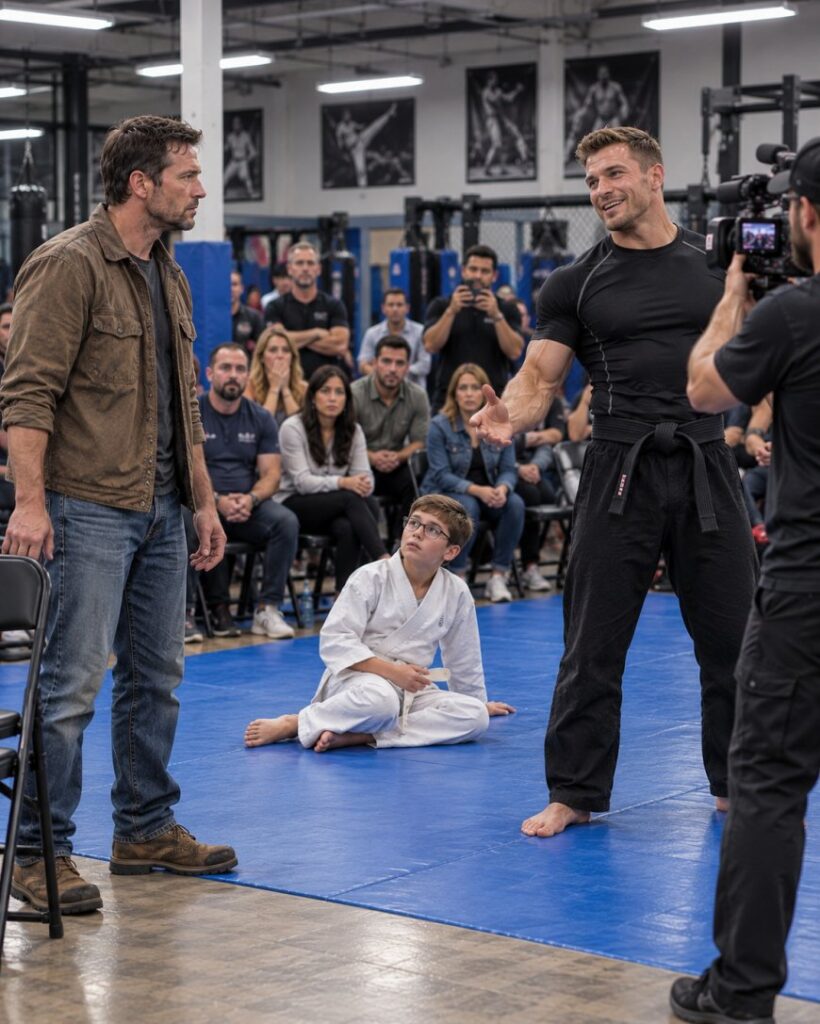
“Then help me. I’ve got a Saturday morning class—self-defense awareness for kids who’ve been bullied. No cost. I could use another instructor.”
I looked at her. “I’m not a teacher.”
“You’re a father who knows how to protect people without hurting them. That’s better than most teachers I’ve met.”
I thought about Claire. About the promise in that hospital room.
“Okay,” I said. “I’ll try.”
The Saturday class became something I looked forward to.
Eight children the first session. Then ten. Then twelve. Word spread through the community—not through social media, not through videos, but through parents talking to other parents.
The slow, organic growth that comes from trust rather than marketing.
The children came from different backgrounds. Some were small for their age. Some were quiet. Some had been bullied at school, in their neighborhoods, in their own homes.
Some had never been taught that they were worth defending.
The first thing I taught them was not how to strike or how to escape a hold. It was how to hold eye contact without aggression. Steady and clear.
The kind of gaze that says a person understands their own worth and doesn’t need anyone to remind them.
“Look at me,” I would say. “Not at my hands. Not at my shoulders. At my eyes. You’re not challenging me. You’re not threatening me. You’re showing me that you see me. That you’re not afraid.”
Some struggled with it. It felt unnatural—too direct, too vulnerable. But we practiced. Week after week. Until it became second nature.
Then I taught them how to use their voices.
“Not yelling. Not screaming. Just speaking. Clearly. Loud enough to be heard. Loud enough to make someone stop and pay attention.”
We practiced phrases. “Stop.” “No.” “Leave me alone.” “I don’t want to do that.” Simple words. Clear words. Words children often aren’t taught to say.
Then I taught them to find trustworthy adults. To use them before situations escalated. To understand that asking for help was not weakness—it was strategy. It was survival.
The striking and grappling came later. After they understood that the most important skill in any conflict was not how to hurt someone else.
It was how to control yourself.
Caleb thrived at Vasquez Martial Arts.
He wasn’t the fastest or the strongest or the most naturally gifted. But he was patient. He listened carefully and practiced diligently.
And slowly, over weeks and months, he changed.
Not into a fighter. Into someone who carried himself differently.
His shoulders didn’t curve inward anymore. His chin didn’t drop when someone looked at him. His hands didn’t tighten on the edge of benches when his name was called.
He stood differently. He moved differently. He looked at the world differently.
One afternoon about six months in, the school called.
It was Patricia Holloway again. My first thought was that something had happened. That one of the bullies had come back. That Caleb had been hurt.
But her voice was different this time. Lighter.
“Mr. Mercer? I wanted to let you know about something that happened today. Some of the older students were bothering a younger boy in the hallway. A sixth-grader. And Caleb stepped in.”
My grip tightened on the phone. “Is he okay?”
“He’s fine. More than fine. He saw what was happening, walked over, and told the older boys to stop. He didn’t raise his voice. He didn’t get aggressive. He just stood there. And spoke. Clearly. Calmly.”
I didn’t say anything.
“He told them what they were doing was wrong and that he wasn’t going to let it continue. The older boys backed off. They didn’t touch him. They didn’t threaten him. They just left.”
Still I said nothing.
“The younger boy told his teacher afterward that Caleb made him feel safe.”
I thanked her. Hung up. Stood in the dock office for a long moment, staring at the wall.
Then I called Caleb.
“Hey, Dad.”
“Hey. I heard what happened at school today.”
A pause. “Oh. Yeah. It was nothing.”
“It wasn’t nothing.”
Another pause. “I just did what you taught me. I didn’t get loud. I didn’t get angry. I just stood there. And spoke. Like you said.”
“How did it feel?”
He thought about it. “Like I was in the right place. Like I was supposed to be there. Does that make sense?”
“Yeah,” I said. “It makes sense.”
The boys who had been targeting him made one more attempt several weeks later.
It was after school. Caleb was walking toward the side entrance—the same place where they had always found him alone and uncertain. They were waiting. Three of them. The same three.
But Caleb didn’t run.
He turned to face them. Stood straight. Spoke in a voice audible to the other students in the hallway.
“I know what you’re doing,” he said. “And I’m not going to let it happen anymore.”
They stopped.
“You think you can scare me,” he continued. “But I’m not scared of you. I know who I am. And I know that what you’re doing is wrong.”
The older boys looked at each other. This wasn’t the Caleb they remembered.
“You’re not alone,” he said. “There are people who see what you do. And there are people who will stand up to you.”
He named them. One by one. Not with anger. Not with threat. Just with clarity.
They made no contact. They left.
Caleb told me about it that evening at dinner. Straightforward. No drama. Just the facts.
“I did what you said,” he told me. “I used my voice. I made it clear I wasn’t alone. And they left.”
I looked at him across the table. Twelve years old, turning thirteen soon. Small for his age. Glasses slightly crooked. Standing taller than I had ever seen him.
“That took more composure than most adults manage under pressure,” I said.
He nodded. Reached for his glass. And the conversation moved on.





