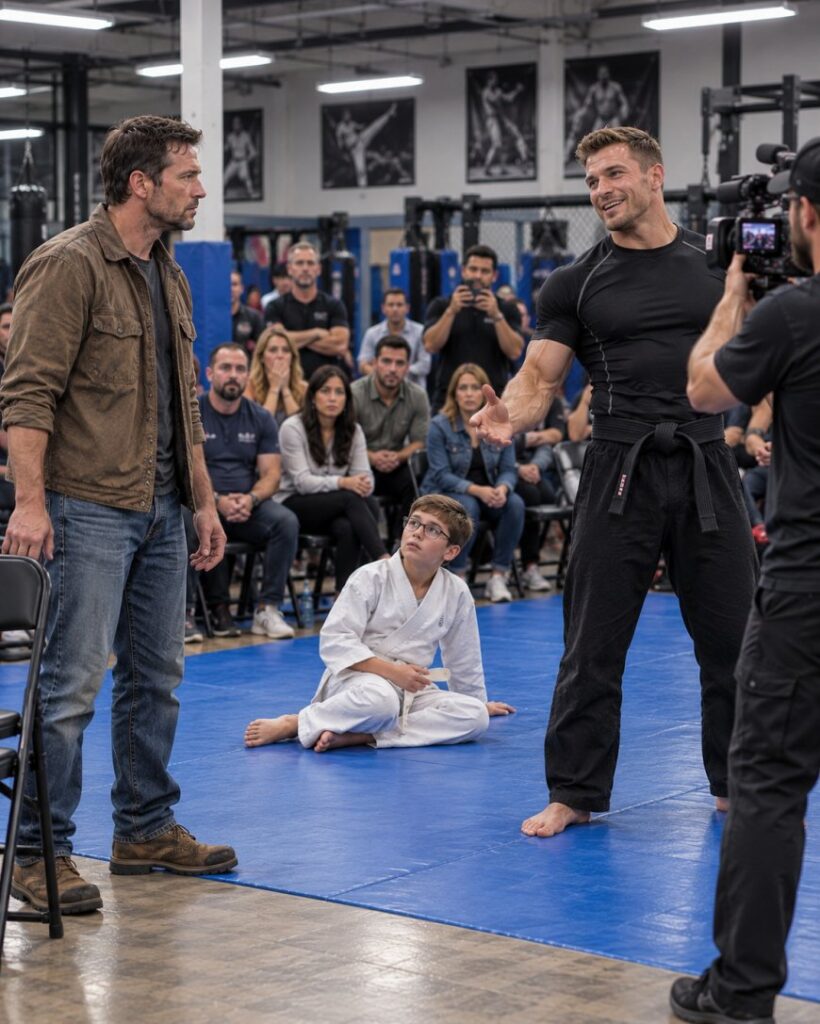
I heard Caleb’s breathing behind me. Frightened. The breathing of a twelve-year-old who had just watched his father take a bad hit in a room full of strangers.
And in the space of the next few seconds, something happened inside me that I had spent four years carefully preventing.
The room dissolved. The gym disappeared. What replaced it was a quality of darkness that belonged to enclosed spaces and incomplete information and the understanding that the situation had already degraded past the point where good options exist.
My hands tightened. The tactical mind that had kept me functional in conditions no public document would ever describe came fully online for the first time since Jacksonville.
Since the freight dock. Since Claire’s hospital room and the promise I made there.
Bryce was still talking. Still waving at the cameras. Still inviting me to stand.
He had no way to read what had shifted in the man kneeling in front of him, because he had never in his life been near that kind of shift.
I rose to my feet.
My eyes were different. Not angry in any recognizable way. Cold and exact in the way instruments are exact. Stripped of everything that wasn’t directly relevant to the problem.
Bryce grinned, opened his hands, and said it again.
“Come on.”
With the same confidence he’d carried all evening. Unaware that the confidence was now entirely unfounded.
I moved toward him.
And then Caleb’s voice came from the corner of the mat. Quiet. But clear. Cutting through the music and the crowd noise and the thing that had opened up in my chest.
“Dad, don’t be him.”
I stopped.
I stood in the center of the mat with the old machinery fully engaged inside me and my son’s voice sitting directly on top of it. The two things pressed against each other for a long moment.
I thought about what Caleb would carry out of this gym. Not the result of the fight. The image of his father at the moment of decision.
Whether that image would show him a man who controlled what he was capable of, or a man who finally let it loose in a room full of children because someone with a black belt and a social media account had pushed the right combination of buttons.
The math wasn’t complicated.
But it was the hardest calculation I had made in years.
Bryce, reading the stillness as hesitation, loaded up the largest strike he had thrown all night. A looping right hand aimed at my temple. Committed entirely. No recovery plan.
Every flaw I had cataloged in the first five minutes presented itself at once. The shoulder drop. The telegraphed weight transfer. The wide arc that left the chin exposed to anyone who stepped inside instead of away.
He swung with everything he had left.
I had one choice remaining.
I didn’t step back. I stepped in.
The move closed the distance so completely that his arm passed over my shoulder and found nothing. In the same motion I rotated my hips, transferred the torque upward through my core, and delivered a right hook that traveled no more than eight inches from where it started to where it landed.
The junction of jaw and chin where the mandibular nerve sits closest to the surface.
It was not a large movement.
It made a sound that was.
The crack carried to every corner of the gym. Bryce’s eyes lost focus before his body understood what had happened. His knees went first, then his hips, then he was on the mat in the collapsed way of someone whose nervous system has received an instruction it cannot negotiate with.
No dramatic fall. No backward stumble. Just a straight-down loss of structure, like a building whose load-bearing wall has been removed cleanly and without warning.
The gym held its breath.
Every phone went still. The music kept playing for several seconds before someone near the sound system reached over and cut it, leaving a silence so complete that the ventilation system above the mat became audible.
No one moved toward the center of the circle.
I didn’t raise my hands. I didn’t turn to the cameras or address the crowd. I crouched beside Bryce, pressed two fingers to the side of his neck, watched his chest for movement, checked his pupils with the unhurried efficiency of a man who had made the same assessment in places where the outcome mattered far more.
He was breathing. His eyes were tracking slowly, returning from wherever the impact had sent them.
I turned to the nearest assistant instructor—a young man in his early twenties frozen near the equipment rack—and told him to roll Bryce onto his side and stay with him. I told someone else to call an ambulance.
Both of them did exactly what I said without questioning it. Which was its own kind of answer about what the room had understood in the last thirty seconds.
A teenage boy near the edge of the circle asked why I hadn’t kept going. The question came out genuinely, without hostility, the way a person asks something when a fundamental assumption has been quietly removed from underneath them.
I looked at him. “The danger was finished.”
Nothing more than that. But his expression shifted as he turned it over. The implicit content of those four words was the thing Bryce had never once demonstrated in front of any of them.
That the purpose of what they were all supposedly learning was not to continue past the point of necessity. That the restraint was not the failure.
That it was the entire point.
I confirmed Bryce was stable. Then I walked to where Caleb was waiting at the edge of the mat.
My son looked at me with an expression somewhere between relief and awe, and a question he wasn’t sure he was allowed to ask.
He asked anyway. “Dad… could you have done that from the beginning?”
“Yes.”





