Now Coach Miller was forcing him to recognize that discipline was tested most severely when someone told him to stop doing the thing he wanted to continue.
The coach waited for an answer.
None came.
Eventually, Miller straightened a little.
“This is what you have to understand before I allow you to represent this academy.”
Noah looked up.
The coach’s face was firm, but his voice carried genuine concern.
“Your ability is not the question.
I know what you can do.
I have watched you work for years.”
He paused.
“What I need to know is whether you can still make the right decision when your pride is telling you to do something else.”
Noah swallowed.
He wanted to promise that it would never happen again.
He wanted Miller to accept that the situation had been an isolated mistake and return things to normal.
But the words felt inadequate.
He had spent the last several minutes demonstrating exactly why a promise spoken under pressure might not be enough.
Beyond the center of the mat, the woman had moved to the side of the training area.
She was now sitting upright with a bottle of water in her hand.
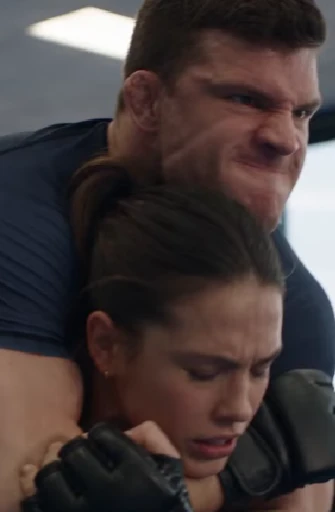
Her breathing had steadied, though she still carried herself with the caution of someone recovering from a frightening exchange.
She was listening.
Noah noticed her for the first time since returning to the mat.
Their eyes met.
The contact lasted only a moment.
He looked away first.
It was easier to face Coach Miller’s anger than the quiet expression of the person whose safety he had disregarded.
She had not shouted at him.
She had not demanded punishment.
She had not attempted to turn the other students against him.
Yet her presence made every explanation Noah had offered seem painfully insufficient.
He had insisted he was in control.
She was the one who had been trapped in the hold.
He had insisted he had not caused serious injury.
She was the one still recovering.
He had claimed he had released her.
She was the person who knew what those additional seconds had felt like.
The gap between his version of the incident and her experience suddenly seemed impossible to ignore.
Coach Miller followed Noah’s glance.
Then he spoke.
“You owe her an apology.”
Noah’s head snapped up.
For a moment, the request surprised him more than the threat of losing his tournament position.
He had expected another lecture.
More conditioning.
Perhaps even a temporary suspension from sparring.
But apologizing meant something different.
It meant walking toward the woman he had just overpowered and admitting, in front of the entire academy, that he had been wrong.
It meant allowing everyone to see that his strength had failed to protect him from making a serious mistake.
And Noah had spent years trying to become someone who would never again appear weak in front of others.
He looked toward the woman.
She remained at the side of the mat, watching without speaking.
He looked back at Miller.
His pride surged once more, almost as though it were the last defense he had left.
“No.”
The word was immediate.
Sharp.
Final.
Coach Miller went completely still.
He studied Noah’s face for several seconds, and whatever uncertainty had remained in his expression seemed to disappear.
He had offered Noah an opportunity to take responsibility.
Noah had refused it.
The coach straightened to his full height.
His voice was quiet when he answered.
“Then we’re finished for today.”
For the second time, the entire gym seemed to stop breathing.
Noah stared up at the man who had taught him how to fight, who had supported him after his father’s death, and who had recommended him for the biggest tournament of his life.
Suddenly, he understood that Coach Miller was no longer asking him to prove how strong he was.
He was asking whether Noah had the courage to admit he had been wrong.
And with everyone watching, Noah rose slowly to his feet.





