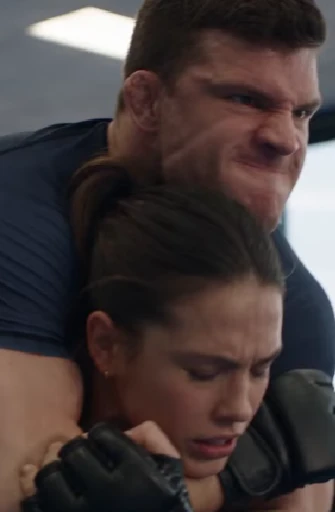
He could argue that he knew exactly how much pressure he had applied.
He could argue that his opponent had never been in serious danger.
But none of those arguments answered the question Coach Miller was asking.
The round was over.
An instruction had been issued.
And Noah had decided, for those crucial additional moments, that his own judgment mattered more.
Behind them, the woman shifted, carefully pushing herself into a more upright position.
She paused, one hand still near her neck, before attempting to settle her breathing.
A younger student standing nearby noticed and moved cautiously in her direction.
Before he could reach her, Coach Miller lifted one hand.
“Give her some room.”
The student stopped immediately.
It was an ordinary instruction, delivered without looking away from Noah.
Yet Noah noticed the response and misread what it represented.
His expression darkened.
“So that’s it?” he demanded.
“Everybody’s afraid of me now?”
Coach Miller did not hesitate.
“No.”
He allowed the single word to settle before continuing.
“They’re watching because they want to know what you’re going to do next.”
Noah looked around again.
The students he had trained beside for years were all watching him.
Some were younger.
Others had shared enough difficult training sessions with him to recognize both his discipline and his temper.
They knew what he could accomplish when focused.
They also knew how dangerous it could become when frustration overwhelmed his judgment.
Noah searched their expressions for something familiar.
Respect.
Support.
Perhaps even a smile suggesting that the situation had been exaggerated.
What he found instead was uncertainty.
Not everyone appeared frightened.
Some simply looked disappointed.
Others seemed uncomfortable, as though they were witnessing a personal argument they had never expected to see.
That hurt more than their fear would have.
Noah had spent years becoming the fighter people noticed when he entered a room.
He had earned that attention through exhausting sessions, painful mistakes, and repeated demonstrations that he could push himself harder than almost anyone around him.
Yet now those same people were standing back, unwilling to defend what he had done.
He turned toward Miller.
“You’re trying to humiliate me.”
“Noah—”
“You want everyone to see you putting me in my place.”
Coach Miller’s shoulders settled.
His expression carried more disappointment than anger.
“I don’t need to make an example of you.
You’re already doing that yourself.”
Noah flinched almost imperceptibly.
It was not the kind of reaction he would have shown after receiving a hard strike during sparring.
His physical toughness was beyond doubt.
He could withstand exhaustion, discomfort, and punishment without giving others the satisfaction of seeing him falter.
But words were different.
Especially words spoken by someone whose opinion mattered.
For a moment, his face seemed caught between fury and something more difficult to identify.
Then he broke eye contact.
Without another word, Noah turned sharply and strode toward the side of the mat.
Several students shifted away from his path.
A few exchanged uneasy glances, uncertain whether he was leaving the confrontation or simply trying to regain his composure before returning to it.
Coach Miller made no attempt to follow.
He watched Noah cross the training area, every movement stiff with frustration.
At the wall, Noah reached down and grabbed his training bag.
The familiar weight should have reassured him.
It contained the ordinary equipment of a fighter whose days revolved around practice, repetition, and preparation.
Yet as he pulled at the zipper, his movements were rough enough to betray the anger he was trying to contain.
He opened the bag halfway.
Then his hands stopped.
Inside lay an old pair of training gloves.
They were not remarkable to anyone else.
Their appearance did not announce their importance, and no one looking casually into the bag would have understood why Noah suddenly became motionless.
But he recognized them instantly.
He always did.
They had belonged to his father.
For several seconds, Noah stared at the worn gloves without touching them.
The anger that had hardened his face slowly altered, giving way to an expression he would have hated anyone to notice.
Coach Miller saw it from across the gym.
Of course he did.
He knew exactly what those gloves meant.
Almost ten years earlier, Noah had arrived at the academy as a quiet, painfully thin boy who seemed determined not to appear intimidated by anything around him.
He had possessed very little of the confidence he carried now.
Back then, the training floor had seemed enormous, the older fighters impossibly strong, and even the basic warm-up drills more demanding than he had expected.
He had struggled through exercises other students completed without difficulty.
His movements were awkward, his breathing uneven, and his body had quickly reminded him that determination alone could not replace physical conditioning.
But he had come back.
And then he had come back again.
His father had driven him to the academy every afternoon after school.
For the young Noah, those journeys had become part of something larger than training.
They meant that someone believed he was capable of growing stronger, even when he himself felt defeated by the smallest challenge.
He had first worn his father’s gloves during those early sessions.
They had been too closely connected to the beginning of his journey for him ever to view them as ordinary equipment.
Years later, when his father died, the meaning of the gloves had deepened.
They became a physical reminder of a voice he could no longer hear and a presence he could no longer reach.
Noah had continued training.
He had developed strength, endurance, confidence, and skill.
But the loss had remained.
And after his father’s death, Coach Miller had become one of the few adults he still trusted.
That was why the argument had cut so deeply.
It was not simply a coach correcting an athlete.
It was a man Noah had come to depend on telling him, in front of everyone, that something inside him was becoming dangerous.





