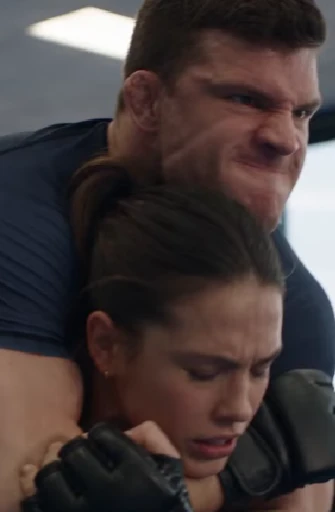
The gloves rested inside the open bag.
Noah stared at them, feeling the distance between the frightened boy he had once been and the angry fighter he had become.
He had spent nearly a decade proving he was no longer weak.
Yet in that moment, he felt strangely close to the boy who had once struggled just to complete a warm-up.
Coach Miller waited.
He did not mention Noah’s father.
He did not use the memory as a weapon or attempt to embarrass him further.
Instead, he spoke with deliberate calm.
“Put your bag down.”
Noah’s hand tightened around the strap.
He gave no answer.
“Noah.
Put it down.”
Finally, Noah turned his head.
“I’m leaving.”
“No.”
The reply came without hesitation.
Noah spun around.
“No?”
His voice rose again, carrying an incredulous edge.
Coach Miller remained near the center of the mat.
“You’re not going to walk away in the middle of this anger and convince yourself that you’ve solved the problem.”
Noah laughed without amusement.
“So now you’re going to tell me I’m not allowed to leave?”
Miller shook his head.
“That’s not what I’m saying.”
“Sounds exactly like it.”
“I’m telling you that running away from a difficult moment isn’t the same as making a decision about it.”
Noah stared.
He wanted the conversation to be simpler.
He wanted the coach to be unreasonable, so he could justify leaving.
He wanted everyone to recognize that he was being treated unfairly, so that his anger would feel righteous rather than embarrassing.
But Miller was refusing to give him that satisfaction.
Instead of raising his voice, the coach continued to speak as though Noah were still someone worth reaching.
Perhaps that was the hardest part.
If Miller had shouted, Noah could have shouted back.
If the coach had threatened him physically, Noah could have interpreted the confrontation as another contest of strength.
But there was nothing to defeat in the calm disappointment of someone who knew him too well.
Noah lifted the bag.
“I’m done talking.”
He started toward the exit.
The students watched without intervening.
Coach Miller made no move to block the door.
He did not reach for Noah, order another fighter to stop him, or attempt to force him back onto the training floor.
He simply spoke as Noah walked.
“You can leave if that’s your choice.”
Noah kept moving.
“But understand something before you go.”
His steps slowed.
“If you walk out of here right now, you’re turning your back on more than this conversation.”
Noah stopped near the exit.
His hand hovered close to the door, but he did not push it open.
He recognized the seriousness in the coach’s voice.
It was different from the sharp correction that had begun the argument.
This was something deeper.
Noah slowly turned.
“What is that supposed to mean?”
Coach Miller looked toward the mat.
“You already know.”
The words brought a different kind of tension into Noah’s face.
He did know.
And the realization made the training bag suddenly feel heavier.
Three weeks earlier, Noah had been selected to compete in a major regional martial arts tournament.
It was not an ordinary opportunity.
For years, he had worked toward a chance to demonstrate his ability beyond the familiar walls of the academy.
He had trained through exhaustion, endured repeated corrections, and devoted himself to becoming the kind of fighter who could stand against serious competition.
The upcoming tournament represented the most significant opportunity of his career.
A strong performance could earn him consideration for an elite training program that identified talented fighters from across the country.
The program offered the possibility of competing and developing at a level Noah had spent years imagining.
And Coach Miller had been the one who recommended him.
That recommendation had meant more than an entry on a competition list.
To Noah, it had been evidence that the man who remembered his earliest failures now believed he was ready for something much greater.
For the first time, the future he had worked toward seemed close enough to touch.
Now that future was suddenly uncertain.
Noah turned fully toward Miller.
“You wouldn’t do that.”
Miller’s expression remained serious.
“I haven’t made a decision.”
“But you’re thinking about taking me out of the tournament.”
“I’m thinking about whether you’re prepared to compete.”
Noah stepped away from the door.
“Of course I’m prepared.”
Coach Miller considered him for a moment.
“Physically, yes.”
Noah’s face tightened again.
“Then what are we talking about?”
The coach’s answer was immediate.
“Everything that doesn’t depend on how hard you can fight.”
The meaning settled slowly.
Noah knew his strengths.
He knew how much he could endure.
He knew the precision of his techniques, the improvement in his conditioning, and the confidence that came from years of difficult practice.
He had become accustomed to measuring progress in ways he could feel with his body.
Faster reactions.
Better control of movement.
Greater stamina.
More effective technique.
But Coach Miller was placing something else at the center of their conversation.
The capacity to obey an instruction even when pride resisted.
The discipline to recognize another fighter’s safety as more important than winning an exchange.
The ability to accept that being powerful did not grant him the right to decide every outcome.
Noah understood those principles when they were explained in training.
He could repeat them.
He could even teach them to someone less experienced.
What he had failed to do was follow them when his temper had been challenged.
And Coach Miller was making it clear that this failure could matter more than his physical ability.
For a long moment, neither man spoke.
Then Miller turned and walked back toward the middle of the mat.
“Come here.”
Noah remained near the exit.
The coach stopped and looked back.
“Noah.
Come here.”
The younger fighter stared at him.
Everything inside him resisted the instruction.
He had already been corrected in front of the academy.





