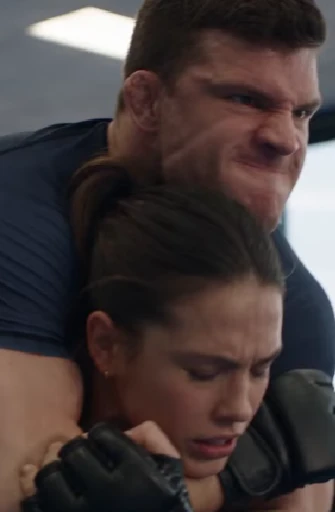
He had been told his tournament position might be in jeopardy.
Now the coach expected him to return to the very place where the confrontation had begun.
But leaving meant accepting an uncertainty that frightened him more than he wanted to admit.
Slowly, Noah walked back.
The students shifted aside, creating a path toward the center.
Their movement made him uncomfortably aware of how much attention remained fixed on him.
He hated being watched this way.
During normal sparring, attention was something he could use.
When people watched him fight, he knew what they wanted to see.
They expected strength, technique, confidence, and determination.
Now the audience was waiting to discover whether he could control his own pride.
Noah approached Coach Miller and stopped.
The coach pointed toward the mat.
“Sit down.”
Noah stared.
“You can’t be serious.”
“Sit.”
“I’m not some little kid.”
Miller’s expression did not change.
“Then quit behaving like one.”
A few students exchanged startled glances.
Noah felt heat rise into his face.
It would have been easy to refuse.
For an instant, he imagined simply turning around and walking away.
He could leave the gym, carry his anger with him, and convince himself that Miller had crossed a line.
But the tournament remained in his thoughts.
So did the gloves inside his bag.
So did the memory of his father bringing him to this place when he had been a boy who could barely survive ten minutes of training.
He looked at the mat.
Then, with obvious reluctance, he lowered himself onto its edge.
The movement was slow.
Deliberate.
Almost painful in its simplicity.
Coach Miller remained standing in front of him.
The arrangement was familiar.
Years earlier, Noah had often sat in nearly the same position, exhausted and embarrassed, while the coach explained what he needed to improve.
Back then, he had listened because he knew he had much to learn.
Now, after years of progress, listening seemed harder than ever.
Miller looked down at him.
“Do you remember the first day you came here?”
Noah said nothing.
“You couldn’t finish the warm-up.”
The coach’s voice contained no mockery.
“You were worn out after about ten minutes.”
A few students smiled faintly, surprised by the image of the powerful fighter in front of them struggling with such basic work.
Yet nobody laughed.
They recognized that this was not a moment for ridicule.
Noah turned his face away.
He remembered.
He remembered the exhaustion that had seemed endless, the embarrassment of being unable to keep pace, and the determination that had brought him back despite it.
He remembered how much he had wanted to become someone different.
Coach Miller continued.
“And what did you do after that first day?”
Noah remained quiet.
“You came back.”
The coach paused.
“And the next day, you came back again.”
Noah’s gaze shifted slightly.
“Every time something was difficult, you returned and worked on it.
You didn’t become strong because everything came easily.
You became strong because you kept showing up.”
The words reached somewhere beneath Noah’s anger.
He knew the coach was right.
Nothing about his early development had been effortless.
He had earned his ability through repetition, frustration, and the willingness to accept correction.
The reason he had advanced was not that he had always known what to do.
It was that he had once understood how much he did not know.
Coach Miller watched his face carefully.
“You came here because you wanted to get stronger.”
Noah finally lifted his eyes.
“I did get stronger.”
Miller nodded.
“Yes, you did.”
There was no hesitation in his agreement.
For a brief moment, Noah felt relief.
The coach was not denying his progress or pretending that years of training meant nothing.
Miller knew exactly how far he had come.
But that acknowledgment was only the beginning.
The coach’s expression became grave.
“Strength without discipline doesn’t make you a better fighter, Noah.
It makes you dangerous.”
The sentence seemed to remain suspended between them.
Noah’s features tightened.
“I didn’t hurt her.”
Miller’s eyes did not leave his face.
“That isn’t what we’re discussing.”
“I let go.”
“After I called for you twice.”
Noah opened his mouth.
Then closed it.
He could still feel the impulse to argue.
His mind searched for explanations: the intensity of the exchange, the noise of the gym, the difficulty of knowing precisely when the round had ended.
But the words would not change what had happened.
Coach Miller had called.
And then he had called again.
Noah had finally released the hold.
The delay might have seemed small to someone watching from a distance.
To the person caught in the hold, however, it had been more than a theoretical breach of etiquette.
Those moments belonged to her safety.
Noah lowered his gaze.
The coach bent slightly, bringing himself closer to Noah’s eye level.
His voice softened.
“Tell me something.”
Noah remained silent.
“What happens when you’re in a real competition and a referee tells you to stop?”
No answer.
“What happens if you’re convinced you know better than the referee?”
The silence deepened.
Miller continued.
“What happens when the person you’re fighting can’t protect themselves anymore, but you decide everything is still under your control?”
Noah looked down at his hands.
For the first time since the confrontation began, he appeared less interested in defending himself than in escaping the implications of the question.
The danger was no longer abstract.
He knew the nature of the sport.
Training was supposed to develop skill while preserving trust.
A fighter who entered a sparring round depended on the other person’s willingness to obey the rules, respect a stoppage, and recognize that the purpose of practice was not to inflict unnecessary harm.
Without that trust, even the most technically impressive athlete could become someone others were unsafe training beside.
Noah had always believed himself to be disciplined because he trained hard.





