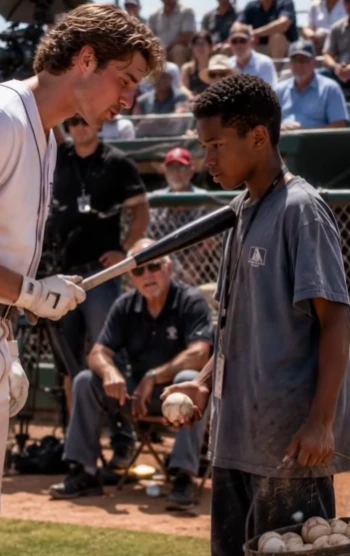
Superstar Mocked the Ball Boy’s Throw — Five Minutes Later, His Career Fell Apart
The summer showcase at Desert Crown Baseball Complex in Mesa, Arizona, was built around one name.
Tyler Vance.
Seventeen years old.
Million-dollar swing.
White uniform spotless.
A camera crew following every step he took from the dugout to home plate.
Every scout in the stands had come to watch him.
And Tyler knew it.
Near the first-base line, a quiet Black boy named Noah Ellis was collecting foul balls in a faded staff shirt.
He was twelve.
Thin.
Sunburned from working all morning.
A bucket of baseballs hung from one hand.
Noah was not there to play.
He was there because his mother worked concessions, and the stadium manager let him help for a few dollars.
During warmups, one ball rolled past the catcher and stopped near Noah’s shoes.
Noah picked it up and tossed it back.
The ball curved strangely in the air.
Not fast.
Not loud.
But it moved as if it had changed its mind halfway to the glove.
An old man sitting alone behind the scout section suddenly leaned forward.
Tyler saw the throw too.
Then he laughed.
“Was that supposed to be a pitch?”
The players around him chuckled.
Noah lowered his eyes.
“I was just returning the ball.”
Tyler walked closer, pointing his bat at Noah’s chest.
“Kids like you carry buckets. You don’t throw to players like me.”
The crowd went quiet.
Noah’s mother froze behind the concession window.
The stadium manager started toward them, but Tyler raised his voice.
“Let him throw one from the mound. I’ll send it into the parking lot.”
Noah shook his head.
“I’m not trying to embarrass anyone.”
Tyler smirked.
“You couldn’t.”
That was when the old man behind the scouts stood up.
His name was Raymond Cross.
Nobody in the crowd recognized him at first.
But every older scout did.
He pointed toward the mound and said, “Let the boy throw.”
Tyler laughed.
“Fine. Five minutes of comedy.”
Noah stepped onto the mound in worn sneakers.
No cleats.
No jersey.
No applause.
Only a superstar waiting to humiliate him.
The first pitch floated toward the plate.
Tyler swung hard.
And missed.
The second pitch moved even later.
Tyler missed again.
Then Raymond Cross took off his sunglasses.
One scout whispered, “That’s impossible.”
Because Noah was not copying a trick.
He was throwing a lost pitch baseball had not seen in twenty years.
And five minutes later, the question was no longer whether Tyler Vance was the future of baseball.
The question was why a twelve-year-old ball boy knew the one pitch that could destroy him.
For several seconds, Tyler remained frozen in the batter’s box.
His bat rested across his shoulder.
The smile was gone.
Behind home plate, the catcher stared at the baseball in his glove.
“What was that?” he asked.
Noah stood on the mound with his right foot pressed into the dry clay.
“I don’t know what you call it.”
Raymond Cross stepped down from the scout section.
His knees were stiff, and he held the railing as he descended, but every person wearing a scouting credential moved aside for him.
One of the younger scouts whispered to another.
“Who is he?”
The older man beside them answered without looking away from Raymond.
“That’s the man who found Julian Reyes.”
The younger scout blinked.
“The Hall of Famer?”
“And six other major leaguers.”
Raymond reached the field.
He looked at Noah first, not Tyler.
“Show me your grip.”
Noah hesitated.
He glanced toward the concession stand.
His mother, Angela Ellis, stood behind the open window with both hands pressed to the counter.
She looked frightened.
Not because her son had done anything wrong.
Because she had spent years teaching him not to attract the wrong kind of attention.
Noah understood the warning in her face.
Stay quiet.
Do your job.
Do not give anyone a reason to remove you.
Stadium manager Dale Mercer had allowed Noah to work only because Angela’s childcare had fallen through. Noah collected baseballs, carried cups, swept the lower rows, and stayed out of the players’ way.
The arrangement was unofficial.
One angry parent could end it.
Raymond waited.
“I’m not asking you to give away a secret,” he said. “I just want to see how you held it.”
Noah looked down at the baseball.
His fingers settled across the seams.
The middle finger rested high.
The index finger floated lightly against the side.
His thumb pressed underneath at an angle that looked uncomfortable.
The ring finger bent against the lower seam.
Raymond’s face changed.
It was not surprise anymore.
It was recognition.
“Who taught you that?”
Noah closed his hand around the ball.
“My dad.”
Angela left the concession window.
She pushed through the side gate and hurried toward the field.
“Noah, come down.”
Raymond turned toward her.
“Mrs. Ellis?”
She stopped.
“How do you know my name?”
Raymond looked from her to the boy on the mound.
“I knew a pitcher named Marcus Ellis.”
Angela’s expression hardened.
“Lots of people knew Marcus.”
“No,” Raymond said quietly. “Lots of people knew his statistics. I knew him.”
Tyler stepped out of the batter’s box.
“Can we stop acting like the kid threw magic?”
His father, Grant Vance, appeared at the dugout railing.
Grant was broad-shouldered, deeply tanned, and dressed in a golf shirt with three sponsor logos stitched across the chest.
He managed Tyler’s public appearances, training schedule, interviews, and social media accounts.
He had spent six years turning his son into a baseball product.
Nothing at Desert Crown happened without Grant noticing.
He looked toward the camera crew.
They were still recording.
“Tyler,” he called, “finish the at-bat.”
Tyler rolled his shoulders.
“He got lucky.”
Raymond looked at Noah.
“Do you want to throw again?”
Noah looked toward his mother.
Angela’s lips pressed together.
She had not given permission.
But she saw the way her son held the baseball.





