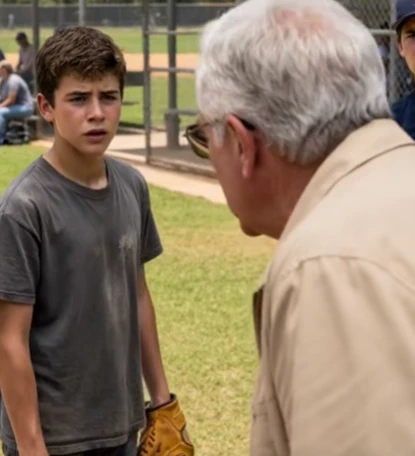
The summer baseball tryout in a quiet Florida suburb was supposed to be invitation-only.
Fresh white chalk lines.
Parents sitting behind the fence.
Kids in clean uniforms warming up under the afternoon sun.
Coolers full of sports drinks sat beneath pop-up tents. Fathers in sunglasses checked their watches. Mothers held clipboards with printed schedules. Coaches walked across the field with serious faces, as if every twelve-year-old and fourteen-year-old warming up on that diamond was already one step from greatness.
The field belonged to Gulf Coast Premier Baseball, one of the most expensive travel programs in that part of Florida.
Everyone knew it.
The boys wore matching workout shirts.
The catchers had glossy gear.
The bats lined up against the dugout looked like they cost more than some families paid for groceries in a month.
And outside the left-field fence, pushing a noisy lawn mower along the edge of the grass, was Caleb Turner.
Fourteen years old.
Faded green T-shirt.
Old sneakers darkened with dust.
Work gloves too big for his hands.
Sweat running down his face.
He was not there to try out.
He was there to help his uncle maintain the field after school.
At least, that was what everyone assumed.
Caleb kept his eyes low as he guided the mower around the warning track outside the fence. The machine rattled and coughed, leaving a sharp smell of gasoline in the hot afternoon air. Every few minutes, he looked up toward the field without meaning to.
He noticed everything.
The angle of the pitcher’s front foot.
The catcher setting too early.
The shortstop cheating toward second before the ball was hit.
The coach near third base who kept writing down names but never once looked beyond the players wearing expensive uniforms.
Caleb told himself not to stare.
Staring only invited trouble.
But baseball had a way of pulling his eyes toward it.
His uncle, Ray Turner, had warned him that morning.
“Do your work. Keep your head down. We’re not here for them.”
Caleb had nodded.
He always nodded when Uncle Ray spoke in that quiet voice.
Ray had raised him since he was six, after Caleb’s mother had taken a night-shift nursing job and his father had disappeared so long ago that people stopped asking where he went. Ray was not old, but hard years made him look older. He had a bad knee, a gray beard, and hands that looked like they had repaired everything from lawn mowers to broken hearts.
He maintained fields for three different baseball complexes across the county.
He dragged dirt.
Painted foul lines.
Fixed sprinklers.
Replaced torn netting.
He treated every field like a church, even when the people using it treated him like furniture.
Caleb had grown up beside those fields.
Not in dugouts.
Not on rosters.
Outside fences.
Near equipment sheds.
Behind snack bars.
Beside mowers and chalk machines and bags of clay.
But every evening after the gates closed, when the rich teams went home and the lights stayed on a little longer, Ray would hand Caleb an old baseball and say, “Show me what your body remembers.”
Caleb never fully understood that phrase.
Not until later.
Near the dugout, a group of boys noticed him watching.
One boy laughed first.
He had blond hair, a silver chain, and a brand-new glove hanging loose from one hand. His name was Preston Weller, and everyone around the field seemed to know it. His father sponsored two tournament teams. His mother sat under the largest tent with an insulated cup and a look that said the sun should have asked permission before touching her.
“Hey, lawn boy,” Preston called.
Caleb kept pushing the mower.
Another boy smirked.
“You cutting grass or trying to learn baseball from the fence?”
A few players laughed.
Caleb lowered his eyes.
He had learned there were two kinds of laughter.
The kind that invited you in.
And the kind that reminded you where other people wanted you to stay.
This was the second kind.
The mower bumped over a root near the fence.
Caleb steadied it.
“Maybe he’s scouting us,” another boy said. “You taking notes, lawn boy?”
Preston leaned against the dugout rail.
“Careful. He might report us to the grass.”
More laughter.
Caleb’s face burned, but he said nothing.
Inside the fence, Coach Darren Pike turned his head.
He was in his forties, fit, tan, wearing mirrored sunglasses and a black Gulf Coast Premier polo tucked into white baseball pants. He had a whistle around his neck and a clipboard under his arm.
He saw the boys laughing.
He saw Caleb.
He saw the mower.
And he chose to do nothing.
That hurt more than the jokes.
Caleb kept working.
The field session began with infield drills. Ground balls snapped across the dirt. Boys shouted. Coaches called names. Parents leaned forward whenever their sons moved.
Caleb tried not to watch.
But when a hard throw from third base missed the first baseman, the ball skipped under the fence opening near the bullpen and rolled toward him.
It came to a stop by his shoe.
The field paused.
Caleb stopped the ball gently with his foot.
Then he bent and picked it up.
For one second, his hand wrapped around the seams.
Different.
Natural.
Like he had held a baseball thousands of times before.
Which he had.
In the dark.
In the rain.
Behind locked gates.
Beside empty bleachers.
With Uncle Ray standing behind a bucket, saying, “Don’t throw angry. Throw honest.”
Coach Pike waved him off.
“Throw it back, kid. Carefully.”
The boys laughed again.
Preston cupped his hands around his mouth.
“Don’t hurt yourself.”
Caleb looked toward home plate.
A catcher stood there with his mask raised, waiting lazily.
The distance was not short.
Not impossible.
But long enough that most boys would have jogged the ball in or bounced it.
Caleb did not think.
That was the thing.
Thinking made him careful.
Careful made him smaller.
So for one second, he let his body remember.





