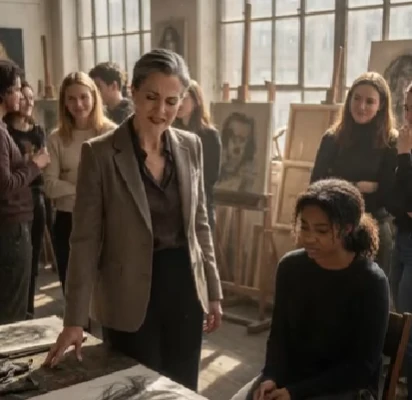
The laughter began before the girl had even finished explaining her drawing.
Standing beside a paint-stained wooden table, Professor Eleanor Whitmore looked down at the large charcoal portrait and shook her head.
Around her, nearly twenty art students gathered in the sunlit studio, watching the confrontation unfold.
At the center of it all sat seventeen-year-old Maya Bennett, a quiet Black student wearing a plain black sweater.
She had spent eleven nights working on that portrait.
Eleven nights of broken pencils, charcoal dust, aching fingers, and memories she had struggled for years to put into words.
But Professor Whitmore saw none of that.
She saw a drawing she believed did not belong in her advanced art class.
“Is this supposed to impress me?” the professor asked, a sharp smile appearing on her face.
Several students exchanged uncomfortable glances.
Maya kept her hands folded in her lap.
“No, ma’am,” she answered softly. “It’s supposed to mean something.”
The professor laughed.
“Meaning is not a substitute for technique, Miss Bennett.”
A few students chuckled.
Maya lowered her eyes.
Then the professor reached down, lifted the corner of the drawing, and examined the woman’s face more closely.
“Tell me something,” she said. “Did you actually draw this yourself?”
The room became quieter.
Maya looked up.
“Yes.”
“Without tracing?”
“Yes.”
“Without copying a photograph?”
Maya hesitated.
That hesitation made the professor smile.
“Ah. There it is.”
But what Eleanor Whitmore did not know was that Maya had never copied the face from a photograph.
She had drawn it from a memory that was disappearing.
And before the afternoon was over, the professor would learn why the girl had refused to let anyone touch that drawing.
The Girl Nobody Expected to Be There
The prestigious Westbridge Academy of Fine Arts occupied the upper floors of a century-old brick building in the heart of the city.
Its studios were famous for their towering windows, antique wooden easels, and walls lined with portraits created by generations of talented artists.
Students traveled from across the country to study there.
Some came from wealthy families who could afford private art lessons, expensive supplies, and international summer programs.
Others arrived with portfolios polished by professional instructors.
Maya Bennett had none of those advantages.
She lived with her grandmother in a small apartment above a neighborhood laundromat.
Her mother had worked as a nursing assistant. Her grandmother cleaned offices in the evenings.
Money had always been tight.
Maya’s first sketchbook had been a stack of discarded printer paper held together with a rubber band.
Her first charcoal sticks came from a damaged art kit someone had left beside a dumpster.
When other children received expensive drawing tablets for their birthdays, Maya practiced with pencils so short she could barely hold them.
But she drew constantly.
She drew people waiting at bus stops.
She drew elderly neighbors sitting outside their apartments.
She drew tired cashiers, sleeping children, and strangers whose faces carried emotions they never expressed aloud.
For Maya, drawing was never simply about making something beautiful.
It was about preserving what people might otherwise forget.
At fourteen, she won a local community art competition.
At sixteen, she received a scholarship to Westbridge.
The acceptance letter arrived on a rainy Thursday afternoon.
Her grandmother cried when she read it.
Maya did not.
She just held the paper against her chest and whispered, “I wish Mom could see this.”
Her grandmother looked away.
Neither of them said anything else.
Three years earlier, Maya’s mother had suffered a serious neurological illness that gradually damaged her memory and speech.
At first, she forgot small things.
Where she had placed her keys.
Whether she had eaten breakfast.
The name of a neighbor she had known for ten years.
Then the forgetting became worse.
There were days when she could not remember how to return home from the grocery store.
Days when she stared at familiar photographs without recognizing the people inside them.
Eventually, there came a morning when she looked directly at her daughter and asked, “Are you the new nurse?”
Maya was fifteen.
She had never forgotten that moment.
And she never would.
A Professor Who Believed Talent Had Rules
Professor Eleanor Whitmore had taught at Westbridge for more than twenty years.
Her reputation was formidable.
She had exhibited paintings in several major galleries, published essays on classical portraiture, and trained students who later became successful professional artists.
She believed in discipline.
She believed in precision.
And above all, she believed that serious art required technical mastery.
Her classes were demanding.
Students who submitted unfinished work received harsh criticism.
Those who failed to follow assignment instructions were corrected publicly.
Whitmore considered this approach necessary.
“The art world will not protect your feelings,” she frequently told her students. “Neither will I.”
Some admired her uncompromising standards.
Others feared her.
Maya had learned to remain invisible.
She arrived early, sat near the back, completed her assignments, and rarely volunteered to speak.
Her technical ability was undeniable, but she had a habit that frustrated Whitmore.
She refused to draw people as perfectly as the professor wanted.
If a face contained an unusual wrinkle, Maya kept it.
If a person’s eyes were slightly uneven, she did not correct them.
If a smile was crooked, she preserved its asymmetry.
Whitmore called these choices mistakes.
Maya considered them honesty.
During one critique, the professor had pointed to a portrait Maya had drawn of an elderly man.
“His left eye is lower than his right.”
“I know,” Maya replied.
“Then why haven’t you fixed it?”
“Because that’s how his face looks.”
Whitmore sighed.
“Art is not an excuse for carelessness.”
Maya said nothing.
She could have explained that the man was her grandfather’s oldest friend, who had suffered a stroke.
She could have explained that the unevenness of his face was part of what made him recognizable.
But she had already learned that explanations rarely helped.
So she stayed quiet.
And Whitmore continued believing that the girl lacked the discipline to become a serious artist.





