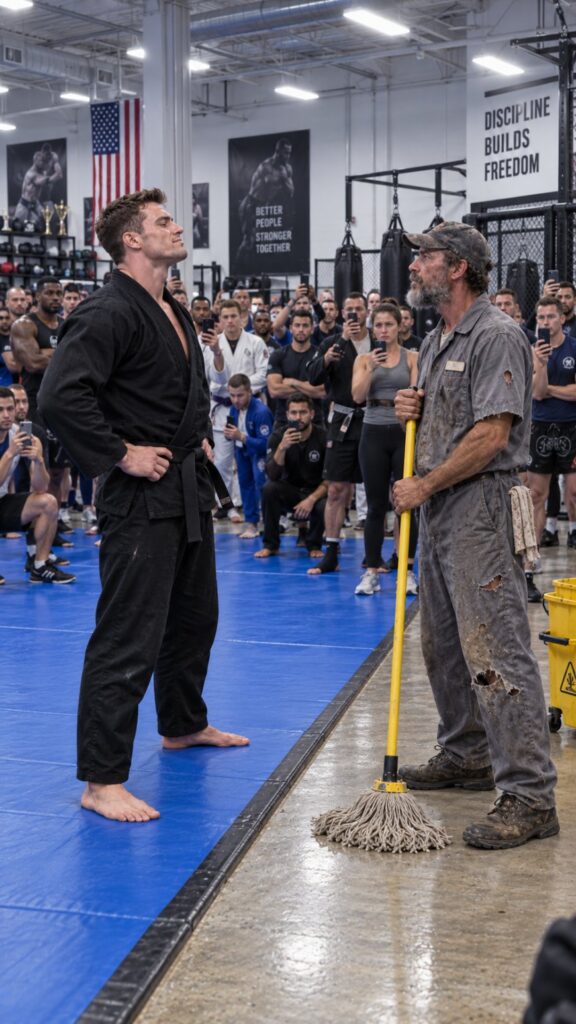
Within seventy-two hours of the judge’s ruling, the state licensing board descended on Lawson Combat Academy. The three previous complaints, no longer hidden behind legal threats, were reopened for investigation. Emboldened by the news coverage, twelve more former students came forward. They flooded the state tip lines with identical stories: public humiliation, forced sparring matches with advanced belts, and relentless bullying by Derek if anyone dared to complain.
The local newspaper ran a front-page exposé. One 19-year-old college student recounted how Derek had broken his nose during a “beginner’s tutorial” just to get a good clip for his Instagram reel.
The consequences were swift and brutal. The state suspended the academy’s operating license pending a full safety review. Within two days, three major sponsors dropped Derek. An energy drink company, a heavy-bag manufacturer, and a popular gi brand all issued public statements terminating their contracts with the Lawson family.
Derek’s social media empire crumbled. TikTok permanently banned his account for violating their strict terms of service regarding bullying, targeted harassment, and the monetization of abuse. His Instagram account bled twenty thousand followers in a single weekend. The comment sections on his remaining posts became a wasteland of people mocking the “undefeated” black belt who got put to sleep by the guy who cleans the toilets.
By the end of the month, the neon sign above Lawson Combat Academy went dark forever. The massive brick building on Westheimer Road was listed for commercial sale. Grant Lawson quietly filed for bankruptcy on the LLC.
As for me, my life moved in the exact opposite direction.
The video of Nathan’s cross-examination leaked online, and the quote, “You personally profited four thousand dollars off of his humiliation,” became a viral soundbite. People were outraged. The veterans’ group that had shown up to court decided to take action. They launched a GoFundMe campaign to help me with my legal fees and living expenses.
I thought it might raise a few hundred dollars. It raised sixty-two thousand dollars in five days.
I used a small portion of it to pay off my back rent and secure a better apartment. The rest of the money, I set aside in a trust. I didn’t want to live off a handout; I wanted to work.
A week later, I got a phone call from the director of a nonprofit community center in the Fifth Ward, a low-income neighborhood on the east side of Houston. They had a large, empty gymnasium and a desperate need for youth programs. They had seen the videos and read about my military background. They didn’t want a janitor. They wanted a head instructor.
They offered me a modest salary, basic benefits, and complete creative control over a new self-defense program for at-risk youth aged ten to seventeen.
I didn’t even have to think about it. I said yes.
I named the program “Ground Up.”
Our curriculum wasn’t about teaching kids how to brawl in the streets. I wasn’t creating a factory for cage fighters. We taught control. We taught de-escalation techniques, situational awareness, and the biomechanics of self-defense. Most importantly, I taught these kids how to stay perfectly calm when the world around them was trying to drag them into chaos. I taught them the exact same principles of dignity and restraint that had kept me alive on that mat with Derek Lawson.
Brenda, the paralegal who had risked her own gym membership to record the truth, quit her job at the corporate law firm. She volunteered to run the administrative side of Ground Up while studying for her law school entrance exams. Nathan Cole joined our board of directors, providing free legal clinics for the parents of our students.
On the very first day of class, fifteen nervous kids filed onto the donated foam mats. They were wearing baggy sweatpants and oversized t-shirts, looking around the gym with wide eyes.
I walked out to the center of the mat. I wasn’t wearing a gray janitor uniform anymore. I wore a clean black rashguard and a pair of athletic shorts. I knelt down so I was at eye level with the smallest kid in the front row, a twelve-year-old boy who looked like he was ready to bolt for the door.
I gave him a warm, reassuring smile.
“First lesson,” I told the group, my voice echoing clearly across the gym. “A real fighter never throws the first punch. We are not here to learn how to hurt people. We are here to learn how to become unshakeable.”
The boy nodded slowly, his shoulders relaxing. I stood up, stepped to the center of the room, and began to teach.
Six months later, Ground Up had a waiting list of over a hundred kids. We expanded to four classes a week. The story of the janitor who stood his ground became a local legend, used in college ethics courses and state legislative meetings to discuss the dangers of social media exploitation. The state of Texas even passed a new set of regulations requiring formal, written consent protocols for martial arts gym sparring sessions. The local media informally dubbed it the “Adams Rule.”
I didn’t care much about the politics or the fame. I just cared about the kids on my mat.
As for Derek Lawson, the internet has a long memory, but people eventually find a way to hide. Almost a year after the lawsuit, a grainy photo surfaced on a Houston Reddit forum. It was a picture of a sign-in sheet at a tiny, rundown strip-mall dojo in Beaumont, Texas, nearly a hundred miles away from the city.
There was no “Derek Lawson” on the list. Just the initials “D.L.” next to a time slot for the adult beginner’s class. The photo showed a man in the background, wearing a brand-new, stiff white belt, standing quietly at the back of the line.





