I opened the front door to find Brenda standing on the concrete walkway. Next to her was a tall, broad-shouldered man in his early fifties. He had graying hair at his temples, wore a slightly rumpled sport coat over a polo shirt, and carried a weathered leather messenger bag that looked like it had seen combat.
“Jerome Adams?” the man asked, extending a hand. “Nathan Cole. Brenda told me what happened. Can we come in?”
I let them inside. I didn’t have much to offer, so we sat around the small kitchen table. Nathan pulled a heavy laptop from his bag and flipped it open.
“I’m a former military JAG officer,” Nathan explained, his eyes scanning my sparse apartment. “Fourteen years in the Army. I’m in private practice now, specializing in civil defense and veterans’ rights. Brenda sent me the full, unedited video of Friday night. But more importantly, she sent me everything else.”
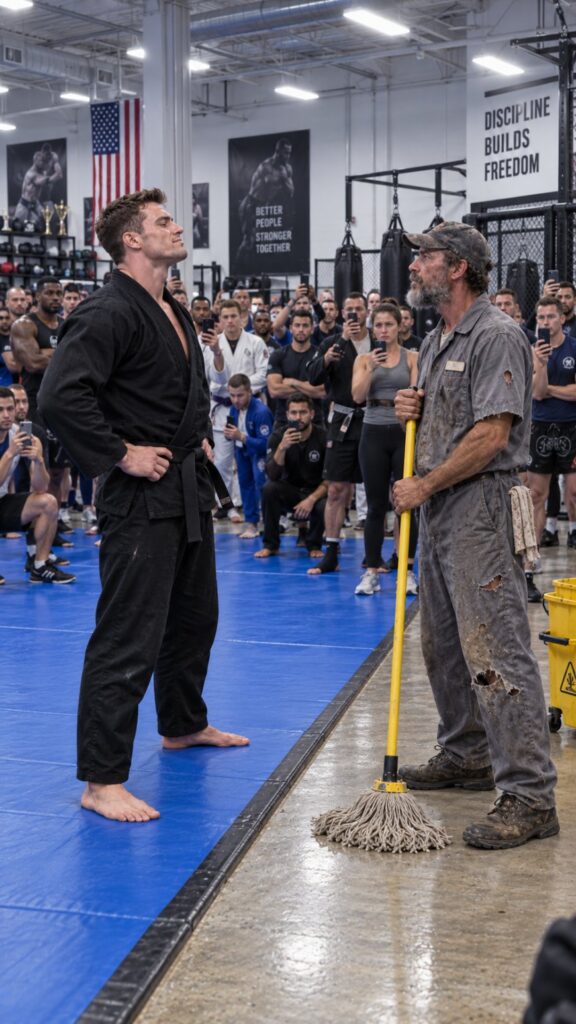
Nathan clicked a folder on his desktop. He had downloaded every single video Derek had ever posted of me. The video of me scrubbing the mat with my bare hands while Derek patted my head. The video of Derek kicking the pad so hard I crashed into the wall. The compilation of his black belt friends twisting my arms in the supply closet.
“The Lawsons have the money and the media,” Nathan said, folding his hands on the table. “But they are arrogant, and arrogant people leave paper trails.”
He reached into his leather bag and pulled out a thick manila folder, sliding it across the table toward me.
“I spent the last forty-eight hours pulling public records from the Texas Department of Licensing and Regulation,” Nathan continued, his voice hardening. “Lawson Combat Academy has three prior complaints filed against them in the last four years. All from former students. All alleging a severe pattern of bullying, public humiliation, and physical intimidation by Derek Lawson.”
I stared at the folder. “If this happened three times, how are they still open?”
“Because Grant Lawson threw money at the problem,” Nathan said in disgust. “All three cases were settled quietly out of court with strict non-disclosure agreements. No press coverage, no admission of guilt. They bought their way out of consequences. They thought they could do the same to you because you’re a janitor making minimum wage. They assumed you wouldn’t fight back.”
Nathan leaned forward, looking me dead in the eyes. “Jerome, you spent twelve years serving this country. You are a level-four combatives instructor. You know exactly what an assault looks like. What you did on that mat was the definition of controlled, proportional self-defense. You aren’t the defendant in this story. You are the evidence we are going to use to burn their predatory business to the ground. I’m taking your case. Pro bono. No fees. Are you in?”
I looked at Brenda. She gave me a firm, resolute nod. I looked back at the eviction notice on my fridge, and then at the folder of Derek’s victims. I reached across the table and shook Nathan’s hand.
The emergency hearing for the civil injunction was scheduled for Wednesday at 9:00 a.m. in Harris County Civil Court, Room 4B.
I arrived wearing the only suit I owned—a charcoal two-piece I had bought the day of my honorable discharge from the Army. It was nearly a decade old, the sleeves a half-inch too short, paired with an olive green tie. I had ironed it on my kitchen counter the night before. Nathan walked in beside me, carrying two massive binders, looking entirely at home in the chaotic hallway.
The courtroom was packed to the gills. The local press corps filled the back rows, their cameras restricted to the hall but their notebooks ready. To my surprise, the entire right side of the gallery was a sea of olive drab and unit patches. Nearly twenty local veterans had driven in from across Houston, San Antonio, and Austin. I didn’t know a single one of them personally, but they had seen the video, and they knew I was one of theirs.
Brenda sat in the second row, her hands folded neatly in her lap.
At the plaintiff’s table sat Grant Lawson in a bespoke charcoal suit, glaring daggers at me. Derek sat beside him, still wearing that ridiculous medical sling. Their high-priced attorney, Harold Whitfield, was organizing his notes with practiced, theatrical precision.
The judge, a stern-faced woman named Honorable Davis, called the room to order.
Whitfield stood up first for his opening argument. He paced the floor like an actor on a stage. He painted me as a sleeper agent of violence—a highly trained military weapon hiding behind a mop, waiting for an excuse to unleash my lethal skills on an unsuspecting civilian.
“Your Honor,” Whitfield boomed, gesturing dramatically toward me. “The respondent is not a simple janitor. He is a former Army combatives instructor. He is a man trained by the United States government to incapacitate, break, and neutralize human beings. He applied a rear-naked chokehold on my client—a lethal technique designed to restrict blood flow and render a person unconscious—in front of forty witnesses. This was not self-defense. It was a calculated, premeditated, and vicious ambush.”
When Derek took the stand, he delivered an Oscar-worthy performance. He looked at the floor, his voice trembling perfectly.
“I was just running my Friday evening class,” Derek testified under oath. “I invited Mr. Adams to participate. I thought it would be a fun, inclusive thing for the gym. He agreed. He stepped onto the mat voluntarily. And then… he just snapped. I was on the ground before I knew what happened. He was choking me. I tapped out because I genuinely believed he was going to snap my neck.”
Whitfield nodded sympathetically. “No further questions, Your Honor.”
It was Nathan’s turn. He didn’t pace. He didn’t yell. He stood up, buttoned his worn sport coat, and walked calmly to the podium, opening his laptop.





