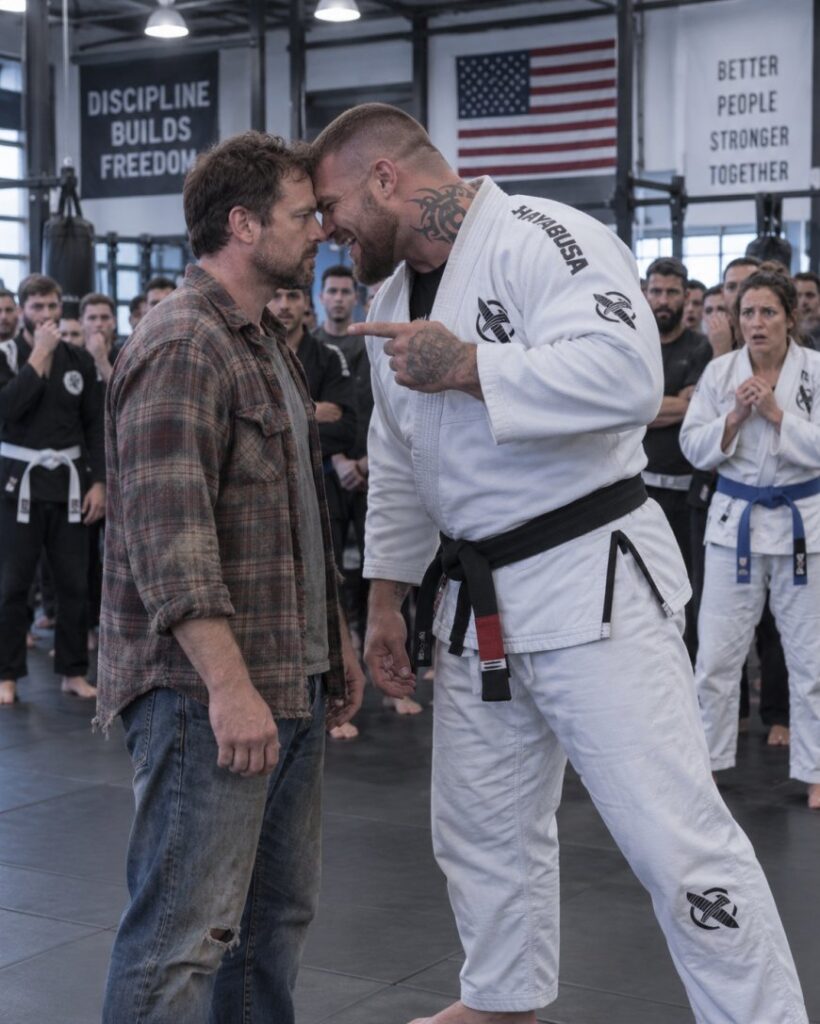
Bradley stood in the center of the room, surrounded by a dozen students. They were a mix of ages and abilities — a few college kids, a couple of older women, a man in his fifties with a bad knee. No white belts terrified of getting crushed. No women avoiding eye contact. Just people who wanted to learn.
Bradley was different. His voice was calm. His movements were patient. He demonstrated techniques slowly, explaining every step, making sure everyone understood. When a student made a mistake, he corrected them gently. When someone got frustrated, he paused and helped them breathe.
He was teaching. Not hurting. Not dominating. Not proving anything.
I watched for an hour. Then I slipped out the back door and drove home.
Chloe was waiting for me in the kitchen.
“Well?” she asked.
“He’s trying,” I said. “That’s all I can say.”
“Is that enough?”
I thought about it. Then I nodded.
“Yeah. I think it is.”
Winter came again. The first snow fell in early December. I stood at the window, watching the flakes drift down, covering the yard in white. The birdhouse was full of wrens, huddled together for warmth. They didn’t know anything about the violence of the world. They just lived.
Chloe came up behind me and wrapped her arms around my waist.
“What are you thinking about?” she asked.
“The future,” I said.
“What about it?”
I turned to face her. She was beautiful. Not just in the way she looked — though she was beautiful in that way too — but in the way she carried herself. The way she faced the world. The way she refused to be defined by her pain.
“I’m thinking about all the things we haven’t done yet,” I said. “All the places we haven’t seen. All the birdhouses we haven’t built. All the mornings we haven’t woken up together.”
She smiled. “That sounds like a lot.”
“It is.”
“Good.” She kissed me. “I’m looking forward to it.”
That night, I opened the cedar box one last time.
I held the trident in my hands, feeling its weight, tracing the eagle, the pistol, the anchor. The symbols of a life I had lived. A life I had survived. A life I had left behind.
I thought about the men I had served with. The ones who hadn’t come home. The ones who had come home but never really left. The ones who had come home and found a way to live.
I thought about Chloe. About the life we had built together. About the trust we had earned. About the love we shared.
I thought about Bradley. About the lesson I had taught him. About the lesson he was teaching others. About the possibility of redemption.
Then I closed the box. I latched it. I carried it back to the bookshelf and slid it into the bottom drawer.
I didn’t need it anymore. Not because I was ashamed of it. Not because I wanted to forget. But because I had finally accepted it. The trident was part of me. The violence was part of me. The past was part of me.
But it didn’t define me.
I walked upstairs. Chloe was already in bed, curled on her side, breathing softly. Her blue belt hung on the back of the chair, a symbol of everything she had earned.
I climbed into bed beside her. She shifted in her sleep, reaching for me, and I wrapped my arms around her.
For the first time in my life, I felt truly whole.
The years passed. Chloe earned her purple belt. Then her brown belt. Then her black belt. She opened her own gym — a small place, just like Bradley’s, focused on safety and respect. She taught self-defense to women, to children, to anyone who wanted to learn.
I stayed in IT. I built birdhouses. I cooked chili. I lived a quiet life.
Sometimes, late at night, I would think about the desert. About the men I had lost. About the things I had done. But the memories didn’t haunt me anymore. They were just memories. Part of my story. Part of who I was.
I never opened the cedar box again. But I knew it was there. And that was enough.
One spring afternoon, Chloe and I were sitting on the back porch, watching the birds. A family of wrens had moved into the latest birdhouse — a big cedar one with a copper roof and a tiny brass door.
“They look happy,” Chloe said.
“They do.”
She reached over and took my hand.
“Do you ever regret it?” she asked. “Leaving that life behind? Giving up the trident?”
I thought about it for a long time. Then I shook my head.
“No,” I said. “I don’t regret it. I never did.”
She smiled. “Good.”
We sat there in silence, watching the birds, watching the sun set, watching the world go by. It was a simple life. A quiet life. A life that most people would never understand.
But it was mine. And I had earned it.
THE END
This content may be created by AI for entertainment purposes. Any resemblance to real persons, events, or places is coincidental.





