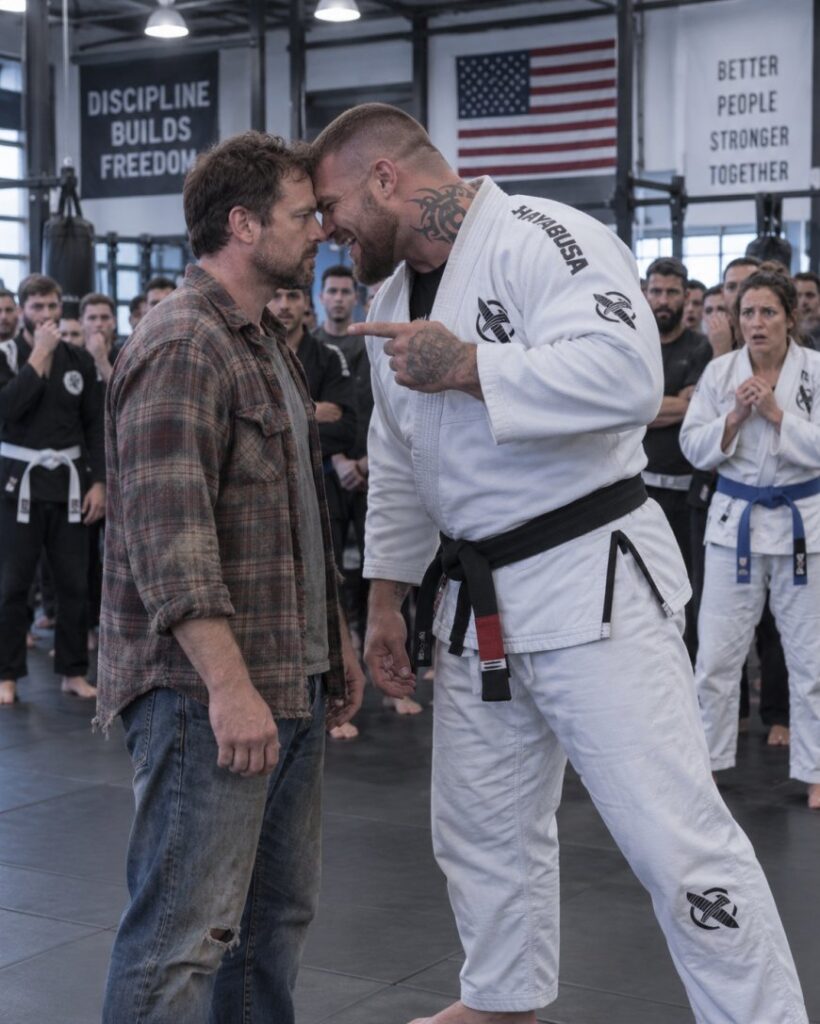
He tried a single-leg takedown. It was slow, telegraphed, powered more by hope than by skill. I sprawled easily, caught his head in a front headlock, and held him there for a moment. Not squeezing. Just holding. Letting him feel the weight of his own failure.
He tapped my forearm. Once. Twice.
I released him immediately. He stood up, rubbing his neck, staring at the mat. He wouldn’t look at me. He wouldn’t look at the crowd. His chest was still heaving, but the fight had gone out of him.
“Good,” I said. “That was better. You’re tired. Your technique is breaking down. But you’re still moving. That’s what matters.”
He didn’t respond. He just stood there, breathing, staring at his own feet.
“You know what separates a brown belt from a black belt?” I asked.
He shook his head.
“A black belt knows when to stop. He knows when the fight is over. He knows that technique without control is just violence. And violence without purpose is just cruelty.”
I stepped closer to him. Close enough that only he could hear me.
“You’ve been hurting people, Bradley. Not teaching them. Hurting them. You’ve been using this gym as a place to feed your ego, to prove to yourself that you’re strong. But strength isn’t domination. Strength is restraint. It’s knowing that you can break someone and choosing not to. It’s understanding that every white belt on these mats trusts you to teach them, not terrorize them.”
He looked up at me then. His eyes were wet. Not crying — he was too proud for that. But something had cracked inside him. Something that had been walled off for a long time.
“I —” he started.
“You don’t have to say anything,” I said. “Just think about it. That’s all I ask.”
I turned and walked off the mat. Chloe met me at the edge, her eyes wide, her hands still trembling slightly. She didn’t say anything. She just wrapped her arms around me and held on tight.
The drive home was quiet, but not the kind of quiet that feels heavy. This was a different kind of silence — the silence that comes after a storm has passed, when the air is clean and the world feels new. Chloe held my hand across the center console. She didn’t let go.
“You could have hurt him,” she said finally. “In there. You could have broken his arm or choked him unconscious. Everyone would have understood.”
“I know.”
“Why didn’t you?”
I stared at the road ahead. The sun was setting, painting the suburban sky in shades of orange and pink. It was beautiful in a way that felt almost foreign after the fluorescent light of the gym.
“Because he’s not the enemy,” I said. “He’s just lost. He built his whole identity around being tough, being dominant, being feared. And when that got taken away, he didn’t know who he was anymore. I’ve seen that before. I’ve felt that before. You can’t beat that out of someone. You can only show them another way.”
Chloe was quiet for a moment. Then she squeezed my hand.
“I’m proud of you,” she said.
“Even though I lied to you?”
“You didn’t lie. You just didn’t tell me everything.” She turned in her seat to look at me. “I understand why now. I see what you were trying to protect me from. And I see what you were trying to protect yourself from too.”
I pulled into our driveway. The garage light flickered on automatically, illuminating the half-finished birdhouse on my workbench. I sat in the truck for a moment, staring at it.
“Bradley reminds me of someone I used to be,” I said. “Someone I met in a place I don’t talk about. He was young. Angry. He thought violence was a tool for proving something. I watched him die in a way that made everything I believed about strength feel meaningless. I promised myself I would never be that person again. I would never let that part of me out unless there was no other choice.”
Chloe leaned her head against my shoulder.
“There’s always another choice,” she said. “You just have to be strong enough to make it.”
The next morning, I was in the garage before sunrise. The cedar birdhouse was nearly finished. I had added a small copper roof and a tiny brass hinge to the door. It was a simple thing — uncomplicated, clean, useful. It would house a family of wrens who would never know anything about the violence of the world. They would just live, and sing, and raise their young. That was enough.
Chloe came out around eight, carrying two mugs of coffee. She had her gym bag over her shoulder. Tuesday morning drilling session.
“You’re going back?”
“I told you,” she said, handing me a mug. “It’s my gym. I’m not letting anyone take that from me. Besides, Dave asked if I’d help with the fundamentals class. He’s short on upper belts now.”
I took a sip of coffee. Black. No sugar.
“I’m glad,” I said.
“I know you are.” She kissed my cheek. “I’ll be back around noon. Don’t burn down the garage.”
I watched her drive away, the truck growing smaller as it turned the corner. Then I went back to the birdhouse. The sanding was done. The finish was dry. All that remained was the final assembly.
I worked for hours. The sun climbed higher in the sky. The neighborhood woke up around me — lawnmowers starting, dogs barking, children playing. Normal sounds. Normal life.
I thought about Bradley. About what he would do now. Whether he would find another gym, another place to be a shark in a small pond. Or whether something had actually changed. I knew the odds weren’t good. Men like him rarely transformed overnight. But I also knew that seeds planted in the dark sometimes grew.





