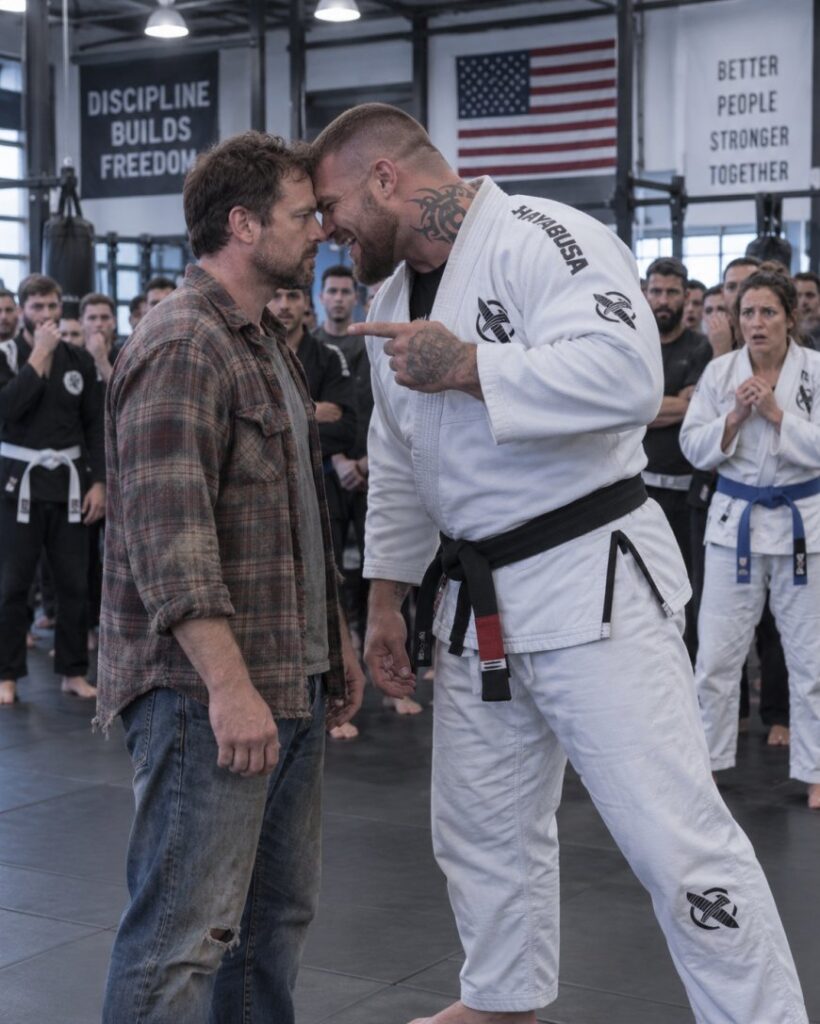
Around ten o’clock, my phone buzzed. A text from an unknown number.
This is Bradley. Dave gave me your number. I just wanted to say I’m sorry. For everything. I’m not looking for forgiveness. I just wanted you to know.
I stared at the message for a long time. Then I typed back:
Thanks. I hope you find what you’re looking for.
He didn’t respond. I didn’t expect him to.
Two weeks passed. The gym settled into a new rhythm. Without Bradley, the atmosphere shifted. The white belts stopped flinching. The women stopped avoiding eye contact. The whole place felt lighter, like a house with the windows finally open after a long winter.
Chloe threw herself into training with a new intensity. She was no longer just surviving the mats — she was thriving. She drilled loop chokes until her fingers cramped. She asked Dave for extra rolls. She came home with fresh bruises and a grin that lit up her entire face.
I watched her from my folding chair in the back row, my laptop open, code scrolling across the screen. But more often than not, I found myself watching her instead of the screen. Watching the way she moved. The way she learned. The way she refused to back down from a challenge.
She was stronger than me. Not physically — that had never been the point. But emotionally. She had a resilience that I had never fully understood. She spent her days absorbing the worst that humanity had to offer, and she still found joy in a sweaty gym, in the simple act of learning, in the quiet dignity of hard work.
I loved her more in those moments than I had ever loved her before.
The promotion came on a Friday night in late spring. The gym was packed — members from affiliate schools, families, friends. Someone had brought balloons. Someone else had brought a cake shaped like a black belt.
Chloe walked to the center of the mat when Dave called her name. Her face was calm, but I could see the excitement in her eyes. She had worked for this. Earned it. Not just the belt, but the knowledge that she could handle herself in any situation.
Dave tied the blue belt around her waist. The crowd applauded. Then he grabbed her lapels and threw her — a clean, beautiful hip toss that sent her flying through the air and landing flat on her back with a slap that echoed through the warehouse.
She popped up immediately, grinning, and bowed to Dave. Then she turned and found me in the crowd. Her eyes locked onto mine, and she smiled — a smile that said more than words ever could.
I nodded. She nodded back.
After the ceremony, I found her near the water cooler, surrounded by training partners. She was laughing, talking, gesturing with her hands. She looked happy. Truly happy. The kind of happiness that came from earning something, not being given it.
Dave walked over to me while she was distracted.
“You know,” he said, “we’ve got a spot open on the instructor team. Now that Bradley’s gone, we’re stretched thin. I could use someone with your experience.”
I shook my head. “I appreciate that. But I’m not an instructor. I’m just a guy who works in IT.”
Dave laughed. “You keep saying that. But I saw what you did on those mats. That wasn’t IT training.”
“It wasn’t something I’m proud of,” I said quietly.
Dave nodded slowly. He didn’t push. He just stood there for a moment, watching the students roll.
“You know what the hardest part of this job is?” he asked. “It’s not teaching technique. It’s teaching people to trust each other. To understand that when you’re on the mats with someone, you’re both responsible for each other’s safety. That’s the foundation of everything we do. Without trust, it’s just fighting.”
I nodded. “That’s true of a lot of things.”
“Yeah.” Dave looked at me. “I think you understand that better than most.”
He walked back to the mats, leaving me alone with my thoughts.
Summer came. The days grew longer. The air grew heavier. Chloe and I settled into a new routine. She trained. I worked. We cooked dinner together. We watched movies. We built birdhouses. We made love on Sunday mornings when the sun streamed through the bedroom windows and the world felt far away.
I didn’t open the cedar box again. I didn’t need to. The trident was still there, resting on its bed of faded blue felt, waiting. It would always be waiting. But I didn’t need to look at it to remember who I was. I didn’t need to touch it to know what I had done.
I carried it with me every day — not as a burden, but as a reminder. A reminder that violence was a tool. A tool that I had used, and used well, but a tool that I had chosen to put down. A tool that I would pick up again only if I had no other choice.
That was the difference between me and Bradley. Not skill. Not strength. Choice.
The parking lot confrontation happened on a Tuesday. It was late August. The heat was relentless. I had just finished a job — a network security audit for a small accounting firm downtown — and I was walking to my truck when I saw him.
Bradley was standing by a beat-up sedan, leaning against the hood, arms crossed. He was wearing jeans and a plain white t-shirt. No gi. No tribal tattoos visible. He looked different. Smaller. Less dangerous.
“Colin,” he said.
“Bradley.”
He pushed himself off the car and walked toward me. I didn’t move. I didn’t tense. I just waited.
“I wanted to talk to you,” he said. “In person. I’ve been thinking about what you said. About strength. About restraint. About the difference between teaching and hurting.”
“And?”





