Influence was not always illegal.
Sometimes it was simply protected by habit.
But his company lost its privileged role in the program.
An audit revealed that several donations had been publicly inflated and privately restricted.
The organization returned the remaining restricted money.
Grant stopped attending games.
Years later, he appeared at one of Tyler’s college-club games and sat alone in the last row.
Tyler noticed him.
He did not leave the field.
People could change slowly.
Or not at all.
The game still had to be played.
On opening day at the South Atlanta Diamond Center, thousands of people filled the new stadium.
Children ran across clean fields carrying gloves with their names written inside.
Buses arrived from neighborhoods that had never had baseball transportation.
The indoor facility contained pitching machines, classrooms, and a dining hall.
A medical clinic offered free injury evaluations.
A wall near the entrance displayed photographs from the championship.
Javier’s slide.
The team holding the trophy.
Coach Pierce at the microphone.
And Malik running beneath the lights.
The final photograph showed him opening his glove for the umpire.
Earl stood beneath it wearing a new suit.
The faded Braves cap remained on his head.
“You could’ve dressed properly,” Malik said.
“I did.”
“The cap.”
“The cap built character.”
“The cap has a hole.”
“Character needs ventilation.”
The opening ceremony included no ceremonial check.
No single person claimed the complex.
The names on the main wall belonged to neighborhoods, not sponsors.
Mechanicsville.
Pittsburgh.
Sylvan Hills.
Capitol View.
South Atlanta.
Danielle stood with Nia near the first-base line.
Nia was ten now and playing softball.
Her sign from the championship hung in Malik’s bedroom.
The letters had faded.
Before the first game, Earl handed Malik a baseball.
“You are throwing the opening pitch.”
“I’m an outfielder.”
“Try not to embarrass us.”
Malik walked to the mound.
Children filled the stands.
Coach Pierce crouched behind home plate.
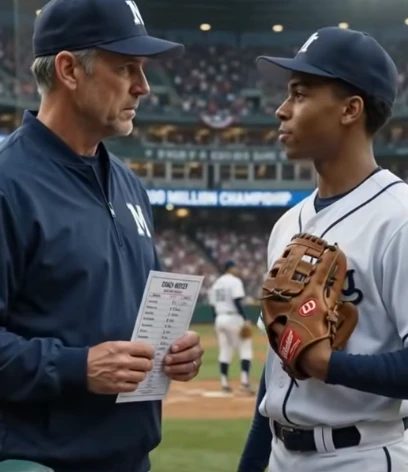
The same coach who had once walked toward right field to remove him now waited to receive the first pitch in a building Malik’s catch had helped save.
Malik looked toward Earl.
The old man tapped his cane once against the ground.
First step.
Malik threw.
The ball crossed the plate.
Coach Pierce caught it cleanly.
The crowd applauded.
Later that evening, Malik walked alone toward right field.
The new stadium lights were brighter than the ones from the championship.
The wall was higher.
The grass was perfect.
He stood where an outfielder would position himself against a left-handed power hitter.
He imagined the crack of the bat.
The ball rising.
The runner leaving third.
The coach walking toward him.
For years, people described the catch as the moment that won one hundred million dollars.
Malik knew that was not completely true.
The grant was not saved by one play.
It was saved by Earl speaking.
By Coach Pierce confessing.
By Tyler refusing to let his father hide behind him.
By parents demanding rules that did not change depending on who wrote checks.
By a board deciding that opportunity without protection was only another promise wealthy people could control.
The catch gave everyone a moment they could see.
The real work happened afterward.
Rules.
Audits.
Transportation schedules.
Scholarship forms.
Adults being watched when they thought no one important was looking.
Malik opened the old glove.
The championship baseball sat in the pocket.
The leather around it was dark and worn.
He remembered standing halfway to the dugout.
He remembered how small he felt.
Not because he doubted his ability.
Because an adult with power had looked at everything he earned and decided money mattered more.
Then Earl spoke.
Malik often wondered what would have happened if the old man had remained quiet.
Tyler would have entered right field.
Maybe Tyler would have made the catch.
Maybe he would not.
People would have called the result strategy.
Coach Pierce would have told himself he protected the program.
Grant Knox would have stood in every photograph.
And Malik would have learned a lesson far more dangerous than losing.
He would have learned that excellence could be taken from him without explanation and that surviving required silence.
Instead, the whole stadium saw the choice.
That mattered.
Years later, when Malik returned to the Diamond Center during college breaks, younger players asked him about the famous catch.
They wanted to know whether he was afraid of the wall.
Whether he lost the ball in the lights.
Whether he knew the grant depended on it.
Malik always showed them the first two seconds of the video.
Not the collision.
Not the glove opening.
The first step.
“That’s where the catch happened,” he said.
The children usually disagreed.
“The ball was still in the air.”
“Exactly.”
He explained that an outfielder’s first movement was often made before certainty arrived.
The body had to commit while the mind was still calculating.
A bad first step made speed useless.
A good first step turned distance into possibility.
Then Malik told them something Earl had taught him beyond baseball.
“The same thing happens when people are treated unfairly.”
The children listened.
“The final result may come later. But someone has to take the first step before everyone knows how it ends.”
Earl had taken that step beside the fence.
Coach Pierce had taken another with the microphone.
Tyler had taken one when he stepped away from his father.
Malik had taken his when he turned back toward right field.
The one-hundred-million-dollar championship did fall from the sky.
But money was never what Malik felt strike the glove.
He felt every early bus ride.
Every practice in taped cleats.
Every whisper that he did not belong.
Every ground ball he collected after the wealthier families had gone home.
Every sunrise when Earl taught him to run toward a spot no one else could see.
The ball landed in his hand because he had prepared for a moment that powerful adults nearly stole from him.
And when he lifted the glove, the stadium did not only see an out.





