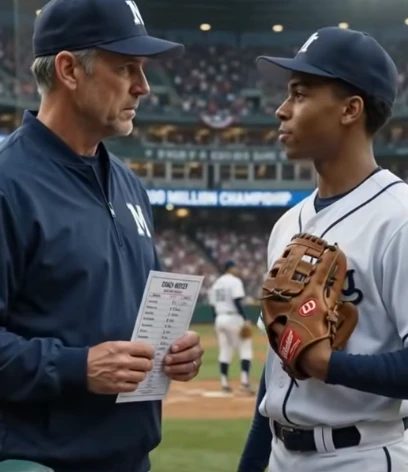
Grant ignored her.
He faced Earl.
“Without my ten-million-dollar commitment, your complex has a funding gap.”
Earl looked toward the Initiative representative.
A woman named Dr. Helen Monroe opened the ceremonial document.
“The Diamond Futures board received an amended commitment this afternoon,” she said.
Grant frowned.
“From whom?”
Helen smiled slightly.
“Several donors who requested anonymity until the program evaluation was complete.”
Earl took the microphone.
“The additional commitment is twelve million dollars.”
The stadium erupted.
Grant’s face went still.
Earl continued.
“The new donors attached one condition.”
He looked toward Malik and the other players.
“No individual sponsor may influence team selection, scholarship decisions, or employment.”
The applause grew louder.
Grant removed his sunglasses.
“You arranged this.”
“I prepared for the possibility that you would confuse generosity with control.”
“You cannot remove my company from the project.”
“The board can reject restricted funds.”
“My name is on the development proposal.”
“Names can be removed.”
Grant stared at the crowd.
For years, people had thanked him before thanking coaches, parents, or players.
He had become accustomed to gratitude arriving before questions.
Now the same field that once treated his money as authority was watching him lose both.
Tyler stepped away from his father.
Grant looked at him.
“Come with me.”
Tyler shook his head.
“I’m staying with the team.”
“You barely played.”
“I’m still on the team.”
Grant’s face reddened.
“After the way they embarrassed us?”
Malik heard.
So did every player nearby.
Tyler looked at his father.
“They didn’t embarrass us.”
He glanced toward Malik.
“You did.”
Grant walked off the field alone.
No cameras followed.
The Diamond Futures board did not announce its final decision that night.
Earl explained that the championship completed only one part of the evaluation.
The board would meet the following morning.
The team received its trophy.
The players cut down a section of the netting behind home plate.
Families took photographs.
But the one-hundred-million-dollar future remained uncertain.
On the bus ride home, no one sang.
The trophy sat in the front seat.
Malik rested his injured shoulder against the window.
Danielle had taken Nia home in a friend’s car.
Coach Pierce sat alone near the front.
Tyler occupied the seat across the aisle from Malik.
After twenty minutes, Tyler spoke.
“Does your shoulder hurt?”
“Yes.”
“Mine would.”
Malik looked at him.
“That’s helpful.”
Tyler stared at his hands.
“My dad says Earl wants to destroy everything he built.”
“What did he build?”
“The donor program.”
“You mean the thing where your family gets new equipment first?”
Tyler nodded.
Malik had expected him to argue.
“I didn’t know that money was restricted,” Tyler said.
“I didn’t either.”
“My dad told me he paid for everything.”
“He didn’t.”
“No.”
The bus moved through downtown Atlanta.
Buildings reflected across the dark windows.
Tyler looked toward the trophy.
“I wanted to be on the field.”
“I know.”
“I kept imagining the picture.”
Malik waited.
“My dad said it would help with private school applications.”
“So you knew.”
“I knew he was talking to Coach Pierce. I didn’t know he’d take you out right then.”
“You still put your glove on.”
Tyler nodded.
The bus hummed.
Malik thought about what his mother often said after difficult hospital shifts.
An explanation could help a person understand a wound.
It did not close it.
“I’m not ready to be your friend,” Malik said.
Tyler looked at him.
“I know.”
“But you told me about my shoulder.”
“Yes.”
“That helped.”
Tyler nodded again.
It was a small beginning.
Not forgiveness.
Not yet.
The next morning, Malik woke with his arm in a sling.
The emergency clinic diagnosed a deep bruise and mild shoulder strain.
No fracture.
He would need rest.
Danielle sat beside him at the kitchen table while Nia ate cereal from the championship cap.
“You cannot use that as a bowl,” Danielle said.
Nia lifted the cap.
“It works.”
“It is fabric.”
Malik smiled despite the pain.
His phone had not stopped vibrating.
Videos of the catch were everywhere.
News stations called it the One-Hundred-Million-Dollar Catch.
Slow-motion clips showed Malik’s first step before the ball reached its highest point.
Former major league outfielders analyzed his route.
One television commentator said the catch displayed “professional anticipation.”
Another asked where Malik had received elite training.
Malik laughed when he heard that.
His elite training had come from Earl hitting chipped baseballs on an uneven public field before sunrise.
At ten, Earl knocked on the apartment door.
He wore the same faded Braves cap.
Nia opened the door.
“You’re famous,” she told him.
“I was hoping to avoid that.”
“You were on television.”
“That is usually how avoiding fame fails.”
Danielle invited him inside.
Earl sat at the table.
Malik looked at the cane.
“You never told me who you were.”
“You never asked.”
“I asked if you played.”
“And I said a little.”
“You played nine years.”
“That is little compared with some people.”
“You were a player-development director.”
Earl removed his cap.
“I was.”
“You knew about the grant the whole time.”
“Yes.”
“Did you train me because of the evaluation?”
Earl’s expression changed.
“No.”
“Then why?”
“Because you stayed after practice to pick up balls no one asked you to collect.”
Malik waited.
“And because the first time I hit one over your head, you did not blame the sun.”
“What did I do?”
“You asked me to hit another.”
Malik looked at the sling.
“Did the board decide?”
“They are meeting now.”
“Why aren’t you there?”
“I submitted my vote.”
“What was it?”
Earl looked at Danielle.
Then back at Malik.
“I voted yes.”
Malik exhaled.
“That doesn’t mean the others will.”
“No.”
“Coach Pierce admitted everything.”
“He did.”
“Does that help?”
“It helps establish truth. It does not erase what happened.”
Danielle leaned forward.
“What would the board need to approve the program?”
“Governance changes. Independent scholarship control. Written limits on donor influence. A new oversight committee.”
“Would Randall remain coach?”
“That is not my decision alone.”





