The crowd chanted his name.
“Ma-lik!”
“Ma-lik!”
Nia held the sign above her head.
Danielle was crying openly.
As Malik approached the foul line, Earl Jennings touched the brim of his cap.
Malik nodded.
No smile.
Not yet.
There was still a game.
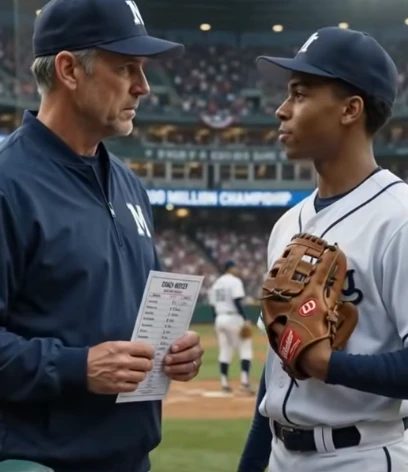
Coach Pierce met him near the dugout entrance.
“Are you hurt?”
“My shoulder.”
“Can you move it?”
Malik lifted his arm.
Pain ran from his collarbone to his elbow.
He kept his face still.
“I’m good.”
The coach looked toward the trainer.
Before he could speak, Grant Knox descended the steps from the stands.
He stopped near the dugout gate.
“What was that?” he demanded.
Coach Pierce turned.
“Not now.”
“I told you Tyler needed to be on the field.”
Malik heard every word.
So did Tyler.
The boy stood several feet away, holding the new glove against his chest.
Coach Pierce lowered his voice.
“Malik made the catch.”
“That is not the point.”
“It is exactly the point.”
Grant glanced at the cameras.
“Do you understand how much my family has invested in this program?”
Earl’s cane tapped against the concrete behind him.
“Less than you’ve taken credit for.”
Grant turned.
His face changed when he saw Earl at close range.
“You.”
Earl stepped forward.
“You remember me.”
Grant removed his sunglasses.
“I remember a man who was asked not to interfere with team operations.”
Earl looked toward the dugout.
“I remember a man who wanted his name printed larger than the children’s.”
Coach Pierce looked between them.
“What is this?”
Grant spoke first.
“Earl used to consult for the Diamond Futures board. He no longer does.”
One of the scouts near the fence laughed quietly.
Earl heard him.
“Is that what you told people?”
Grant’s expression hardened.
Earl removed the faded Braves cap.
The old man’s posture changed.
For years, he had walked around South Atlanta with a cane and grass stains on his shirt.
Now the people who recognized him saw the man beneath the disguise.
Earl Jennings had spent nine seasons as a professional outfielder.
He never became a superstar.
He played defense late in games.
He stole bases.
He made catches that appeared in old highlight reels.
After retiring, he became a scout.
Then a farm-system director.
Then the first Black executive to oversee player development for one of the region’s major baseball organizations.
He had discovered players in fields no other scout bothered to visit.
He built training programs in rural Georgia.
He helped create scholarship systems for athletes without travel-team connections.
When he retired from professional baseball, he became one of the original trustees of the Diamond Futures Initiative.
The one-hundred-million-dollar grant had not been Grant Knox’s idea.
It had been Earl’s.
The old man looked at Coach Pierce.
“I didn’t leave the board.”
Coach Pierce went still.
Grant tried to laugh.
“This is neither the time nor place.”
Earl reached into his shirt pocket and removed a folded identification card.
He handed it to the coach.
EARL JENNINGS
FOUNDING TRUSTEE — DIAMOND FUTURES INITIATIVE
Coach Pierce read it.
Then read it again.
Grant stepped closer.
“You have a ceremonial title.”
“I hold one of seven deciding votes.”
The dugout became silent.
Earl looked toward Malik.
“And I have spent this season evaluating whether this program deserves the grant.”
Coach Pierce’s face lost color.
“You were evaluating us?”
“Every practice.”
“You never said anything.”
“I wanted to see what happened when adults thought no one important was watching.”
The words landed harder than shouting.
Earl turned toward Grant.
“I saw transportation denied to boys whose parents could not leave work.”
Grant folded his arms.
“That was a budget decision.”
“I saw new equipment reserved for sponsor families.”
“Those families funded the purchases.”
“The equipment came from a nonprofit account.”
Grant’s jaw tightened.
Earl continued.
“I saw you pressure coaches about playing time.”
“I made suggestions.”
“You threatened donations.”
“My contributions kept this program alive.”
“And that made you believe you owned the children.”
The bottom of the seventh inning was about to begin.
The umpire called for the Stars’ first batter.
Coach Pierce looked toward his lineup card.
Malik was due to bat fourth.
The team had thirty seconds to prepare.
Earl placed the trustee card back into his pocket.
“Finish the game,” he said.
Grant pointed toward him.
“This conversation is not over.”
“No,” Earl replied. “It is finally beginning.”
The first Stars batter struck out.
The second grounded to short.
Two outs.
No one on base.
If the Stars failed to score, the game would enter extra innings.
Javier Ruiz came to the plate next.
He had thrown the entire game and looked exhausted.
He fouled off two pitches.
Then he hit a slow ground ball toward third.
The North County third baseman charged.
Javier ran with everything he had.
The throw arrived low.
The first baseman scooped it.
The umpire spread his arms.
“Safe!”
The Stars’ dugout erupted.
Malik was next.
Coach Pierce turned toward him.
“Can you swing?”
Malik tested his shoulder.
The movement hurt.
He picked up his bat.
“I can swing.”
The coach studied him.
For the first time that day, there was no donor in his eyes.
No camera.
No calculation.
Only the player.
“Then hit.”
Malik walked toward home plate.
The crowd rose again.
The North County coach changed pitchers.
A tall right-hander named Connor Blake entered from the bullpen.
Connor threw harder than anyone Malik had faced that season.
His fastball reached the mid-eighties.
His slider broke late.
As the pitcher warmed up, Tyler approached Malik near the on-deck circle.
Malik expected him to apologize.
Tyler stared at the dirt.
“My dad told Coach Pierce I had to play.”
Malik tightened his batting gloves.
“I know.”
“I didn’t ask him to do it.”
“You put your glove on.”
Tyler flinched.
Malik regretted the sharpness but did not take it back.
“I thought if I said no, he’d be mad.”
Malik looked toward Grant.
“So you let him be mad at me instead.”





