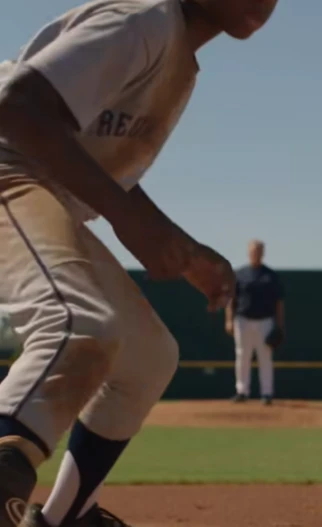
“But it tells me how quickly you’re going to throw.”
For the first time, Dennis smiled.
“Now we’re getting somewhere.”
The coach stood and called for Tyler to return to the mound.
He wanted a sequence of controlled repetitions, not a reckless contest in which a teenager could be injured by a badly timed slide or an overthrown ball.
Jordan would take a lead.
Tyler would alternate between pitching home and attempting a pickoff.
Chase would receive the pitches and make his normal throws when a steal was attempted.
Dennis would watch for balks, false starts, and anything that gave either side an unfair advantage.
The car was not going to be transferred in the parking lot that afternoon.
Everyone understood that.
But the promise had been made in front of witnesses, and Dennis was determined that Chase would at least give the kid a fair chance.
As the players reset, Jordan noticed someone standing in the dugout entrance.
A man in a navy jacket was watching him with a strange intensity.
He was older than Dennis, perhaps in his late sixties, with silver hair, a narrow face, and a small leather notebook tucked beneath one arm.
Jordan had seen him around the stadium once or twice, usually speaking with the front-office staff.
He assumed the man was a scout or an executive.
Dennis noticed him, too.
“Walt,” he called.
“Didn’t know you were here.”
Walter Bennett stepped onto the grass.
“Was supposed to meet the general manager,” he said.
“Then I saw everyone staring at a boy’s feet.”
Chase gave a short laugh.
“Perfect.
Another expert.”
Walter ignored him and walked toward Jordan.
“What is your name, son?”
“Jordan Price.”
“Do you play?”
“Not anymore.”
“Why not?”
Jordan looked at Dennis, uncertain whether he should answer.
“Equipment costs money,” Walter said quietly.
“And sometimes life gets in the way.”
Jordan looked up.
“Yes, sir.”
Walter studied the boy’s cleats, then the distance between first and second base.
“Show me what you saw.”
Jordan pointed toward Tyler.
“He holds his weight differently when he picks over.
With Rafael, the clue was later.
I wasn’t sure until his front knee started moving.”
Walter’s face changed almost imperceptibly.
“You noticed the difference between an early cue and a commitment cue.”
Jordan didn’t know the terminology, but he understood the distinction.
“I think so.”
Walter opened his notebook.
“Who taught you that?”
“My dad.”
“Was he a player?”
“Local league.
Nothing professional.”
“What was his name?”
“Marcus Price.”
The notebook stopped moving.
Walter looked directly at Jordan.
“Marcus Price?”
Jordan nodded.
“From the Eastside youth league?”
“I think so.
He played there when he was younger.”
For several seconds, Walter said nothing.
Then he closed the notebook.
“Let’s see the next attempt.”
Jordan returned to first.
Tyler took his position.
Chase crouched behind home plate, still visibly irritated.
“Try to steal on me,” the catcher called.
“Let’s get this over with.”
Jordan settled into his lead.
The stadium seemed quieter than before.
Even the players near the batting cage had stopped talking.
Somewhere above them, a metal door slammed, and the sound echoed around the empty upper deck.
Tyler came set.
Jordan watched the pitcher’s back foot, but he also watched the angle of his shoulders and the slight turn of his head.
He remembered his father’s voice from years earlier, explaining that a runner should never confuse a habit with a guarantee.
A habit gave you a clue.
A guarantee did not exist.
Tyler began his delivery.
Jordan took off.
Chase received the pitch, transferred the ball, and fired toward second in one fluid motion.
The throw arrived chest-high, and the second baseman caught it cleanly.
Jordan slid beneath the tag.
“Safe!”
The umpire’s call came so quickly that Chase remained in his throwing follow-through for a moment, as though he hadn’t heard it.
Jordan lay on the dirt, staring up at the sky.
He had done it.
Not against Rafael, not against an ordinary catcher, but against Chase Dalton himself.
The team erupted again.
One of the younger pitchers ran toward second and offered Jordan a hand.
Jordan took it, rising slowly as the others crowded around him.
Chase removed his mask.
“How?”
Jordan dusted his pants.
“You shifted your weight forward before Tyler released the ball.
Your glove was already moving, but your shoulders were still square.
I knew you were preparing for a fast transfer, so I had to go on the earliest reliable sign from Tyler.”
Chase stared at him.
“You watched me and the pitcher at the same time?”
“I watched both.”
“That’s impossible.”
“Not if you know where to look.”
The words came out more sharply than Jordan intended.
He immediately regretted them.
But Walter Bennett had heard every word.
The older man walked onto the infield, his expression grave.
“Jordan, I need to ask you something.
When your father taught you to watch a pitcher, did he ever mention a man named Ray Holloway?”
Jordan frowned.
“No, sir.
I don’t think so.”
Walter glanced at Dennis.
Then he looked toward the empty dugout, where a framed photograph of an old River City Falcons team hung above the equipment shelves.
“Because,” Walter said slowly, “your father was the only young player I ever saw who could read a pitcher’s delivery the way you just did.
And there’s something about his time with this organization that nobody has explained to you.”





