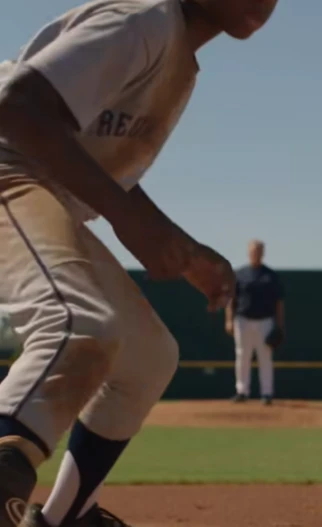
The six-foot-four pitcher was famous for fastballs regularly reaching triple-digit speeds.
“What’d I miss?”
Rafael asked.
Chase pointed toward Jordan.
“Apparently, this kid thinks he’s Rickey Henderson.”
Rafael looked at the teenager’s taped-up cleats.
“You’re serious?”
Dennis nodded.
“From the stretch.”
Rafael smiled, but Dennis wasn’t smiling anymore.
He had just witnessed something extraordinary, and now he wanted to know whether the boy could do it again.
Jordan stood near first base, staring at one of baseball’s fastest pitchers.
Chase’s luxury sports car was still on the line, and every player was watching.
Then Rafael gripped the ball, stepped onto the rubber, and made his first move…
Rafael came set.
His hands rested comfortably at his chest.
His shoulders were square to home plate, and his expression carried the easy confidence of someone who had spent years making difficult things look simple.
Jordan took his lead.
Three steps.
Half a step more.
He bent his knees and let his arms hang loosely.
His body wanted to lean toward second, but he resisted.
He had learned from watching hundreds of runners on the stadium monitors that the first movement often betrayed the rest.
Lean too early, and a pitcher knew exactly where you intended to go.
“Ready?”
Dennis called.
Jordan nodded.
Rafael looked toward Chase, then back at the runner.
The pitcher’s front shoulder dipped.
Jordan stayed put.
Rafael’s eyes narrowed.
He paused, brought his hands together, and shifted his weight.
His right heel rose slightly, but the movement was too small to interpret confidently.
Jordan’s mind raced through the possibilities.
Tyler had a habit.
Rafael had a different body, a different delivery, and a different rhythm.
A clue that worked on one pitcher could be useless against another.
The important question wasn’t whether Rafael moved his heel.
It was whether the movement meant the same thing every time.
Rafael lifted his front leg.
Jordan exploded toward second.
“Pick!”
Dennis shouted.
Rafael’s foot came down, and his throwing arm moved toward first base.
The ball shot from his hand like a white streak.
Jordan twisted back, throwing himself toward the bag as the first baseman stretched for the catch.
The ball struck the glove with a sharp pop.
“Out!”
Chase yelled.
But the umpire Dennis had called over from the practice infield raised both hands.
“Safe!
Runner’s back!”
Jordan’s fingertips were on the front edge of first base.
Rafael’s throw had arrived in time, but the first baseman had failed to keep the tag on Jordan’s arm as he reached back.
Chase stood up.
“He was going!”
“He was going back,” Dennis replied.
“That’s the point.”
Jordan dusted his uniform and returned to his lead.
Rafael looked at him with a different expression now.
The smile had disappeared.
“You saw the pick?”
“I thought I did.”
“Thought?”
“I wasn’t sure until your front foot came down.”
Dennis stepped closer.
“Explain.”
Jordan swallowed.
“You looked at the bag twice.
The second time, your eyes moved before your shoulder.
I thought you were trying to make me expect a pickoff.
Then your heel lifted, but your front leg didn’t start forward.
I wasn’t certain.”
Rafael slowly rolled the ball between his fingers.
“Most guys in the majors don’t explain my motion that well.”
“Most guys in the majors get paid to play,” Chase said.
“This kid gets paid to collect baseballs.”
The words landed harder than Jordan expected.
He glanced toward the upper deck.
His mother had finished wiping the railings and was now carrying her cleaning bucket toward the stairs.
She had not noticed the gathering around the infield.
Jordan could already imagine the conversation if she heard about the car wager.
She would tell him not to get involved with grown men who made promises for laughs.
She would remind him that his job was to keep his grades up, help at home, and stay out of trouble.
She would be right.
But she had also been the person who taught him never to pretend he hadn’t seen something simply because someone else refused to believe it.
When Jordan was nine, she had taken him to a public baseball clinic after he spent weeks drawing little diagrams of the players on television.
They couldn’t afford the registration fee, so she’d spoken to the organizer and offered to clean the clubhouse afterward.
Jordan had spent the morning watching the catchers rather than the batters.
On the ride home, he had asked why one catcher moved his glove before the pitcher started his delivery.
“Maybe he knows where the ball is going,” Tamara had said.
“How?”
She had looked at him in the rearview mirror.
“Maybe he pays attention to things other people don’t.”
That sentence had stayed with him.
A year later, when Jordan’s father died unexpectedly after a heart attack, baseball became something he could study without having to explain how he felt.
His father, Marcus Price, had loved the game.
He had played on a neighborhood team until a shoulder injury ended his chances of advancing, and he used to sit with Jordan on their apartment balcony, talking through old games and arguing about stolen bases.
Marcus had never played professionally.
He had never claimed to be an expert.
But he had taught his son that a player who watched carefully could sometimes see a game differently from someone who only played it.
After Marcus died, Tamara worked more shifts.
Jordan stopped attending his school baseball program because the fees, equipment, and transportation had become too expensive.
He never stopped watching.
He studied televised games on a secondhand laptop whose screen flickered whenever the charging cable moved.
He replayed stolen-base attempts until he could recognize a catcher’s transfer from glove to hand.
He watched pitchers’ feet, hips, shoulders, and eyes.
When Falcon Park hired him to retrieve practice balls and keep the dugout areas tidy, he discovered that being overlooked had an advantage.
Nobody expected the ball boy to be watching the game.
“Again,” Dennis said.





