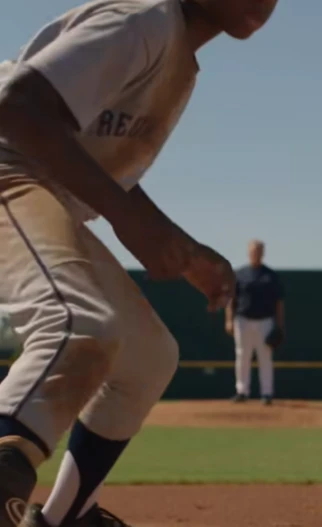
Jordan blinked and returned his attention to the field.
Rafael tossed the ball to the first baseman, who threw it back.
“Same lead,” Dennis instructed.
“No guessing.
Watch.”
Jordan stepped away from the bag.
Rafael came set.
This time, the pitcher did not look at first base.
He stared toward home, held the ball still, and waited.
One second.
Two.
Three.
Jordan remained motionless.
Rafael lifted his front leg and drove toward the plate.
Jordan broke.
His first step was explosive, his second longer than the first, and his third carried him past the point where a slower runner would have begun to lose balance.
He kept his head down, pumping his arms.
Behind home plate, Chase received the pitch and came out of his crouch.
The ball was in his throwing hand almost instantly.
Jordan heard the footfalls behind him, then the baseball snapping into the second baseman’s glove.
He slid.
Dirt burst around his legs.
His right hand reached for the front of the bag just as the tag swept down toward his left shoulder.
“Safe!” the umpire shouted.
For half a second, nobody spoke.
Jordan lay stretched across the dirt, one hand gripping second base.
His chest rose and fell rapidly.
His taped cleats had left two dark streaks in the ground.
Then a player near the dugout yelled, “He got there!”
The rest of the team erupted.
Chase stood behind home plate, mask hanging from one hand.
“Hold on,” he said.
“That was a bad jump.”
Dennis turned to the umpire.
“What did you see?”
“The runner broke after the pitcher committed to the plate.
Good jump, excellent acceleration, close tag.
Safe.”
Rafael stared at Jordan.
“You weren’t even looking at me when you took off.”
Jordan pushed himself up.
“I was watching your front knee in my peripheral vision.”
“Why?”
“Your back heel stopped moving.
The tension shifted forward.
Your knee started rising a fraction before your shoulders moved.
I thought you were committed.”
Rafael’s eyebrows rose.
“Thought you were committed,” he repeated.
“And you went anyway.”
Jordan nodded.
“That’s stealing a base,” Dennis said.
“You don’t get certainty.
You get a window.”
Chase walked out from behind the plate, his expression caught between disbelief and annoyance.
“Fine.
He got one.”
“One?”
Dennis asked.
“He’s safe at second.”
“You said steal second once against me.
He stole second against Rafael.”
The coach looked at Chase for a long moment.
“You’re going to pretend you didn’t hear yourself make the wager?”
Chase glanced at his teammates.
He could have laughed it off, offered the boy a handshake, and admitted that his joke had backfired.
Instead, he chose the only response that would preserve his pride in front of the men who had watched him boast.
“The bet was that he could steal against me,” he said.
“Not against somebody else.”
Dennis folded his arms.
“Then catch him.”
A chorus of laughter rose from the dugout.
Chase’s jaw tightened.
Jordan stood between second and first, unsure whether he wanted another attempt.
He had proved something, but the excitement in his chest was mixed with a familiar discomfort.
The men surrounding him were not schoolboys.
They were professionals, and he was a fourteen-year-old employee wearing a uniform that smelled faintly of detergent and the dusty storage room.
He didn’t want to become a joke.
He also didn’t want to let Chase turn the whole thing into one.
“I can try against you,” Jordan said quietly.
Chase looked at him.
“What was that?”
“I said I can try against you.”
The catcher laughed once, without humor.
“Kid, do you understand what I do for a living?”
“Yes, sir.”
“I throw out runners who are faster than you.
Stronger than you.
Guys who have stolen hundreds of bases.”
“Yes, sir.”
“And you think you can beat me?”
Jordan glanced down at the taped cleats.
“I think I can learn something if I try.”
That answer unsettled Chase more than a boast would have.
Dennis took the baseball from the second baseman and handed it to Rafael.
“Five minutes,” he announced.
“Then we run it properly.
Same rules, same distance, no tricks.
We have a witness, an umpire, and a player who made a very public offer.”
“I didn’t mean the car literally,” Chase protested.
“Then you shouldn’t have pointed at it and said it was his.”
A few players stopped smiling.
They knew Chase’s reputation.
He was generous when cameras were around, quick with autographs for children, and happy to buy dinner for teammates after a win.
But he was also proud, intensely competitive, and accustomed to being the person whose word ended an argument.
He looked toward the red sports car.
It was a limited-production model he’d bought after signing his latest contract.
He often parked it near the players’ entrance because he liked seeing people notice it.
He had joked about trading it for a better model, but he had no intention of giving it away.
“You’re all taking this too seriously,” he said.
“Then you won’t mind the next attempt,” Dennis replied.
Jordan returned to first base.
Rafael stepped away from the mound and joined the group watching near the infield grass.
Dennis crouched beside the bag.
“Jordan, tell me what you’re thinking.”
The boy hesitated.
“I’m trying to separate the things that happen before a pitch from the things that happen before a pickoff.
Some pitchers use their eyes.
Some use their shoulders.
Some change how they hold the ball.
But none of those things means anything by itself unless it’s different from their usual movement.”
“Good,” Dennis said.
“What about Chase?”
Jordan looked toward the catcher.
“He moves his glove early.”
Chase’s head snapped around.
“What?”
“Not always.
Sometimes you move it toward your throwing hand before the pitcher releases the ball.
It looks like you’re preparing to receive the pitch, but your hand is already getting ready to transfer.”
Chase’s expression hardened.
“That doesn’t tell you anything about stealing.”
“Maybe not,” Jordan said.





