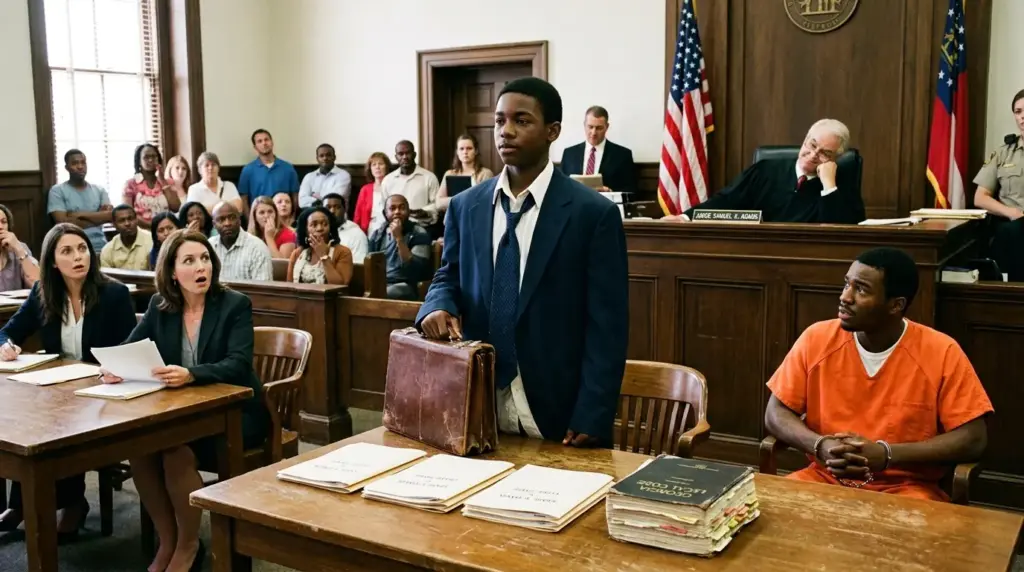
“No, Your Honor.”
Tolbert handed her the document.
She read it once.
Then again.
Her face lost its color.
The envelope contained an amended incident report from the warehouse security contractor.
It indicated that a second person had entered the restricted corridor during the missing footage window.
That person had used an employee access card.
The card belonged to Victor Harlan, the injured supervisor.
But Harlan had told investigators he was in his office at the time of the attack.
Judge Tolbert looked toward the prosecutor.
“Has this information been disclosed to the defense?”
Lindholm shook her head.
“No, Your Honor.”
“Why not?”
“I have no explanation at this time.”
The judge’s voice sharpened.
“This court will not proceed as though this discrepancy does not exist.”
He ordered the hearing paused until the new information could be reviewed.
Isaiah leaned toward Elijah.
“What does it mean?”
Elijah studied the report.
“It means there is another person we need to identify.”
He looked toward the courtroom doors.
“And it means the investigation may have missed something important.”
A Discovery Hidden in the Fine Print
After the hearing was adjourned, Elijah returned to the courthouse library.
He spread the documents across a wooden table.
Isaiah sat opposite him.
For several minutes, neither brother spoke.
Then Isaiah finally asked, “How did you know where to look?”
Elijah kept reading.
“I didn’t know. I just kept asking what each piece of evidence actually proved.”
Isaiah leaned back.
“You’re seventeen.”
“I know.”
“You shouldn’t have to do this.”
Elijah stopped turning the pages.
For a moment, he looked younger than he had in the courtroom.
“I know that, too.”
Isaiah reached across the table and placed a hand over his brother’s.
“I’m proud of you.”
Elijah swallowed.
“I just want you to come home.”
Isaiah nodded.
“Then we’ll keep going.”
They returned to the documents.
The new incident report contained a reference number for the warehouse’s access-control system.
Elijah compared it with the logs already included in the disclosure package.
A pattern emerged.
The same employee card had been used at two locations within minutes of each other.
One entry was recorded near the supervisor’s office.
The other was recorded at the eastern service entrance.
That should have been impossible.
Unless the access card had been duplicated, the system clock was inaccurate, or the records had been entered incorrectly.
Elijah wrote the times on a legal pad.
Then he checked the maintenance report.
The access-control system had been reset earlier that evening.
A technician had replaced a damaged controller.
The system’s internal clock had not been synchronized afterward.
Elijah stared at the page.
“Isaiah.”
His brother leaned forward.
“What?”
“The times may not mean what the prosecution thinks they mean.”
He explained the discrepancy.
If the system clock was inaccurate, the apparent sequence of events could be misleading. A card entry recorded after the alarm might have occurred earlier—or later—than the report suggested.
It did not prove that Isaiah was innocent.
But it undermined the prosecution’s claim that the digital records independently confirmed its timeline.
Elijah added a note requesting the underlying system data, the maintenance records, and testimony from the technician who had performed the reset.
Then he noticed something else.
The access card assigned to Victor Harlan had been used after Harlan was taken to the hospital.
Isaiah looked at the entry.
“That can’t be right.”
“Maybe the report is wrong,” Elijah said.
“Or someone used his card.”
The brothers stared at the page.
For the first time, they were looking at a possible explanation that went beyond a simple identification mistake.
Someone else may have had access to the supervisor’s credentials.
And if that person had entered the corridor during the missing footage window, the entire theory of the prosecution might need to be reconsidered.
The Prosecutor’s Unexpected Visit
The next morning, Elijah arrived at the courthouse before the doors opened.
He was carrying a revised memorandum.
He had slept for barely four hours.
His father’s suit hung loosely from his shoulders, and the knot of his tie was still slightly crooked.
But his documents were immaculate.
Every argument was numbered.
Every factual claim was tied to a specific record.
Every unresolved question was clearly identified.
He wasn’t trying to sound impressive.
He was trying to make it impossible for anyone to misunderstand what the evidence did—and did not—show.
As he approached the courtroom, Andrea Lindholm stepped out of a side office.
“Mr. Carrington?”
Elijah stopped.
“Yes, ma’am.”
“Do you have a moment?”
“Of course.”
She gestured toward a quiet conference room.
Elijah followed her inside.
Lindholm closed the door.
“I’ve reviewed your memorandum.”
Elijah waited.
She placed several documents on the table.
“Your questions about the system clock are legitimate. The contractor has confirmed that the maintenance reset may have affected the recorded timestamps.”
Elijah felt a cautious surge of hope.
“Does that mean the prosecution is withdrawing the charge?”
“No.”
The answer was immediate.
“The investigation is still ongoing. There is evidence that requires explanation, and we cannot draw conclusions from one technical discrepancy.”
Elijah nodded.
“Understood.”
Lindholm studied him.
“You are unusually careful about distinguishing what you know from what you suspect.”
“My father taught me that.”
“Was he an attorney?”
“No. He was a legal assistant for several years. He helped people organize documents and understand their paperwork, but he wasn’t a lawyer.”
Lindholm glanced at the old briefcase.
“That explains the briefcase.”
Elijah smiled faintly.
“It was his.”
The prosecutor sat down.
“I also need to be clear about something. You cannot represent your brother as licensed counsel. The court must follow the rules governing who may practice law, and your brother should have qualified legal assistance.”
“I understand.”
“But your factual observations have identified issues that need to be investigated.”
She paused.
“I wanted to tell you that directly.”
Elijah thanked her.
As he gathered his papers, Lindholm spoke again.
“One more thing. Don’t let the courtroom’s reaction to your age distract you from the seriousness of this case.”





