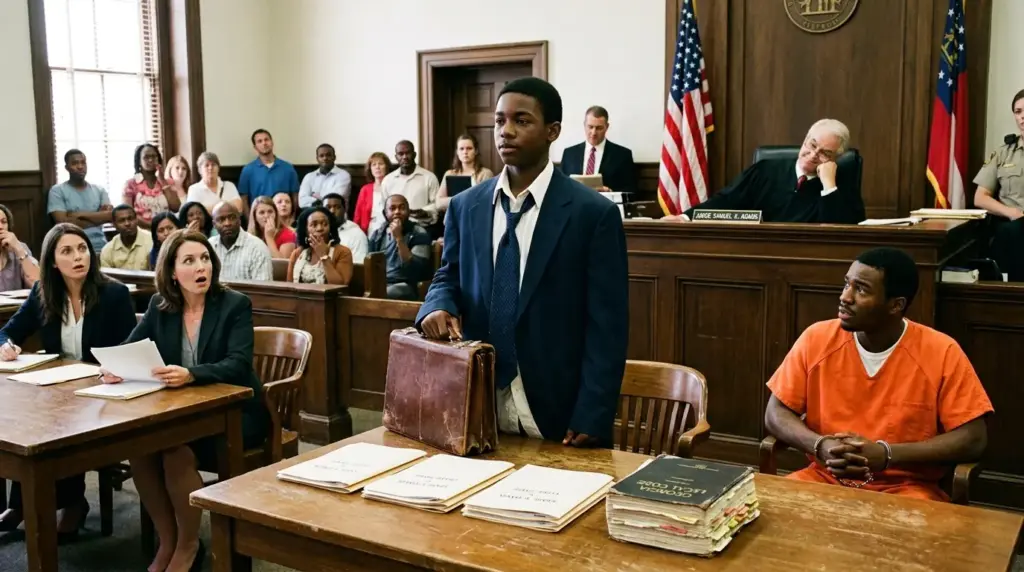
Judge Tolbert raised his hand.
“Ms. Lindholm, let him finish.”
Elijah continued.
“The video provided to the defense does not show the storage corridor continuously. There is a seven-minute gap between the two available clips. That gap overlaps with the period during which the prosecution says the assault occurred.”
The judge looked toward the prosecutor.
“Is that accurate?”
Lindholm checked her notes.
“The footage was incomplete, Your Honor. The missing portion was attributed to the system interruption.”
“Was the original recording preserved?”
“I would need to confirm that.”
Elijah opened his folder.
“The disclosure materials do not include a preservation report or a complete explanation of the interruption.”
The judge’s expression hardened.
“Why not?”
Lindholm paused.
“I cannot answer that at this moment.”
Elijah remained standing.
“I am not asking the court to conclude that the missing footage proves my brother’s innocence. I’m asking the court not to treat an incomplete recording as if it establishes the entire sequence of events.”
That distinction mattered.
He wasn’t claiming the gap proved a conspiracy.
He was pointing out that the available evidence could not establish everything the prosecution wanted it to establish.
Judge Tolbert leaned back.
“That’s a fair question.”
The words surprised the room.
Lindholm looked down at her notes.
Isaiah stared at his brother.
And Elijah, still wearing his father’s oversized suit, returned to his chair without a hint of triumph.
He had not won the case.
But he had forced the court to acknowledge that the prosecution’s story was not as complete as it first appeared.
The Witness Who Changed His Story
The prosecution’s next witness was warehouse employee Martin Greer.
Greer had told investigators that he saw Isaiah leaving through the eastern service entrance shortly before the alarm sounded.
Under questioning, he repeated that claim.
“I saw him walking out,” Greer said.
Lindholm nodded.
“You’re certain it was Isaiah Carrington?”
“Yes.”
“How well do you know him?”
“We worked together for almost a year.”
“Could you recognize him?”
“Of course.”
Lindholm thanked him and sat down.
Judge Tolbert looked toward Elijah.
“Do you have questions concerning the witness’s account?”
Elijah stood.
“Mr. Greer, you told investigators that you saw my brother leave through the eastern service entrance at approximately 10:18 p.m., correct?”
“That’s right.”
“Where were you standing?”
“Near the loading area.”
“How far from the entrance?”
“Maybe forty feet.”
“Was the loading area illuminated?”
“Yes.”
Elijah glanced at the written statement.
“Your initial interview says you were inside the loading office when you heard the alarm. Is that correct?”
Greer shifted in his chair.
“I might have been inside before I came out.”
“Your formal statement says you were outside when you saw my brother. Your initial interview says you did not see him leave. Can you explain the difference?”
Greer looked toward Lindholm.
The prosecutor rose.
“Your Honor, the witness has already explained that he was working in the loading area.”
Judge Tolbert considered the objection.
“Mr. Greer, answer the question if you can.”
Greer cleared his throat.
“I was tired that night. It was a long shift.”
Elijah nodded.
“Of course. You also told investigators that you saw my brother carrying a dark backpack, didn’t you?”
“Yes.”
“Did you see his face?”
“Yes.”
“Clearly?”
Greer hesitated.
“I believe so.”
Elijah removed a photograph from the folder.
“Is this the eastern service entrance?”
Greer looked at it.
“Yes.”
“And this photograph shows the lighting near the entrance?”
“Yes.”
Elijah placed the photograph on the table.
“According to the maintenance report, the exterior lights at that entrance were not working that evening. Were you aware of that?”
Greer’s face tightened.
“I don’t remember.”
Elijah turned toward the judge.
“Your Honor, the defense requests that the maintenance report be considered when assessing the reliability of the identification.”
Lindholm stood.
“The report does not establish what the witness could or could not see.”
“Agreed,” Elijah replied. “But it does establish that the conditions described by the witness require further examination.”
Judge Tolbert looked at the photograph and the maintenance record.
Then he addressed Greer.
“Mr. Greer, did you see Isaiah Carrington’s face that night, or did you infer his identity from his clothing and build?”
Greer opened his mouth.
Closed it.
Then looked toward the prosecutor again.
“I saw someone who looked like him.”
The courtroom became still.
Elijah did not smile.
He simply asked one final question.
“So you cannot say with certainty that the person you saw was my brother?”
Greer lowered his eyes.
“No. Not with absolute certainty.”
The judge made a note.
The prosecution’s strongest eyewitness identification had just become less certain.
And Elijah had accomplished it without raising his voice once.
The Judge Stops Smiling
During the recess, Judge Tolbert called both sides to the bench.
His expression had changed completely.
He was no longer amused by Elijah’s age or his oversized suit.
Instead, he appeared concerned about the gaps in the case.
“Ms. Lindholm,” he said quietly, “I want a clear explanation of the missing footage, the alarm interruption, and the discrepancies in Mr. Greer’s statements.”
Lindholm nodded.
“Yes, Your Honor.”
The judge turned toward Elijah.
“And I want you to understand something. Identifying inconsistencies does not make you an attorney, and it does not automatically establish that your brother is innocent.”
“I understand, Your Honor.”
“But these are legitimate evidentiary questions.”
Elijah lowered his head slightly.
“Thank you.”
Tolbert looked at Isaiah.
“Mr. Carrington, I strongly recommend that you obtain qualified legal counsel if you can. This is a serious criminal matter.”
Isaiah nodded.
“I understand.”
The judge paused.
Then he added, “And Mr. Carrington?”
Elijah looked up.
“Your memorandum was unusually well organized.”
For the first time that morning, the judge’s voice carried something close to respect.
Elijah thanked him.
But before the hearing could resume, a courthouse clerk approached the bench and handed Tolbert a sealed envelope.
The judge opened it.
He read the first page.
Then his expression became unreadable.
“Ms. Lindholm,” he said, “have you seen this?”





